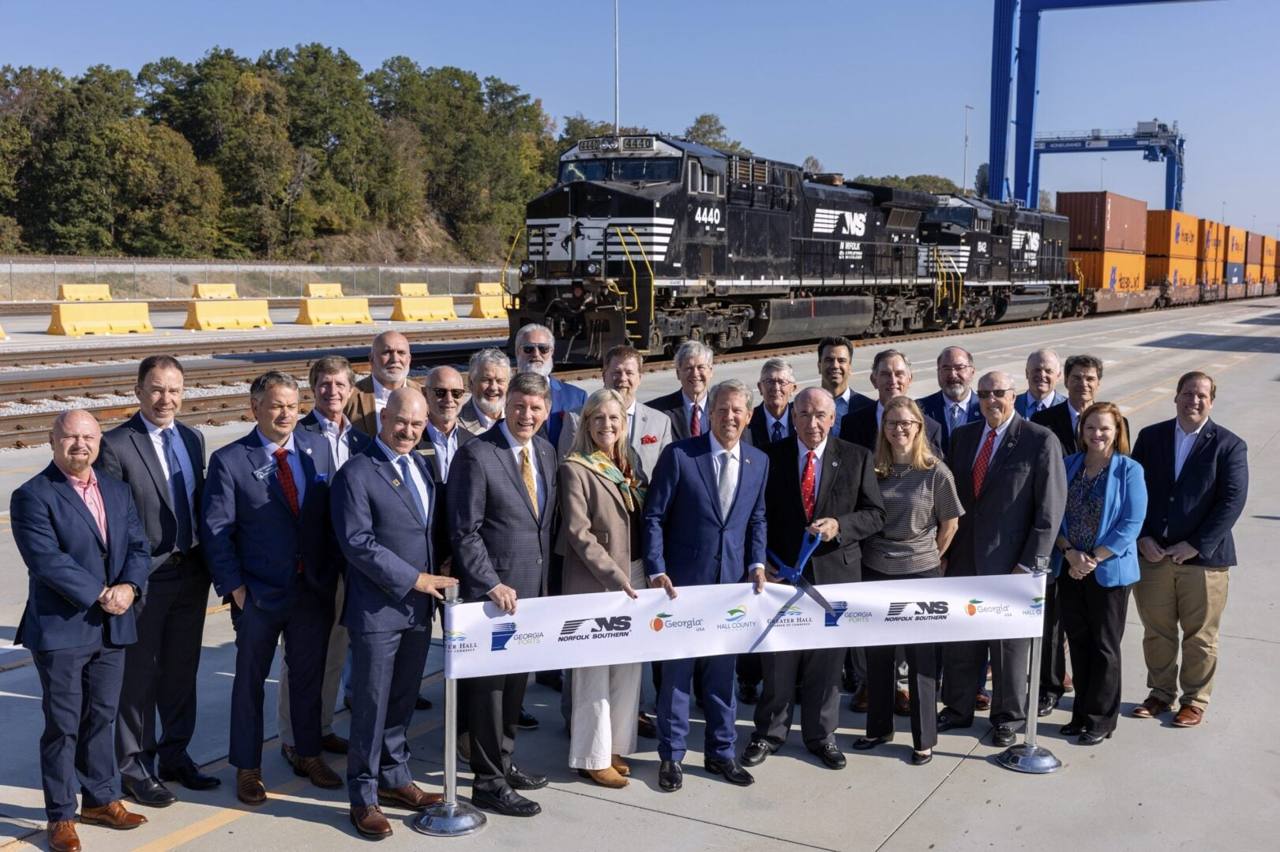
Georgia has formally opened a new way for Northeast Georgia factories to reach the sea without sending every container down the highway to Savannah. Governor Brian Kemp joined Hall County officials and Georgia Ports Authority (GPA) leaders on Thursday, October 29, for the grand opening ceremony of the $134 million Gainesville Inland Port — a 104-acre rail terminal on White Sulphur Road in Gainesville, in Hall County, that links the region directly to the Port of Savannah by Norfolk Southern train.
Source: Georgia Ports Authority, Oct. 29, 2026
The terminal has been operating since May 4, according to GPA's facility page, and Thursday's ceremony marked its formal grand opening. Its scale is built for volume: an annual capacity of 200,000 containers, 18,000 feet of working track and a fleet of seven electric cranes, with next-day Norfolk Southern rail service connecting customers to the Port of Savannah's 40 weekly vessel calls.
Source: Container Management, Oct. 30, 2026
What changes for truckers
For drivers, the headline number is 26,000. GPA expects to shift 26,000 containers to rail in the terminal's first year of operation, improving emissions and reducing trucks on Atlanta and Georgia highways. Container Management put the comparison plainly: each container that moves by rail replaces a roughly 600-mile round trip by truck between Gainesville and Savannah, and GPA puts the emissions reduction compared with trucking at 75 percent. That does not end trucking at the site — customers can still choose truck-only movement for faster transit, and trucks reach the terminal from Interstates 85 and 985, with a truck gate open from 7 a.m. to 8 p.m., Monday through Friday, and on-terminal storage for inventory flexibility.
Source: Georgia Ports Authority, Oct. 29, 2026
"Georgia's ports are a major reason companies choose to invest and create jobs here, and the Gainesville Inland Port brings that advantage directly to Northeast Georgia," said Gov. Kemp. "Connecting this region to the Port of Savannah with new supply chain options makes it easier for Georgia businesses to reach customers around the world and helps ease congestion on our highways." Georgia Ports CEO Griff Lynch added: "We view this as a high growth market where we can improve supply chain performance and make customers more competitive long-term. We're bringing the Port of Savannah closer to Gainesville."
Source: Georgia Ports Authority, Oct. 29, 2026
The region it serves
Northeast Georgia is a growing manufacturing and logistics corridor with a consumer market of 2 million people and more than 300 manufacturers — GPA's ceremony photo caption puts the figure at more than 330. Since 2020, 78 new and expanding firms have added more than 4,800 jobs and $2 billion in capital investment to Gainesville-Hall County, and the area's largest employment segment, at 33 percent of the overall workforce, is concentrated in manufacturing, processing and logistics. The terminal is presently handling a mix of home and retail goods and manufacturing components for imports, while exports consist of farm and forest products and manufacturing goods, serving North Georgia and the Carolinas.
Source: Georgia Ports Authority, Oct. 29, 2026
Georgia Ports Chairman Alec Poitevint called the terminal "another important investment in Georgia's statewide logistics network" and thanked Gov. Kemp, the General Assembly and the Georgia Department of Transportation. Georgia Ports President Kevin Price said the authority is "working with customers and the logistics community to create more business opportunities for them," and praised Gainesville and Hall County leadership.
Source: Georgia Ports Authority, Oct. 29, 2026
Road work paid for by the port
Alongside the terminal, Georgia Ports funded $4.8 million in Hall County road projects for safer local traffic flow. The work eliminated an at-grade rail crossing, rerouted White Sulphur Road and resurfaced Cagle Road. GPA said the new White Sulphur route south of the inland terminal now ensures free access for emergency vehicles and avoids traffic disruption from trains, while the resurfaced Cagle Road offers an improved alternative route for residents.
Source: Georgia Ports Authority, Oct. 29, 2026
For Punjabi owner-operators and fleets running the Atlanta–Savannah corridor, the change is practical, not abstract: more Northeast Georgia freight will start or end its journey at Gainesville instead of making the full highway run to Savannah, which means shorter drayage work around I-85 and I-985, fewer long container hauls on I-16 and I-75, and gate hours — 7 a.m. to 8 p.m. on weekdays — that set the rhythm for pickups. Rail takes the long leg; trucks keep the first and last miles.
Part of a $5 billion expansion
The Gainesville opening sits inside GPA's nearly $5 billion, ten-year investment plan — the most expansion of any U.S. port, according to the authority — which will add five container berths at the Port of Savannah and a roll-on/roll-off berth at the Port of Brunswick. GPA recently announced it will start construction in 2028 on the Savannah Container Terminal, a $2.3 billion, 350-acre facility with a 3.5 million TEU capacity and an on-dock rail terminal, due to open in the mid-2030s and take Savannah's total container capacity to 12 million TEU.
Source: Georgia Ports Authority, Oct. 29, 2026
What happens next
The terminal now has to fill toward its 200,000-container annual capacity, with GPA's first-year test being the promised shift of 26,000 containers to rail. CDL Life, reporting the opening for a trucking audience on October 30, framed the facility the same way GPA does: a $134 million inland terminal, accessible to trucks from I-85 and I-985, expected to cut commercial truck traffic on Atlanta and Georgia highways. Shippers in North Georgia and the Carolinas can now choose rail for greater affordability and heavier loads, or truck-only for faster transit — and how they split that choice will decide how much traffic actually leaves the highways.
Source: CDL Life, Oct. 30, 2026