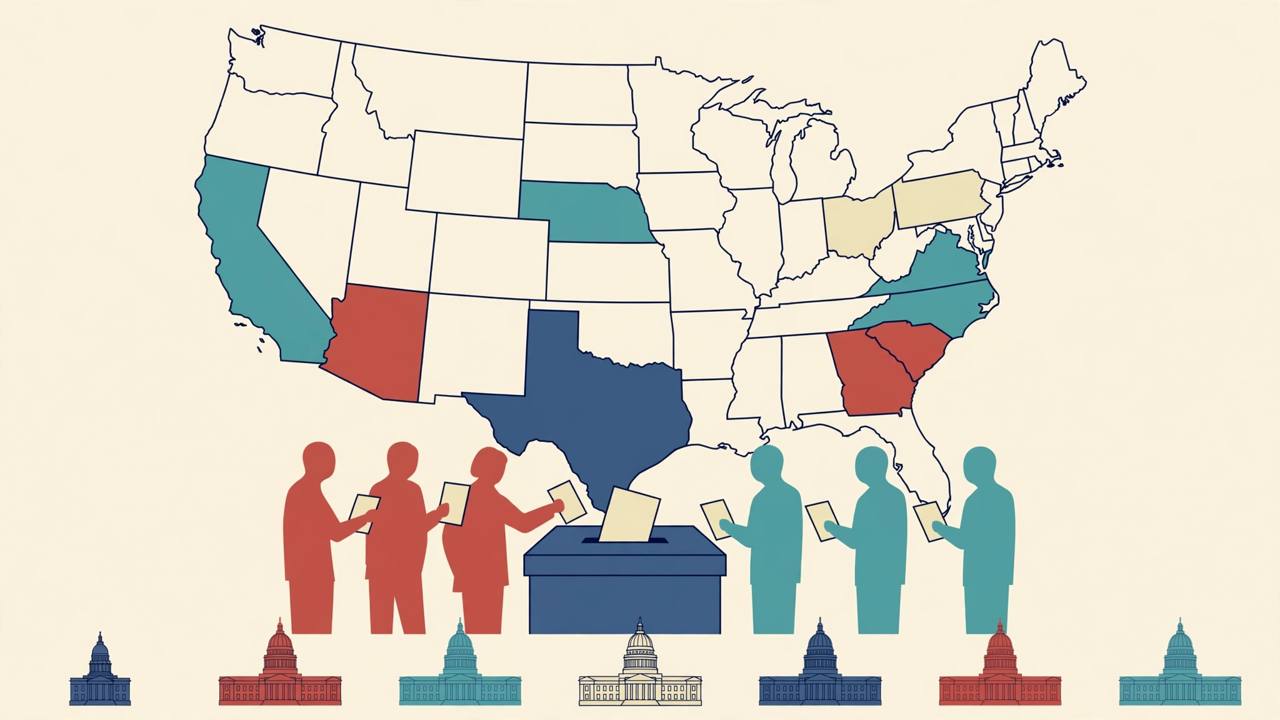
NEW YORK — Three dozen governors' races will be decided in the November 3 elections, with President Donald Trump's unpopularity and the cost of living at the top of voters' minds, alongside local concerns ranging from water rights and data centers to cancer rates, Reuters reported on Friday, October 30.
Source: Reuters via SRN News
The national picture
Democrats now hold 24 governorships and Republicans 26, Reuters reported. If Democrats manage a net gain of at least two seats, they will lead a majority of states for the first time since 2010. Ballotpedia's preview of the November 3 elections notes that of the governorships on the ballot this year, Democrats and Republicans each hold 18, and it has identified 10 races as battlegrounds, split evenly between five Democratic-held and five Republican-held governorships — eight of the 10 have no incumbent running. Democrats are defending five governorships in states Trump won in the 2024 presidential election — Arizona, Kansas, Michigan, Pennsylvania and Wisconsin — while Republicans are defending two in states Kamala Harris won in 2024, New Hampshire and Vermont.
Source: Ballotpedia News
Arizona: water, prices and the border
Water has become a key campaign issue in drought-hit Arizona, where Democratic Governor Katie Hobbs is seeking reelection against Republican U.S. Representative Andy Biggs, Reuters reported. The other top issues are the cost of living and immigration, with Hobbs seeking to position herself as tougher on border security than many national Democrats. Biggs is a former head of the right-wing U.S. House Freedom Caucus, which has pushed for deep cuts in federal spending. Abortion rights have also featured prominently: Hobbs is a supporter, Biggs has a long record as an opponent, and Arizona voters approved a constitutional amendment protecting abortion rights in 2024. Ballotpedia notes Hobbs won in 2022 by 50.3% to 49.6%, while Trump carried the state in 2024 by 52.2% to 46.7%.
Michigan: an open seat in a swing state
Michigan's race is one of the most competitive contests, pitting Democrat Jocelyn Benson, the state's top election official, against Republican U.S. Representative John James, Reuters reported. They are battling to succeed term-limited Democratic Governor Gretchen Whitmer, making it one of 19 open-seat races this cycle. Michigan is a closely divided swing state that Trump won in 2016 and 2024, while Democrat Joe Biden carried it in 2020 — and neither party has elected back-to-back governors in the state since the 1960s.
Georgia: a possible first in U.S. history
Republican Rick Jackson, a billionaire healthcare executive, is running against Democrat Keisha Lance Bottoms, the former Atlanta mayor, to succeed Republican Governor Brian Kemp, Reuters reported. A Bottoms win would make her the first Black woman elected governor in the United States and the first Democrat elected governor of Georgia in more than a quarter century. Because Georgia will likely be a key presidential battleground in 2028, both parties view the race as an early test of voter sentiment. Jackson, who has spent more than $100 million of his own money on the race, has generally aligned himself with Trump's agenda, while Bottoms has sought to mobilize the diverse Democratic coalition that helped Biden win the state in 2020. She rose to national prominence that year guiding Georgia's largest city through protests, civil unrest and the COVID pandemic, and her base is in the Atlanta metro area, whose rapid growth has reshaped Georgia politics.
Ohio: an ugly race tests a changed state
Some races have turned ugly, Reuters reported, including the Ohio contest between Republican entrepreneur Vivek Ramaswamy and Democrat Amy Acton, a physician. The race drew national attention over an attack ad run by the Ramaswamy campaign featuring Acton's estranged mother disputing Acton's account of her childhood; Acton, a former director of the Ohio Department of Health who led the state's response to the COVID-19 pandemic, has said she was sexually abused by her stepfather, who died in 2004 after fleeing the state when charged — he never stood trial. Ohio's reputation as a perennial swing state faded after 2016, when Trump won it with strong support from working-class voters and turned it into a reliably Republican state; the race is being watched as a test of whether Democrats can turn economic dissatisfaction into votes. Democrats have won just one of the state's last nine gubernatorial elections.
Iowa: first open race since 2006
Iowa is holding its first open governor's race since 2006, after Republican Governor Kim Reynolds said she would not seek reelection, Reuters reported. State Auditor Rob Sand, the only Iowa Democrat currently holding statewide elected office, faces Republican businessman Zach Lahn. The state's incidence of cancer, at the second-highest rate in the country behind Kentucky, has emerged as a major campaign topic alongside kitchen-table issues such as the cost of living, with interest fueled by worries that exposure to nitrates, pesticides and other environmental contaminants may be contributing to the high rate. The race has also focused on education and government accountability: Sand has campaigned as an independent watchdog critical of Republican fiscal management and the state's private-school voucher program, while Lahn has embraced lower taxes, school choice and a more conservative approach to social issues.
Nevada: affordability and data centers
In a contest centered on affordability, Republican Governor Joe Lombardo is in a neck-and-neck race with Democratic challenger Aaron Ford, the state's attorney general, Reuters reported. Nevada residents have voiced concerns over tariffs, a tourism slowdown and high gas prices, giving Ford an opening despite the incumbent's 2-to-1 fundraising advantage. Data centers have also emerged as a central issue: Ford has proposed a halt to new data-center tax abatements and wants to require developers to shield residents from higher energy costs, and he has called for strong regulations to protect jobs from AI. Lombardo, while imposing new restrictions on some of the tax incentives that lured the industry to the state, has generally championed data centers as an economic driver.
Wisconsin: a referendum on Trump, again
A central question in Wisconsin's race is whether voters, who backed Trump in 2024 and Biden in 2020, want a governor aligned with the Republican president, Reuters reported. Republican Tom Tiffany, a three-term U.S. Representative endorsed by Trump, has played down that connection, while his Democratic opponent, Milwaukee County Executive David Crowley, has sought to link Tiffany to Trump's agenda. In Congress, Tiffany has supported conservative causes such as gun rights and lower taxes and co-sponsored federal legislation that would have banned most abortions after about six weeks of pregnancy. Crowley supports abortion rights and has framed reproductive rights as a key campaign issue; Wisconsin bans abortion after 20 weeks and requires a 24-hour waiting period as well as parental consent for minors.
Governors run the state machinery readers deal with every day: state police and highway patrols, commercial driver's licence (CDL) programs, state taxes, road and bridge spending, and how state agencies cooperate with federal immigration enforcement. A change of governor in a state like Arizona, Michigan, Nevada or Wisconsin can change enforcement on the highways Punjabi truckers drive and the rules local businesses and families live under — which is why these seven races matter well beyond their state lines.
What happens next
All 36 races are decided on Tuesday, November 3, with results expected through election night and, in the closest contests, possibly beyond. The seven races above will show whether cost-of-living anger is hurting the president's party, whether Democrats can flip the governorship majority for the first time since 2010, and whether Georgia makes history. Winners take office under their states' normal transition schedules and will govern through the 2028 presidential cycle, when several of these same states are expected to be battlegrounds again.