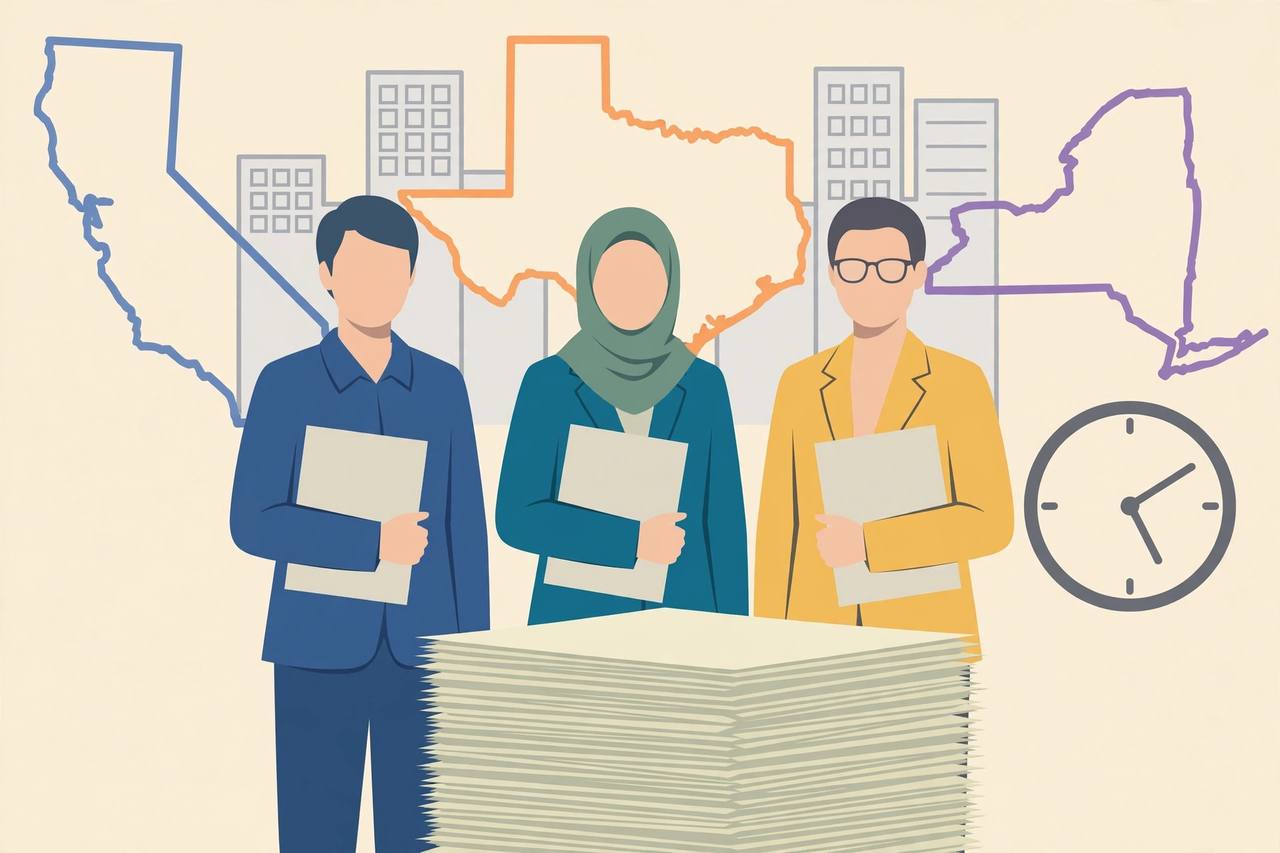
California, Texas and New York accounted for a combined 35% of employment-based green card petition filings and approvals in the United States during the third quarter of fiscal year 2026, according to U.S. Citizenship and Immigration Services (USCIS) data cited by Financial Express and reported by The American Bazaar on October 22.
Source: The American Bazaar
USCIS received 62,932 Form I-140 petitions between April 1 and June 30, 2026, approved 37,975 and denied 7,069, with 203,204 petitions pending at the end of the period — yaani more than two lakh cases still waiting in the queue. Form I-140, the Immigrant Petition for Alien Workers, is usually filed by a U.S. employer sponsoring a foreign worker for permanent residency; some extraordinary-ability and national-interest-waiver applicants can file for themselves.
Indian-born applicants are the largest group
Indian-born workers filed 19,549 petitions — 31.1% of all I-140 receipts in the quarter — and received 13,923 approvals, 36.7% of all approvals, more than the next eight countries combined, the report said. The concentration was sharpest in the EB-2 category for professionals with advanced degrees or exceptional ability, where Indian-born applicants accounted for 68.8% of filings and 69.7% of approvals.
A second report of the same USCIS quarterly data, published by We Are Main Street on October 22, gave the same headline figures — 62,932 received, 37,975 approved and 203,204 pending — and the same 31.1% Indian-born share, with EB-2 as the dominant category.
Source: We Are Main Street
An approved I-140 does not by itself grant permanent residency. A green card still depends on the employment-based category and the applicant's priority date becoming available under annual and per-country limits — the point where Indian applicants have historically faced the longest waits.
California's technology and startup sector, Texas's business and technology centres and New York's finance and professional-services hub help explain why the three states lead the filings, the reporting noted. The combined 35% figure does not show each state's individual share, and approvals in a quarter can include petitions filed earlier, so the gap between receipts and approvals in one quarter is not a direct measure of how much the backlog grew.
What is solid
- USCIS data for April-June 2026: 62,932 I-140 petitions received, 37,975 approved, 7,069 denied, 203,204 pending at June 30.
- Indian-born applicants filed 19,549 petitions (31.1%) and received 13,923 approvals (36.7%); they were 68.8% of EB-2 filings.
- California, Texas and New York together made up 35% of filings and approvals; their individual shares were not established in the reporting.
What is only claimed
- How quickly the 203,204-case pending inventory will fall is not established by one quarter's data — receipts, approvals and pending totals measure different things and should not be added or subtracted as a simple backlog change.