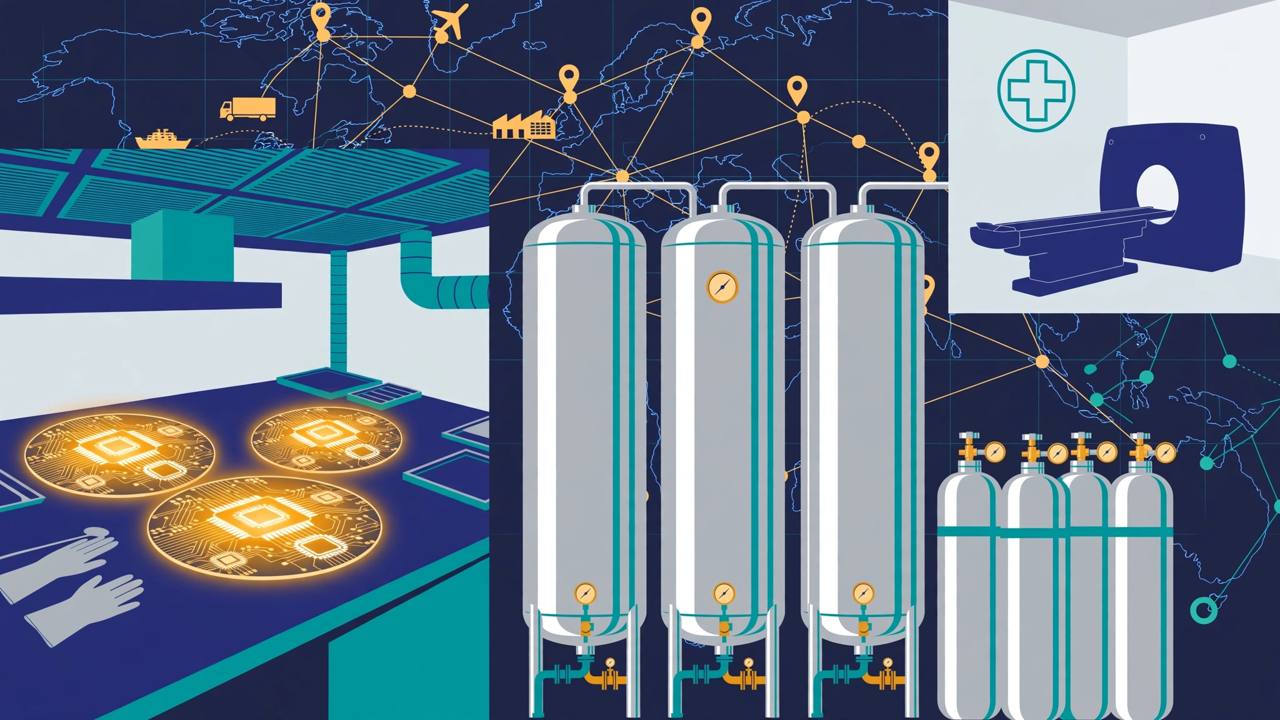
The U.S. Department of Energy has added helium to its list of critical materials, a designation announced on Friday, October 23, 2026, that puts the gas used in chipmaking, medical scanners and quantum computing under closer federal monitoring and opens the door to more federal financing for producers.
Source: Associated Press via EL7.AI
The designation was made under the Energy Act of 2020. Assistant Secretary of Energy Audrey Robertson signed the notice in Washington on October 21, before it was published two days later, according to the department's Federal Register announcement. Helium becomes the twentieth material on the Energy Department's list, and only the second gas — fluorine is the other. Metallurgical coal, used in steelmaking, was the last material added before helium, in 2025.
Under Section 7002 of the Energy Act, a critical material is one the Energy Secretary determines faces a high risk of supply-chain disruption and performs an essential function in one or more energy technologies. The department's notice describes helium as non-substitutable for multiple critical functions, including semiconductor manufacturing, leak testing of natural gas infrastructure and quantum computing, along with key medical and scientific applications such as MRI scanners.
"Helium is essential to producing the semiconductors and advanced technologies that power our economy," Energy Secretary Chris Wright said in a statement announcing the designation. "By designating helium as a critical material, we are taking another step toward securing our supply chains, creating American jobs, and ensuring the United States leads the world in energy and technological innovation."
Source: U.S. Department of Energy via CBS News reporting
Robertson warned that helium "could be a single point of failure," linking the security of its supply to future U.S. competitiveness and energy security, which she described as national security. "We need to make sure that we can build those here. And helium is one of those components that could be a single point of failure, where we cannot let that happen," she said in an interview quoted by The Canadian Press.
Source: Assistant Secretary Audrey Robertson via The Canadian Press
The move comes during a global helium shortage. The United States is the world's largest helium producer, while Qatar and Russia are also major suppliers, according to Euronews reporting cited by CBS News. About one-third of the world's helium supply was trapped in the Persian Gulf after the effective closure of the Strait of Hormuz in February, CBS News reported, and Iranian strikes hit Qatar's Ras Laffan production facility in March. Russia introduced temporary export restrictions in April, and China imposed a temporary ban on helium exports in July, further tightening supply.
Helium is extracted mainly as a byproduct of natural gas processing, so supply cannot simply be switched on. The Energy Department says global demand for helium is growing faster than production, while refining capacity and lengthy permitting procedures limit the United States' ability to increase supply. Beyond balloons, the gas is required to manufacture smartphones and cars and to cool the superconducting magnets in MRI machines and laboratory equipment.
According to the Associated Press, the designation makes greater federal funding available to producers and brings closer government monitoring of the material. What it does not do on its own is create new supply: producers, hospitals and chip factories will still depend on how quickly domestic projects can be financed, permitted and built.