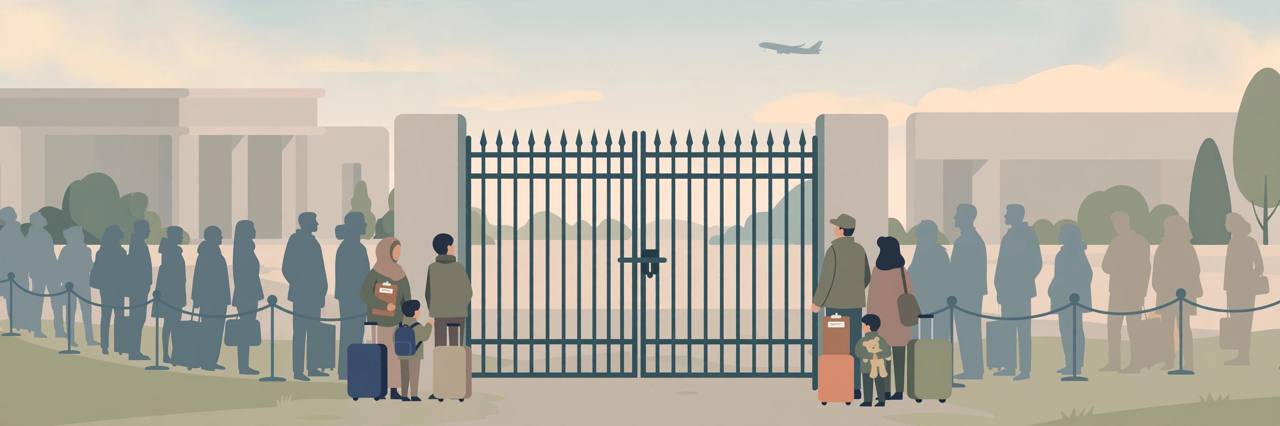
Thousands of immigrants who were already in the process of getting a visa to live in the United States are still stuck abroad, nearly a year after they applied and months after a federal judge ordered a processing ban lifted, NPR reported on Monday, October 26.
Source: NPR via KNKX
In January, the Trump administration banned the processing of immigrant visas for citizens of 75 countries. Many applicants were already mid-process, NPR said, and some had already been approved and were only waiting for the physical visa to be delivered. The ban affected more than 280,000 immigrants who had applied by the time the policy took effect, and an analysis by the Cato Institute said it targeted thousands of close family members of U.S. citizens and permanent residents, including spouses and minor children.
A federal judge in August ordered the ban lifted — the Associated Press reported at the time that the judge vacated the policy that had suspended processing of immigration visas from the 75 countries. On its website, the State Department acknowledges the visa ban is no longer in effect because of the court ruling, NPR said.
Source: Associated Press via PBS NewsHour
A veteran's family, still separated
NPR centred its report on Dustin Hoffman, a U.S. Army veteran who served in Iraq and moved to Argentina in 2013, and his wife Gloria, who is from Colombia — one of the countries on the list. The couple started the paperwork late last year for Gloria to live in the U.S., together with their 5-year-old daughter and Hoffman's 12-year-old stepson. Nearly a year later the family is still in Argentina, and the State Department continues to ask them for additional evidence that they can support themselves in the U.S. without becoming a public charge, NPR reported.
Attorneys representing migrants allege — and NPR reports this as their allegation — that the administration is not complying with the court order and is instead slow-walking visa processing. Alexis Axelrad, president-elect of the American Immigration Lawyers Association, told NPR: while technically the ban does not exist, it does not matter practically if people still cannot get their green-card interviews finished or their immigrant visa stamps and come to the United States.
The State Department declined to comment to NPR, saying the matter is subject to pending litigation. The agency told NPR in August that it had paused processing as it launched an in-depth training program for embassies and consulates on identifying immigrants who could become a burden on taxpayers. A former State Department consular officer told NPR such a substantial pause is uncommon.
A researcher approved for an EB-1A is also waiting
The delays are also holding up applicants approved on merit, NPR reported. Dr. Fernando Lizcano, a Colombian researcher whose work focuses on cardiovascular health and obesity, was deemed qualified by U.S. Citizenship and Immigration Services for an EB-1A visa — the category reserved for immigrants of extraordinary ability, including outstanding professors and researchers. All that remained, NPR said, was the visa itself and the stamp in his passport. He is still in Colombia awaiting the State Department's final approval, and told NPR: 'This is not fair.'
The court ruling ended the 75-country ban as a policy, but it did not issue anyone a visa. Applicants still face interviews, public-charge screening and added checks — and, their lawyers allege, long delays. Families with a spouse, parent or child from one of the 75 countries should expect the wait to continue and keep their evidence of financial support up to date. (Summary of NPR's reporting, not legal advice.)