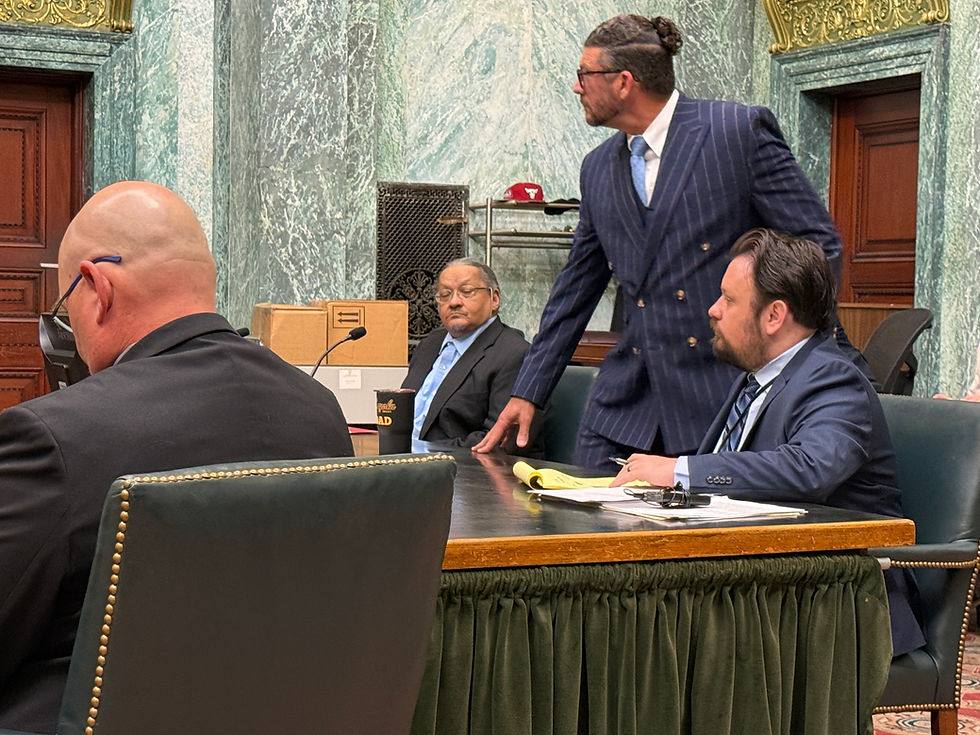
Raphael Helton, 65, was found guilty of murder on Thursday, October 29, 2026, for the 2015 beating death of Michael Fedock, 67, in Fort Wayne, Indiana — a verdict that came more than 11 years after Fedock's body was found and more than a year after the cold case was revived with a murder charge in August 2025.
Source: The Probable Cause (Fort Wayne court reporting)
A second Fort Wayne report, carried by NewsLocker, also confirmed the jury verdict: Helton was found guilty after a jury trial of murdering his roommate, Michael J. Fedock, over 10 years after the homicide.
Source: NewsLocker / Fort Wayne news
The last day: a bank withdrawal, a jail call and a journal that stopped
Detectives established that Fedock's activities stopped after a February 26, 2015 bank deposit, court reporting said. The normal monthly pattern was a large withdrawal after the Social Security deposit, typically about $1,100. That evening, at 7:57 p.m., Helton took a jail call from his wife, Barbara Helton, who was being held at the Allen County Jail at the time of Fedock's beating. "Got to take care of Mike. This is going to be hard," he told her, according to the trial reporting — words prosecutors Tom Chaille and Rachel Gschwend found foreboding, while the defense said Helton often helped Fedock get around the house.
Prosecutors said Helton tracked Fedock's movements constantly in a daily journal, with more than 120 entries in each of January and February 2015 detailing Fedock's whereabouts in the house — and that those journal entries stopped cold after February 26, the same day as the bank withdrawal.
What officers found on March 28, 2015
On March 28, 2015, Fedock's badly decomposed body was discovered in the closet of the second-floor bedroom Fedock once shared with his wife, after an officer arrived for a wellness check and noticed a bad smell, court reporting said. "Mike's not here," Helton immediately told the officer at the door of the home at 216 Woodland Avenue, where Helton and his wife were tenants in Fedock's house.
Police found the body crammed into the small closet, wrapped in clear plastic, with piles of clothing and blankets on top, according to crime-scene photos shown in court. The closet door had been screwed shut. Helton told the officer to come back in a week and he would have it open, but Allen County Sheriff's Deputy Sean Kelly called for backup, and Kelly and Fort Wayne officer John Chambers used pliers to open the closet door, the reporting said.
The defense: "anyone could have killed Mr. Fedock"
Defense attorney Robert Scremin told the jury the case was based on innuendo and a lack of forensic evidence. The duct tape that carried both Helton's and Fedock's DNA was found on a roll of tape outside in Fedock's work van — not on the tape used to wrap the body — Scremin said, adding that there was unidentified DNA, no evidence tying Helton to the body, and that Helton, a renter who did handyman jobs with Fedock and had known him for four to five years, had nothing to gain from his death.
Prosecutors answered that $1,100 was never accounted for after Fedock's monthly trip to ProFed bank on February 26, and that when family tried to contact Fedock, Helton concocted a story about Fedock going to Michigan for double knee surgery. Deputy Prosecutor Rachel Gschwend told the jury the autopsy did not indicate any knee surgery, which put a lie to that claim, the reporting said.
Why the charge took a decade
There was a reason prosecutors did not bring charges in 2015, Scremin argued, though Chaille and Gschwend said they were not sure why charges were not brought then. By 2025, when the murder charge was filed, the top personnel at the Allen County Prosecutor's Office had changed, court reporting noted. Helton himself testified on Thursday, just before closing arguments began.
The jury's guilty verdict on the murder charge is the step the October 29 reports record. A sentencing date was not given in those reports; sentencing in Allen Superior Court is the next stage of the case, before Magistrate Sam Keirns, who presided over the trial.
Court officials in the trial were Allen Superior Court Magistrate Sam Keirns presiding; Chief Deputy Prosecutor Tom Chaille and Deputy Prosecutor Rachel Gschwend for the state; and public defenders Robert Scremin and Chase Stoddard for Helton. Fedock's wife had died from cancer five years before his death, in the same second-floor bedroom where his body was later found, the defense noted during the trial.