GREENWOOD, Indiana — Three men from three different states have been charged with robbery resulting in bodily injury after, according to court documents, two of them allegedly rushed workers who were servicing an ATM at an Indiana Members Credit Union in Greenwood and stole cash cassettes containing $143,200. The arrests, reported by Indianapolis station WTHR and summarised by ATM Marketplace on October 28, closed a multi-state investigation that ran through Colorado and North Carolina before it ended back in Indiana's courts.
Source: WTHR via ATM Marketplace, Oct. 28, 2026, reporting court documents
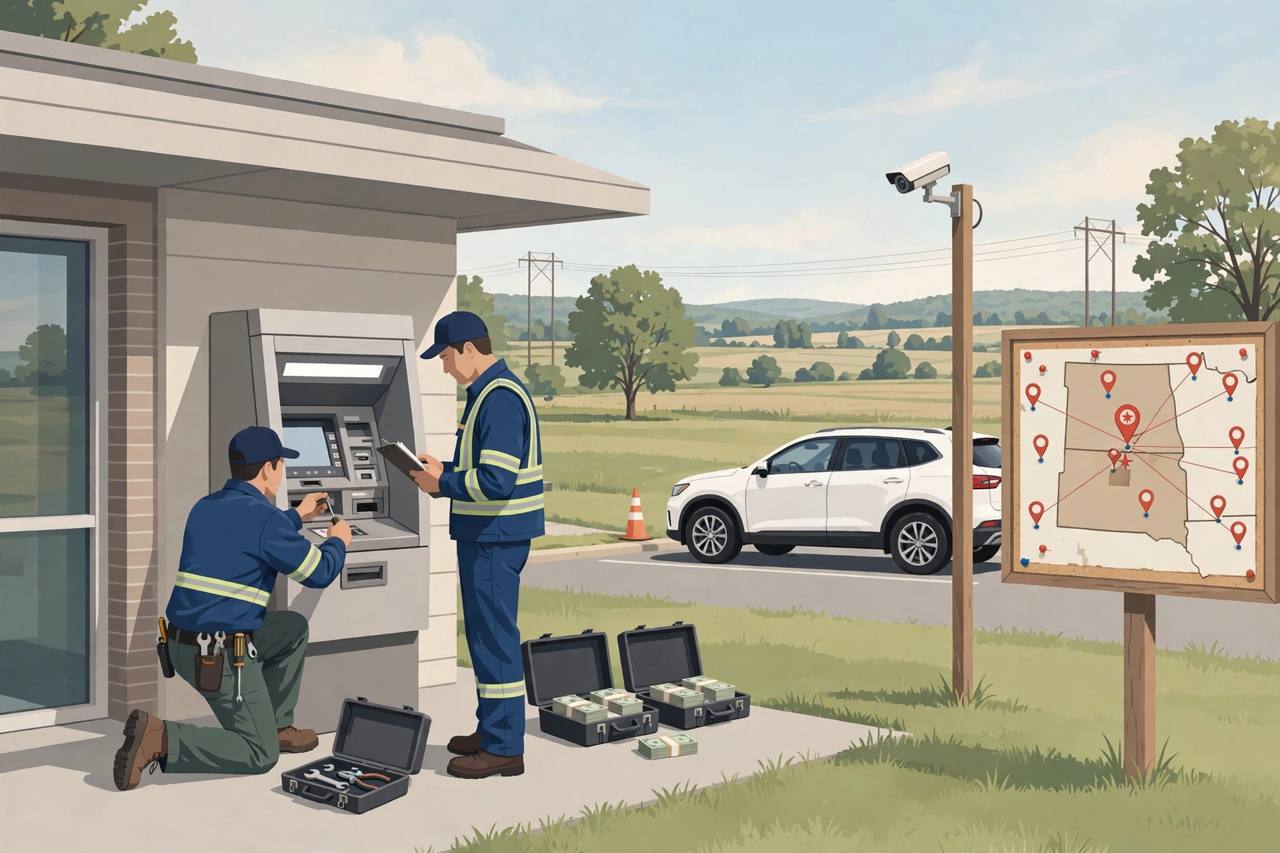
Greenwood is a suburb directly south of Indianapolis, in Johnson County. The robbery itself happened on October 7, at an Indiana Members Credit Union ATM while technicians were servicing the machine — the vulnerable moment in an ATM's working life, when the machine is open and its cash cassettes, the sealed boxes that hold the banknotes, are being handled outside the vault's protection.
What court documents say happened at the machine
According to the court documents cited by WTHR, two suspects rushed the workers servicing the ATM, shoved one employee, and took cash cassettes containing $143,200 before fleeing in a Toyota SUV. The charge filed against all three men is robbery resulting in bodily injury. The shoving of the technician is central to that charge: this was not, on the allegation, a quiet theft from an unattended machine, but a robbery committed directly against the people working on it. All of the conduct described in this report is alleged; the three men are presumed innocent unless and until they are proven guilty in court.
The three men charged
The men charged are Jucquian Tyson and Terrell Jackson, both of Arkansas, and Khalil Orr, of Colorado, WTHR reported. Their alleged roles, as laid out in the court documents, were not identical. Orr is the man investigators say rented the getaway SUV in Colorado before the robbery — and, in a detail investigators treated as a sign of planning, allegedly disabled the vehicle's GPS shortly before the heist, so the rental's own tracking system could not follow it.
After the robbery, according to the documents, the group abandoned the Toyota SUV, switched to a white Nissan, and later divided the stolen cash among themselves. That vehicle switch is a classic attempt to break the trail: police looking for a Toyota leaving a credit union in Greenwood would not automatically be watching for a white Nissan on the highways out of Indiana.
How investigators built the trail anyway
Investigators tracked the alleged scheme using three kinds of evidence together — surveillance footage, GPS data and phone records — according to the court documents. Cameras placed the suspects and vehicles; phone records connected the men to each other; and the rental trail led back to Colorado. The case is an example of how a robbery planned across state lines also leaves evidence across state lines, in systems no single suspect controls.
The break, on the documents' account, came in Colorado. After Orr was arrested there, he confessed to FBI agents — investigators say he told them the group had planned the Indianapolis-area heist in advance. His statements, together with his phone records, helped authorities identify Tyson and Jackson. The two Arkansas men were then captured on October 21, two weeks after the robbery, during a traffic stop in North Carolina — roughly 600 miles from Greenwood — which ended the search without a chase or a further robbery.
An ATM is hardest to rob when it is closed and alarmed, and most exposed in the few minutes when a technician has it open for servicing, with cassettes of cash in hand. That is why service visits are a known risk point for credit unions and ATM operators, and why a robbery at that moment is charged as a robbery against people, not just a theft of money from a machine.
Background: a planned job, not an opportunistic one
Read together, the details in the court documents describe preparation rather than impulse: a rental vehicle obtained in a third state, its GPS allegedly disabled in advance, a second vehicle ready for the switch, and a division of cash afterwards. Prosecutors will have to prove each of those elements in court, and the defence will have its own account — but the planning allegations are why a single October 7 robbery in a Greenwood parking area became a federal-agent-assisted, multi-state case instead of a local police file.
What happens next
What happens next is the court process in Indiana: formal proceedings on the charge of robbery resulting in bodily injury for Tyson, Jackson and Orr, at which the court documents' account — the shove, the $143,200 in cassettes, the disabled GPS, the vehicle switch and the alleged confession — will be tested as evidence rather than read as a report. For the credit union and its technicians, the case has already made its wider point for every worker who services a roadside machine in the open: the minutes when the ATM is open are the minutes that matter, for robbers and for investigators alike.