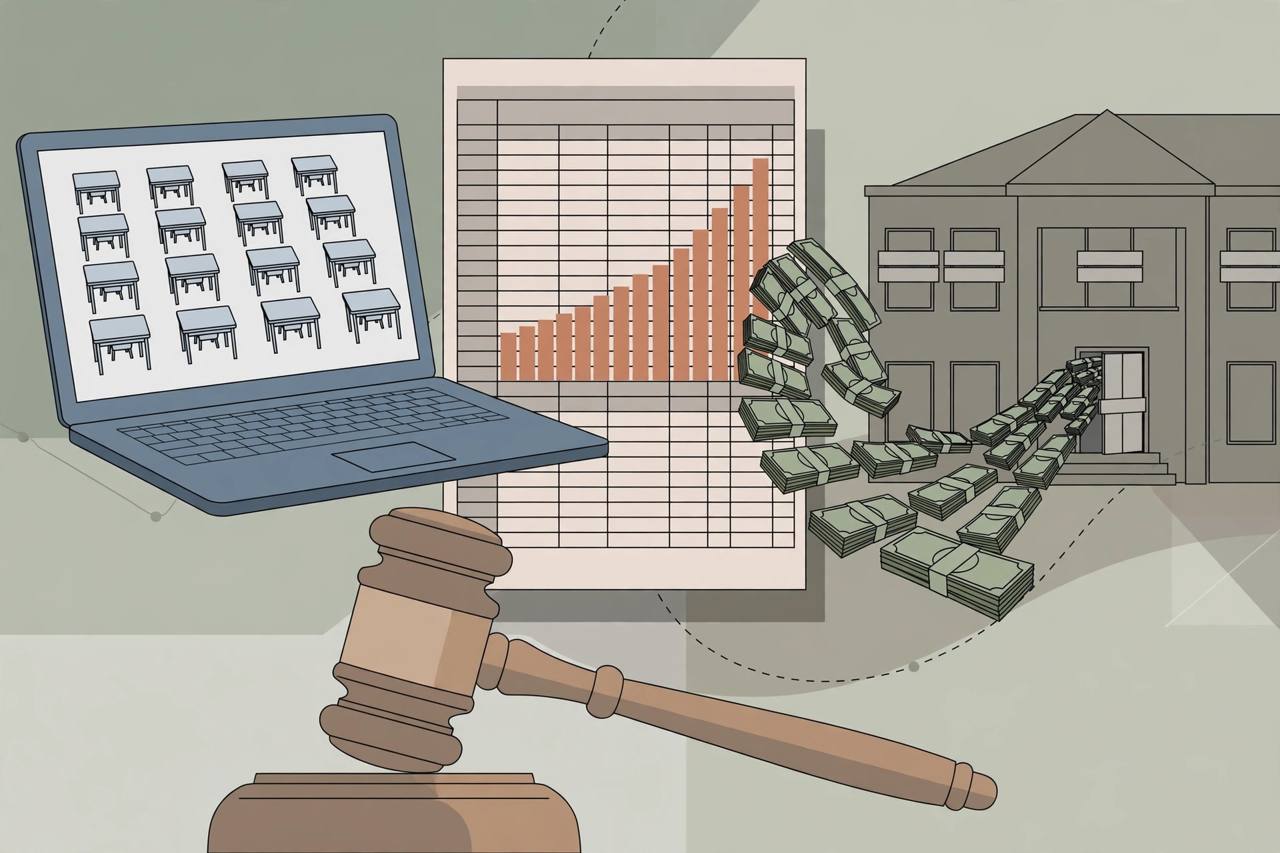
The federal fraud trial of Phillip Holden, the former director of the Indiana Virtual School, began on Tuesday, October 27, in U.S. District Court in Indianapolis — with Holden as the sole defendant, after school founder Thomas Stoughton pleaded guilty to fraud charges on Monday, the day before their joint trial was due to begin. Holden faces 17 counts of wire fraud and one count of conspiracy to commit wire fraud in a scheme prosecutors say inflated enrollment at the online charter schools and siphoned about $44 million in Indiana per-pupil funding.
What the indictment alleges
According to the 2024 grand jury indictment, Holden was responsible for student enrollment, attendance and teacher compensation at Indiana Virtual School and the related Indiana Virtual Pathways Academy. The indictment alleges that Holden, Stoughton and superintendent Percy Clark inflated enrollment numbers to draw per-pupil funding from the state, then funneled the money to for-profit companies owned by Stoughton and paid it out to Stoughton, Clark and others.
A summary of the indictment filed by federal prosecutors, reported by School Matters, says the schools claimed thousands of students who were not actually attending, defrauding the state of $44.6 million, and that Stoughton created multiple shell companies to funnel school revenue to himself — money prosecutors say was used to buy a Cadillac sedan, a boat and Tiffany's jewelry, and to pay his grandchildren's private school tuition at Park Tudor School. The charges are allegations that the government must prove at trial; Holden has pleaded not guilty by proceeding to trial.
Two leaders have already pleaded guilty
Stoughton's guilty plea on Monday, October 26, left Holden alone in the dock. Clark, the schools' superintendent, pleaded guilty to conspiracy to commit wire fraud in June 2025 and agreed to pay back around $1.3 million, Chalkbeat reported; his sentencing is set for January 14, 2027, according to School Matters. Indiana Attorney General Todd Rokita has also filed a separate $154 million lawsuit against the schools and their officers.
Opening statements: 'fall guy' or 'right-hand man'
Prosecutors told jurors that Holden and Stoughton were financially desperate when they started the school, and that Holden — a former police officer who was collecting unemployment when he was hired — knowingly put the inflated enrollment into place as Stoughton's right-hand man. They said Holden re-enrolled students who had withdrawn before count day, the date Indiana uses to set school funding, and that a state report found the school had enrolled students who had only submitted requests on its website, students who had moved out of state, and in one case a student who had died. Prosecutors also said the men kept a separate spreadsheet of genuinely attending students so teachers were paid only for real students, not the inflated figure reported to the state.
Holden's attorneys opened with two words: “Fall guy.” They characterized him as a blue-collar worker who did not financially benefit from the scheme, earning no more than a $65,000 salary in each of his five years with the school, and repeatedly noted that in the emails included as trial evidence, Holden was frequently neither a sender nor a recipient.
How the case began
The charges grew out of a 2017 Chalkbeat investigation that found the virtual school's enrollment ballooning while it employed just one teacher for every 222 students, alongside financial conflicts of interest. That reporting led Indiana lawmakers to tighten funding and attendance requirements for virtual schools. Both schools closed in scandal in 2019, and a grand jury indicted Stoughton and Holden in January 2024.
On the trial's first day, Holden's attorneys also said they had lost contact with Merle Bright, a person who received payments from the school according to a 2020 state audit, and asked the court to order Bright's attorneys to appear in person. During jury selection, U.S. attorneys asked potential jurors whether they had ever taken an online course and how they proved attendance, while defense attorneys asked about opinions on charter schools.
What happens next
The trial is expected to last into next week, U.S. District Judge Richard Young said, with breaks on Friday and on the afternoon of Election Day. The indictment summary reported by School Matters says the fraud and conspiracy charges in the case could carry sentences of 10 to 20 years in prison. Whatever the verdict, the trial is the courtroom culmination of one of the largest online charter school scandals in the United States — a case built on the simple question of how many students were really in class.