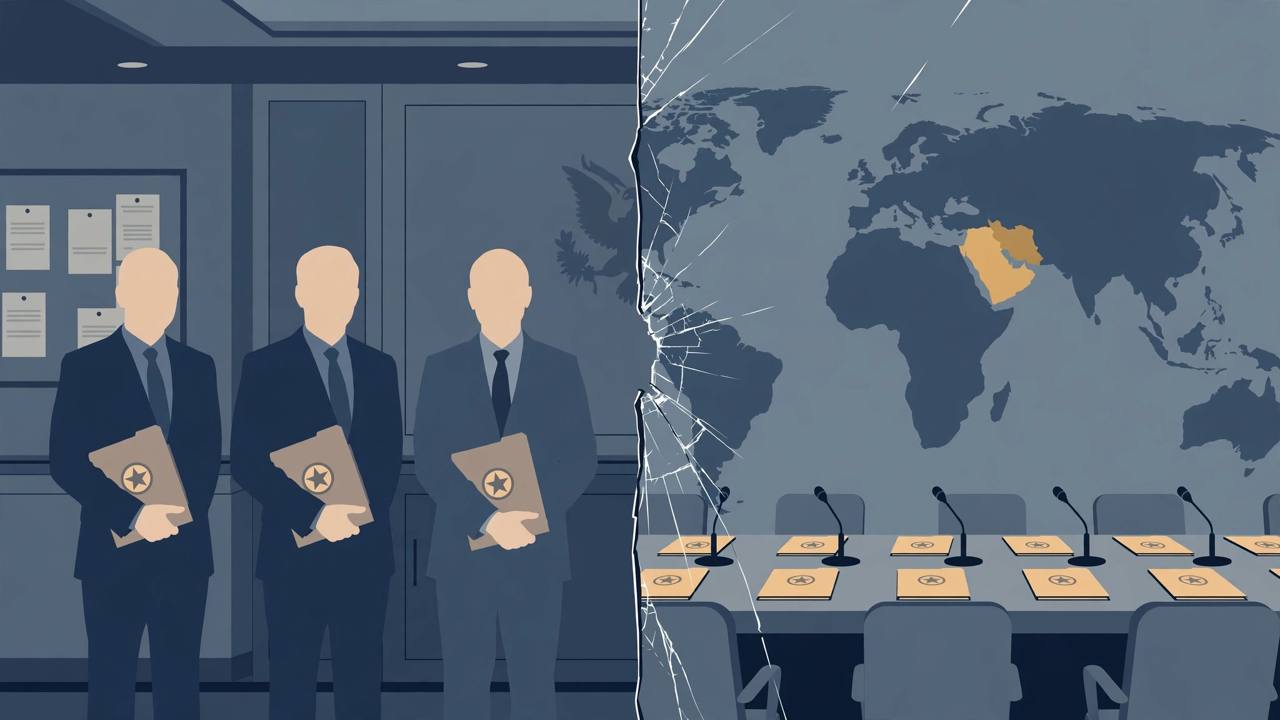
WASHINGTON — Intelligence sharing on Iran and other global threats inside the United States government has slowed and, in some cases, temporarily stopped during President Donald Trump's second term, according to a Reuters investigation published on Tuesday, November 3, based on eight current and former officials and people briefed on the matter. The disruption, which Reuters said had not been previously reported, reaches from the CIA to Congress at the exact moment the administration is weighing whether to resume strikes on Iran after Tuesday's midterm elections.
Source: Reuters (Erin Banco and Jonathan Landay), Nov. 3, 2026
The timing is what makes the finding serious. American voters went to the polls on Tuesday with the Iran war in its ninth month, US forces having struck Iran's Qeshm Island on Monday, and the president publicly saying he is in 'no rush' to decide on wider strikes while also saying a deal 'could happen.' Decisions of that size are supposed to rest on the intelligence community's shared, written assessments. Reuters found that the machinery that produces those shared assessments has been breaking down for more than a year.
What broke: the CIA stopped co-authoring the community's shared assessments
At the centre of the breakdown is the National Intelligence Council, known as the NIC — the analytical group inside the Office of the Director of National Intelligence (ODNI) that for decades has combined the views of all 18 intelligence agencies into the assessments that presidents, cabinet officials and lawmakers use to make foreign-policy decisions. According to the officials who spoke to Reuters, the CIA has stopped co-authoring those assessments. The council relied heavily on the CIA for analysis on subjects including Iran and Russia, so when CIA analysts stopped writing into the shared reports last year, the NIC lost its main author.
The CIA continued to share intelligence with the NIC and to work with it on some reports, officials said, but its analysts increasingly focused on their own agency assessments instead. Since then, the council — which was also hit by staff cuts — has slowed production of its assessments, two people familiar with the matter told Reuters, and none of the assessments it has produced have focused on the war in Iran, according to five current and former officials.
Congress felt the break directly. Lawmakers and their staffs briefly stopped receiving intelligence reports from the office of then-Director of National Intelligence Tulsi Gabbard in the days after the US military intervention in Iran in June 2025, and again after the capture of former Venezuelan President Nicolás Maduro in January 2026, according to two people familiar with the matter. Gabbard's team had accused lawmakers of leaking to the press, Reuters reported. Her office also stopped briefing Congress on election threats in 2025, according to two people familiar with the matter and a former US official.
A turf war officials call one of the biggest in three decades
The problems emerged during Gabbard's tenure as director of national intelligence, amid what officials described as one of the biggest turf wars in three decades between the ODNI and the CIA. The ODNI itself was created after the September 11, 2001, attacks precisely to force the agencies to share what they know. The infighting was triggered when Gabbard's office revoked the security clearances of current and former intelligence officials a year ago, and it reached the point where White House Chief of Staff Susie Wiles had to intervene several times to defuse tensions, three former officials told Reuters. The tensions have subsided since Gabbard's resignation in June, officials said, but problems stemming from the clash persist, according to two US officials.
Inside the agencies, officials described a chilling effect on the analysis itself. The breakdown began last year amid significant cuts to national security agencies, including the ODNI and the CIA, as Trump moved to remove or sideline officials he viewed as disloyal. Some analysts who remain are now careful not to write assessments at odds with the White House's views for fear of political retaliation, two former officials and a current US official told Reuters; the officials did not say which topics the analysts were avoiding. 'Analysts still do the work, but this White House has made them irrelevant because the president treats unwelcome information as disloyalty,' said Julia Curlee, a former CIA analyst who said she was fired from the Trump National Security Council last year for being transgender, as quoted by Reuters.
Former officials warned that the cost is a thinner picture at the top. 'All of these things are adding up in a really complex world where policymakers need to have a more sophisticated, nuanced, and integrated view of the world, and they are getting less,' said Beth Sanner, a former deputy director of national intelligence during Trump's first term, as quoted by Reuters. Morgan Muir, a former deputy director of national intelligence in the Biden administration who also briefed President George W. Bush, warned of 'little lily pads' — isolated pockets of analysis that each decision-maker can pick from instead of one shared picture. There was also a second, separate clash: late last year the FBI stopped sharing some intelligence with the National Counterterrorism Center for several weeks after the center's then-head, Joe Kent, and his staff tried to investigate the shooting of Turning Point USA founder Charlie Kirk; FBI leaders told Kent they believed the center was overstepping its authority, two former officials said. The FBI did not respond to a request for comment.
The agencies answer back — and a repair effort begins
The CIA and the ODNI both pushed back on the picture of a broken system. CIA spokesperson Liz Lyons said the CIA 'participates fully' in the process of providing intelligence assessments through the Presidential Daily Brief, which is led by ODNI, and through the NIC. An ODNI official said the council has maintained assessment levels close to 'historic trendlines,' and ODNI said in a statement to Reuters: 'Director Clayton remains committed to ensuring that ODNI and the intelligence community have the resources they need to continue informing key U.S. government decision-makers and keeping Americans safe.' The White House did not respond to a request for comment. Jay Clayton, who became director of national intelligence in August, has resumed congressional briefings on election threats, officials said, and one US official told Reuters that while Gabbard 'did not utilize the NIC,' Clayton 'has proven to be a good steward' of the intelligence community and recognises the value of the council.
Source: Reuters — CIA and ODNI statements, Nov. 3, 2026
A longer repair is also being drafted outside government. Some former officials are working on a bipartisan basis at Stanford University's Hoover Institution to draw up plans to rebuild the intelligence community in the next administration, four former US officials told Reuters. That effort underlines how far the concern reaches: the people designing the fix are not waiting for the current administration to restore the old system on its own.
Why this matters for Punjabi and diaspora readers in America
For Awaaz Punjab's readers in the United States — including Punjabi truckers, farm and warehouse workers and families across California's Central Valley, New York, New Jersey and Texas — the Iran file is not distant. The war that began on February 28, 2026, has kept oil near its highest levels in months, pushed diesel and petrol prices up along the freight corridors readers drive, and now sits behind an Election Day decision about control of Congress. If the officials who must judge Iran's next move, the safety of shipping in the Strait of Hormuz and the risk to American forces are working from slower, narrower and sometimes competing assessments, the quality of every one of those decisions is affected. That is the same failure pattern investigators identified after September 11, 2001 — information held in one part of the government and never joined up in another — which the ODNI and the National Intelligence Council were built to prevent.
Watch three things: whether Director Jay Clayton restores CIA co-authorship of National Intelligence Council assessments, including one on the Iran war; whether congressional briefings stay restored after the midterms; and whether the post-election decision on resuming strikes on Iran is accompanied by a shared intelligence assessment lawmakers can examine. Reuters' sources say the Gabbard-era tensions have eased since June — the test is whether the written, shared product recovers with them.