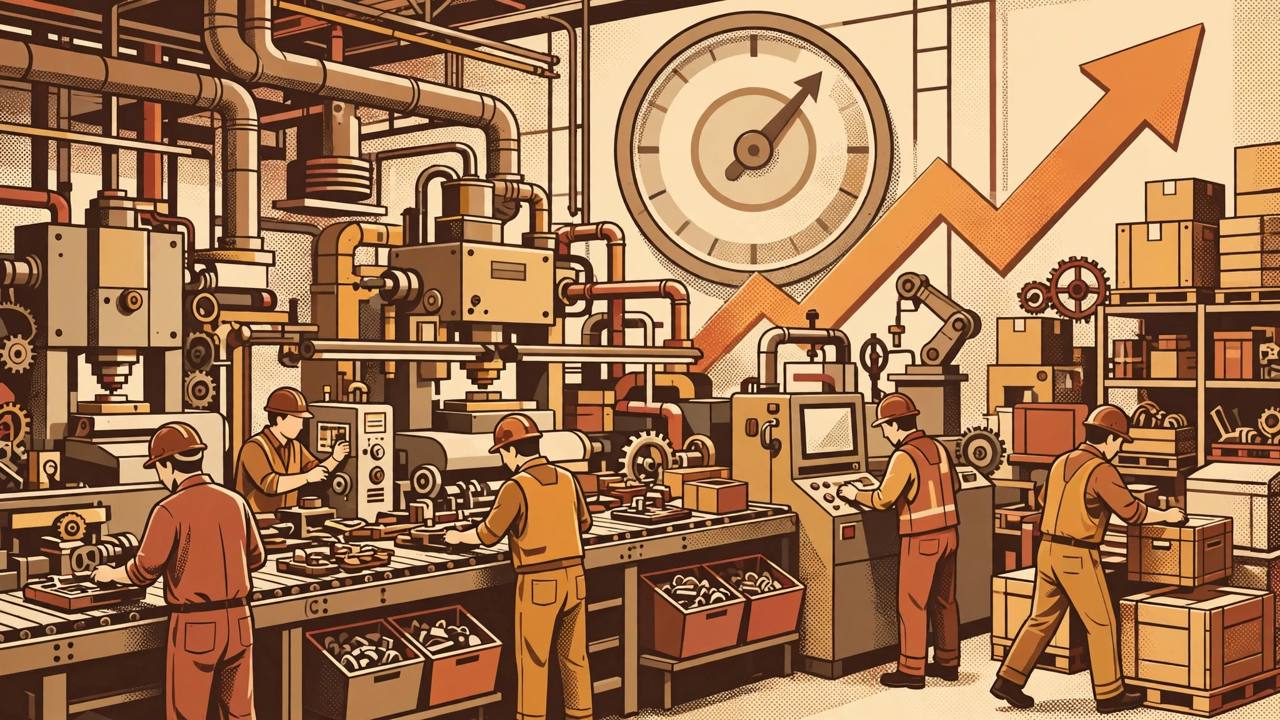
U.S. manufacturing picked up pace in October, expanding for a 10th consecutive month and beating economists' expectations, the Institute for Supply Management (ISM) said in its monthly survey released on Monday, November 2. The Manufacturing PMI registered 55.5 percent, a full point above September's 54.5 percent. Economists polled by Reuters had forecast the index would stay at 54.5. Any reading above 50 signals growth in a sector that accounts for about 9.4 percent of the U.S. economy.
Source: Reuters, Nov 2, 2026
The report was issued by Susan Spence, chair of the ISM Manufacturing Business Survey Committee, from Tempe, Arizona. Spence said the overall U.S. economy has now expanded for 24 months in a row, and that an October PMI reading of 55.5 corresponds, on the survey's past relationship with growth, to a 2.7 percent increase in real gross domestic product on an annualized basis. Twelve manufacturing industries reported growth in October, led by plastics and rubber products, electrical equipment, machinery, and computer and electronic products; only three — printing, paper products and nonmetallic mineral products — reported contraction.
Source: ISM via PR Newswire, Nov 2, 2026
Production does the heavy lifting
The sharpest move in the report was output. The Production Index jumped 2.3 points to 59.0 percent — its highest reading since November 2021, when it stood at 60.5 — and has now expanded for 12 straight months. Factory managers' comments on production turned more positive, at two favourable comments for every negative one, up from 1.6-to-1 in September. New orders, the clearest forward-looking demand gauge, edged up 0.2 point to 55.5 percent for a 10th month of expansion, and new export orders rose 0.3 point to 51.2 percent.
Order books remain full enough to keep lines busy. The Backlog of Orders Index eased 1.8 points to 54.6 percent but stayed in growth territory for a 10th month, while customers' inventories held at 41.6 percent — a level ISM classifies as 'too low' for a 25th straight month, which the institute says is usually a positive sign for future production because buyers will have to restock. Factories also rebuilt their own stocks: the Inventories Index rose 2.8 points to 51.4 percent, returning to expansion after a month of contraction, and imports grew faster, up 1.9 points to 52.9 percent.
The bill keeps rising: prices at 75.2 and deliveries slowing
The warning light in the report is cost. The Prices Index fell 2.7 points to 75.2 percent — less than the 77.5 economists expected, but still deep in 'increasing' territory for a 25th consecutive month, meaning far more factories are paying higher prices for inputs than lower ones. Supplier deliveries slowed for an 11th month, with that index at 59.1 percent; slower deliveries are typical when demand is strong, but managers also blamed genuine bottlenecks. ISM's commodity lists put aluminum, copper, steel, electronic components, semiconductors and diesel fuel among items rising in price, and electrical and electronic components among those in short supply for 16 and 20 months respectively.
The factory numbers land in an economy running hot on paper and squeezed on prices in practice. The government reported last week that the economy grew at a 3.4 percent annualized rate in the third quarter, up from 2.2 percent in the April–June quarter, while the Personal Consumption Expenditures price index — the Federal Reserve's preferred inflation gauge — rose 3.6 percent in the year to September. The Fed held its benchmark rate at 3.75 to 4.00 percent last Wednesday, said inflation 'remains elevated,' and economists expect the central bank to raise borrowing costs again in December, according to Reuters.
Source: Reuters, Nov 2, 2026
What factory bosses told the survey
Beneath the strong headline, mood in the sector darkened for a third straight month: only 34 percent of survey comments were positive, against 66 percent negative. Among the negative comments, ISM counted pricing volatility in 62 percent, longer lead times in 41 percent, tariffs in 25 percent and the Iran war in 21 percent. One food, beverage and tobacco products manager told the survey: 'Diesel rates and the trucker shortage are impacting costs beyond the raw material inputs to levels I have never seen.' A machinery maker described 'explosive growth' in semiconductor and defence demand, with a part that took four weeks now taking 50, and a US$2,000 item six months ago now costing $4,000.
A second survey released the same morning pointed the same way on growth and slightly differently on momentum. S&P Global's manufacturing PMI eased to 54.9 in October from 55.9 in September — still a 15th straight month of expansion — with delivery times lengthening to their worst since August 2022, but firms hiring at the fastest pace in five and a half years. Read together, the two surveys describe a factory sector that is genuinely busy, short of parts and people, and passing its costs down the chain.
Source: Sharecast (S&P Global / ISM), Nov 2, 2026
Why this matters for truckers and Punjabi families in the U.S.
Manufacturing is the freight economy's engine room, and a large share of this site's U.S. readers drive trucks or work in the warehouses, plants and logistics yards that factories feed. Busier production and fuller order books support freight demand into the holiday season. But the same report explains why that work is not getting cheaper: diesel was again listed among commodities rising in price, delivery lead times are stretching, and managers say those costs are being passed on through surcharges and higher prices for finished goods — the cost-of-living pressure that shows up in the 3.6 percent PCE inflation figure and in household budgets from Fresno to Edison.
A packed data week follows the PMI: job-openings figures, private payrolls and then the October employment report on Friday, all before the Federal Reserve's December 8–9 meeting, where economists currently expect another rate increase. ISM publishes its next manufacturing report in early December; the number to watch is whether the Prices Index finally cools below the mid-70s or stays at levels factories say they have never seen before.