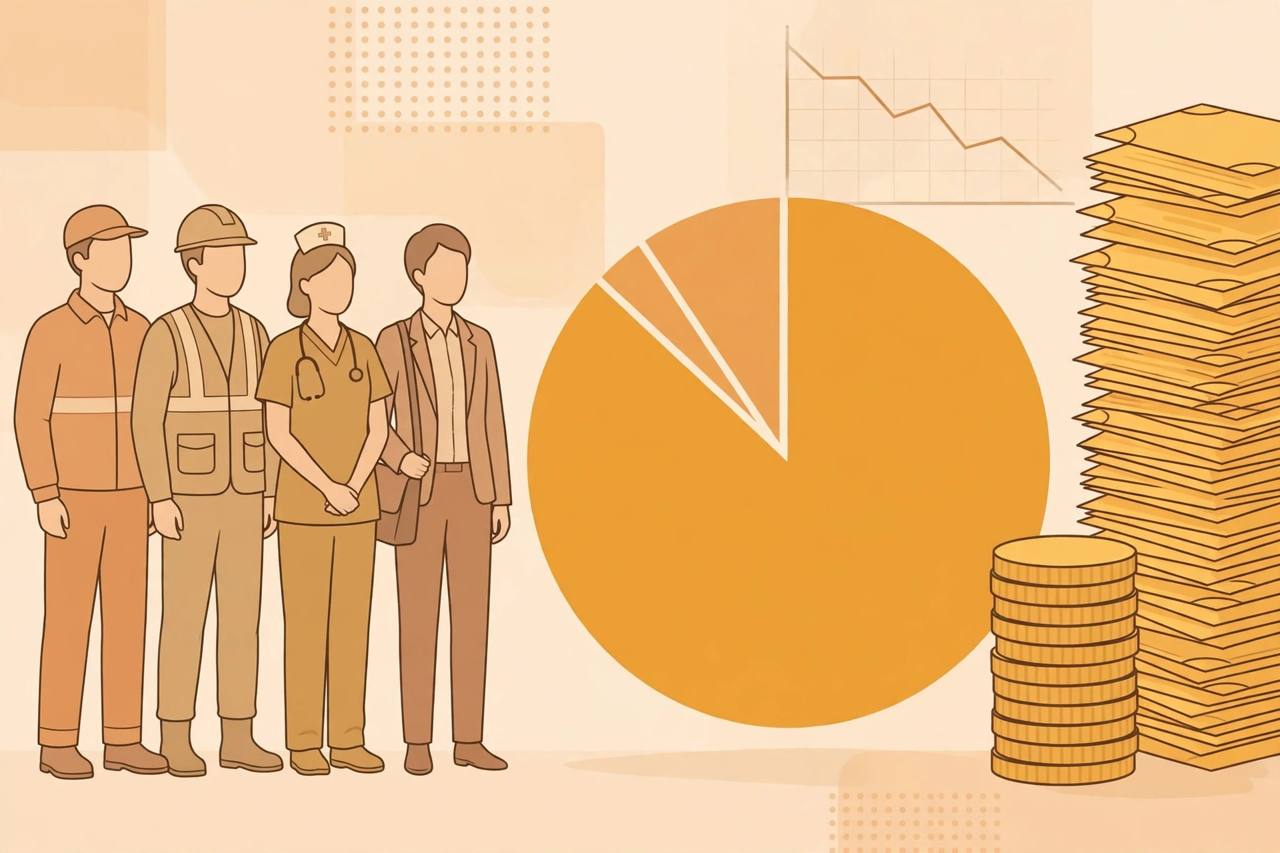
WASHINGTON — American workers received a smaller share of what the US economy produced in the second quarter of 2026 than in any quarter since the federal government began measuring it in 1947. The Bureau of Labor Statistics (BLS) puts the labour share of nonfarm business output at 52.8 percent in the second quarter of 2026, the lowest level in a series that begins in the first quarter of 1947, in its revised Productivity and Costs release (USDL 26-1434, September 3, 2026). The figure returned to the centre of the national economic debate on Tuesday, October 27, when CNN reported economists linking this year's faster decline to the wave of corporate spending on artificial intelligence.
Source: U.S. Bureau of Labor Statistics
The labour share is the percentage of output that accrues to workers in the form of compensation — wages and salaries plus benefits, pensions and employer payroll taxes, in the BLS definition. Whatever is not paid out as compensation accrues on the other side of the ledger, as profits, interest and other returns to the owners of capital. It is not a measure of any one worker's pay cheque, and it is not the percentage of companies raising wages; it is the economy-wide split of the value businesses produce.
A fall of 1.9 points in a single year
For most of the postwar era, workers took home roughly 60 to 66 percent of business output. BLS figures cited in the October 27 reporting put the share at 65.5 percent in the first quarter of 1947 and 63.8 percent in the first quarter of 2000. It was still 58.9 percent in the second quarter of 2020. It then fell to 54.7 percent in the second quarter of 2025 and 53.6 percent in the first quarter of 2026, before reaching 52.8 percent in the second quarter of 2026 — a fall of 1.9 percentage points in a single year, which economists described as unusually fast for a measure that normally moves slowly.
The same BLS release shows why the split widened. Nonfarm business labour productivity rose 1.4 percent in the second quarter of 2026 at an annualised rate, as output rose 1.7 percent and hours worked rose 0.3 percent; against a year earlier, productivity was up 2.2 percent. Hourly compensation rose 2.6 percent in the quarter, but real hourly compensation — pay adjusted for consumer prices — fell 3.3 percent in the quarter and 0.1 percent over the year. Unit labour costs rose 1.2 percent in the quarter and 1.4 percent over the year. In manufacturing, productivity rose 2.4 percent in the quarter. In the nonfinancial corporate sector, unit profits rose at an annualised rate of 43.0 percent in the second quarter, the highest rate since the second quarter of 2021, and were up 17.8 percent over the year, also the highest since late 2021, the BLS said.
Why economists blame the AI spending wave
"It's really telling you that workers have less and less power in this technology age and certainly in the AI age," Heather Long, chief economist at Navy Federal Credit Union, told CNN. "The rewards, the financial gains, are mainly going to shareholders." Long said this year's sharper decline likely reflects heavy investment in, and rapid adoption of, artificial-intelligence technologies, and may signal what lies ahead. Michael Feroli, chief US economist at JPMorgan, told CNN the BLS measure could fall below 50 percent by the end of the decade if current trends and the anticipated effects of AI hold.
CNN's reporting pointed to corporate decisions this autumn as illustrations of where the money is going: General Motors plans to spend $20 billion buying back its own stock; American Express and Barclays announced job cuts while profits rose, with both pointing to AI; and Microsoft is offering voluntary buyouts to about 60,000 employees, according to news reports, while it pours money into AI. Those company moves are reported here as CNN reported them; each company's own filings are the primary record for its programme.
Gregory Daco, chief economist at EY-Parthenon, estimated for CNN that returning the labour share to 56 percent would mean about $3,900 more per household, and a return to the early-2000s level near 62 percent would mean about $14,400. "It's a slow-moving phenomenon but one that has real consequences in terms of consumer spending and consumer sentiment," he said.
The other side: how much of the drop is measurement?
Not all of the decline is money workers lost, according to a Goldman Sachs research note cited by CNN. Goldman economist Abhay Duggirala estimated that about 40 percent of the drop since the 1990s comes from measurement effects — tax changes that pushed more businesses into pass-through structures, so some owners' pay is booked as profit, faster depreciation of computers and software, and equity pay the BLS measure undercounts. He attributed the other 60 percent to higher markups, more industry concentration, automation and a decline in workers' bargaining power.
The Tax Foundation goes further. Its senior economist, Richard DiSalvo, told CNN that gross measures overstate how much goes to owners, because much of that income pays for depreciation and taxes and never reaches anyone as spendable income. Excluding those, the group found capital's share of net income runs between 22.6 percent and 31.7 percent, and the labour share stays within historical levels. DiSalvo acknowledged the share has fallen over the past 20 years but said the drop is smaller than the BLS headline suggests. Even on Goldman's reading, most of the decline is still tied to employers' pricing power and workers' weaker leverage — the disagreement is about size, not direction.
What is solid
- BLS official figure: labour share was 52.8% in Q2 2026, the lowest in the series beginning Q1 1947 (USDL 26-1434).
- Productivity rose 2.2% year over year in Q2 2026 while real hourly compensation fell 0.1% over the year (BLS).
- Prices rose 3.7% in the year through September while average hourly pay rose 3.0%, a 0.7% cut in real earnings (BLS data cited Oct 27).
What is only claimed
- How much of the long decline is real loss to workers versus measurement: Goldman Sachs estimates ~40% measurement, ~60% structural; the Tax Foundation argues the net-income labour share stays within historical levels.
- Whether AI is the main driver of this year's faster fall: economists told CNN it likely is; no BLS finding attributes the move to AI directly.
What it means for diaspora and trucker families
For Punjabi diaspora households in the United States — including the large number who drive trucks, run small businesses or work hourly jobs — the monthly version of this squeeze is already visible in the same official data: prices rose 3.7 percent in the year through September while average hourly pay rose 3.0 percent, a 0.7 percent cut in real earnings. When output per hour rises but real compensation does not, a household feels it as longer hours for the same standard of living, and an owner-operator feels it when load revenue rises more slowly than the costs around the load. The BLS figures do not single out any one community; they describe the national split within which every wage-earning and small-business family in the US is operating.
Bargaining power is the other half of the story in the official record. Union membership was 10.0 percent of wage and salary workers in 2025, half the 20.1 percent rate of 1983, and just 5.9 percent in the private sector, according to the BLS. Full-time union members earned a median $1,404 a week, compared with $1,174 for nonunion workers, the BLS reported. Economists on both sides of the measurement debate cite that long fall in worker leverage as part of why productivity gains now flow more to capital than they did when the labour share stood in the low-to-mid 60s.
What happens next
The next official reading arrives soon: the BLS has scheduled the preliminary Productivity and Costs release for the third quarter of 2026 for Thursday, November 5, 2026, at 8:30 a.m. Eastern, which will show whether the labour share stabilised, recovered or fell further after June. The argument will also run through the November 3 midterm elections, where the parties competing to write labour and tax law are on the ballot. Until the November 5 release, the verified position is the BLS one: 52.8 percent in the second quarter, the lowest since 1947, with the cause — AI, markups, concentration, bargaining power, measurement, or a mix — still contested by economists reading the same numbers.
Sources: U.S. Bureau of Labor Statistics, Productivity and Costs, Second Quarter 2026, Revised (USDL 26-1434, September 3, 2026) and BLS Economics Daily on the labour share (September 15, 2026); CNN, "Workers are getting a shrinking slice of America's economic pie" (October 27, 2026), as summarised with full figures by WorkersRights.News (October 27, 2026); BLS, Union Members 2025 (February 18, 2026).