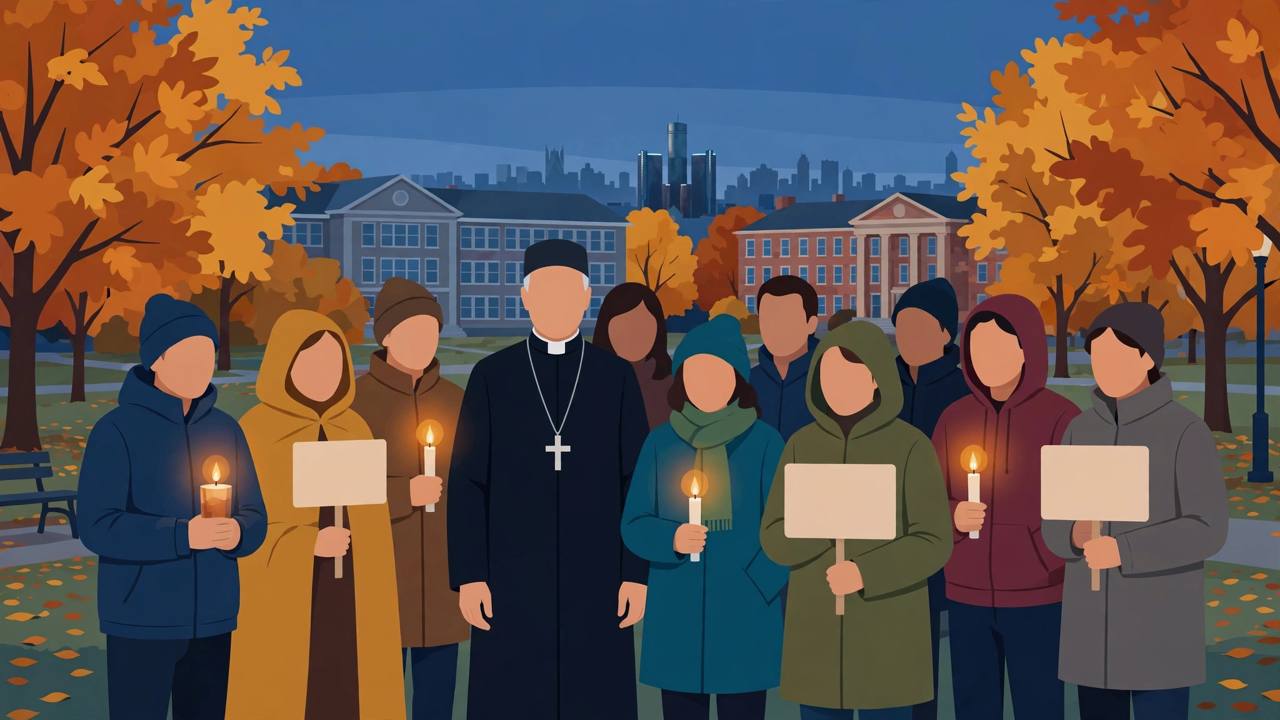
DETROIT, Michigan — Detroit Archbishop Edward J. Weisenburger joined Catholics and non-Catholics alike on Friday, October 30, at the weekly prayer vigil in Clark Park in southwest Detroit, advocating for the rights and dignity of immigrants and calling for just immigration reform as reports of stepped-up immigration enforcement rattled the city's Mexicantown neighbourhood. He carried a sign reading “Todos Somos Familia” — Spanish for “We Are All Family.” Other signs at the vigil read “No human is illegal” and “Jesus was a refugee.”
Source: Detroit Catholic via EuropeSays
“After hearing reports of the presence of ICE officials in the area, I wanted to stand in solidarity with my brothers and sisters, especially in this area,” Archbishop Weisenburger said. “We as Christians are not permitted not to recognize the face of Christ in others. My only reason for being here today is that I want to stand in solidarity with the people who are suffering. I do recognize the face of Christ in them, and I want to be associated with them.” He added that just as Jesus challenged the Pharisees and Sadducees of his day when they were abusing their power, today's Christians must stand up to injustice and avoid a “polite religion” that goes along to get along: “I think sometimes people want to reduce religion to just sweetness and prayer. And as much as being kind and prayer are critical, to reduce it to that and carve out and excise Jesus' message on justice and dignity of humanity and truth — that's not Christianity. We really must do both.”
Why this week: reported detentions beside an early-voting centre
The archbishop's appearance came two days after a tense Wednesday morning in the same park. Community members reported that at least three people were taken into custody on Wednesday, October 28, during a federal immigration enforcement operation near Clark Park, according to community reporting by Midwest Mexican, which said it had contacted the Department of Homeland Security for confirmation. City Council Member Gabriela Santiago-Romero posted a video warning residents about a surge in ICE enforcement in the neighbourhood, days before the midterm election on November 3, and said she had notified Detroit's mayor's office, the police chief and the deputy city clerk, as well as U.S. Rep. Rashida Tlaib's office. The community group Asamblea Popular de Detroit alerted residents to reported enforcement near Clark Park, along Vernor Highway, and near Western International High School, Maybury Elementary and Amelia Earhart Elementary-Middle School, describing agents travelling in unmarked vehicles — a gray Dodge Durango, a dark blue Ford Explorer and a black Chevrolet Tahoe, some reportedly with out-of-state plates. Those vehicle and tactic details are community allegations; DHS has not confirmed them, and the same community reporting noted that unverified sightings and misinformation were also circulating.
The location matters. Clark Park, at 1130 Clark Street, is one of Detroit's eight early voting centres, and early voting has been running since Saturday, October 24, through Sunday, November 1. Kim Redigan — a Gesu Parish parishioner, a member of Strangers No Longer and director of campus ministry at Cristo Rey High School — told Detroit Catholic that as the November 3 midterms approach, many naturalized citizens in the community have expressed fears about going to the polls. “That's why many of us have been trained and are prepared,” Redigan said. “I'm going to be a poll chaplain in a vulnerable community next Tuesday, and I think many of us are doing similar work. Our role is to be a presence to let people know they are safe to come in and vote, to accompany people as they come in to vote, and to keep a close eye on what is going on.” Poll chaplains, she noted, are different from poll watchers: they offer spiritual and emotional support to voters.
What is solid
- Archbishop Weisenburger attended the October 30 Clark Park vigil and made the statements quoted here, reported by Detroit Catholic.
- Clark Park is one of Detroit's eight early-voting centres, and the vigil group has met there on Friday afternoons since 2017.
- NPR's reporting found ICE activity surging ahead of the midterms in Detroit and other cities; DHS told NPR that ICE upholds immigration laws in all 50 states, seven days a week, 24 hours a day.
What is only claimed
- The number of people detained near Clark Park on October 28 and the unmarked-vehicle details come from community reports and a council member's video; DHS had not confirmed them in the reporting reviewed.
- Whether the timing and location of enforcement near a voting site was intended to affect turnout is alleged by advocates and not established; the Brennan Center's Wendy Weiser told NPR there is no indication the activity is suppressing turnout, and early voting in minority communities has surged.
A vigil that began in 2017
Strangers No Longer, a lay-led Catholic immigration advocacy group, has hosted the Friday-afternoon vigil in the heart of Mexicantown since February 2017, during the first Trump administration. “We started in February of 2017… when there were waves of (ICE agents) banging on the doors of immigrants, and a social worker in our group spoke of children being traumatized,” Redigan said. “We had children who were wetting their beds, getting into fights, being scared in their own neighborhood.” The group deliberately meets at Clark Park — near Western International High School, Cristo Rey High School and Holy Redeemer School — near the end of the school day, to support students. “It's not really a protest; it's more a sign of friendship and solidarity with that child and all children,” Redigan said. “That's why we're here when school's getting out.” She said members have lately noticed an uptick in harassment by immigration enforcement officials, particularly when parishioners of immigrant backgrounds are going to work or church.
Archbishop Weisenburger, appointed to the Archdiocese of Detroit by Pope Francis in March 2025, recalled that shortly after his appointment a priest told him of parishioners living in fear of deportation — some even self-deporting for fear of risking the wellbeing of loved ones. “They were going back to a country that they had not been to in years, and it was devastating for them and their parish,” he said. Speaking to media after the vigil, he acknowledged immigration is a key issue in the upcoming election and said the Church teaches that a nation's immigration laws and enforcement must be rooted in the human dignity of every person. “Who someone votes for is a complex issue, and Catholicism does not fit in perfectly in any political party,” he said. “That's one of the reasons the Church is completely nonpartisan in that sense.” But, he added, “the Church always speaks to moral issues. We not only have the right to do that, but we also have a Gospel obligation to do so.”
Early voting in Detroit ends Sunday, November 1, and Election Day is Tuesday, November 3, when vigil members plan to serve as poll chaplains in vulnerable communities. The Clark Park vigil itself continues on Friday afternoons, as it has since 2017. DHS has not, in the reporting reviewed, confirmed the reported October 28 detentions near the park.
For Awaaz Punjab's readers in Michigan — where Punjabi families and truckers are spread across the Detroit suburbs and the I-75 and I-94 corridors — the Clark Park story is a reminder that the pre-election enforcement surge documented by NPR in Detroit, New Jersey, Oregon, Illinois and California is landing in specific neighbourhoods, beside specific schools and, in this case, beside a place where people are actively casting ballots. What is verified is the vigil, the archbishop's words, and the fear residents described to reporters; what remains unconfirmed is the full scale of the enforcement that prompted them.