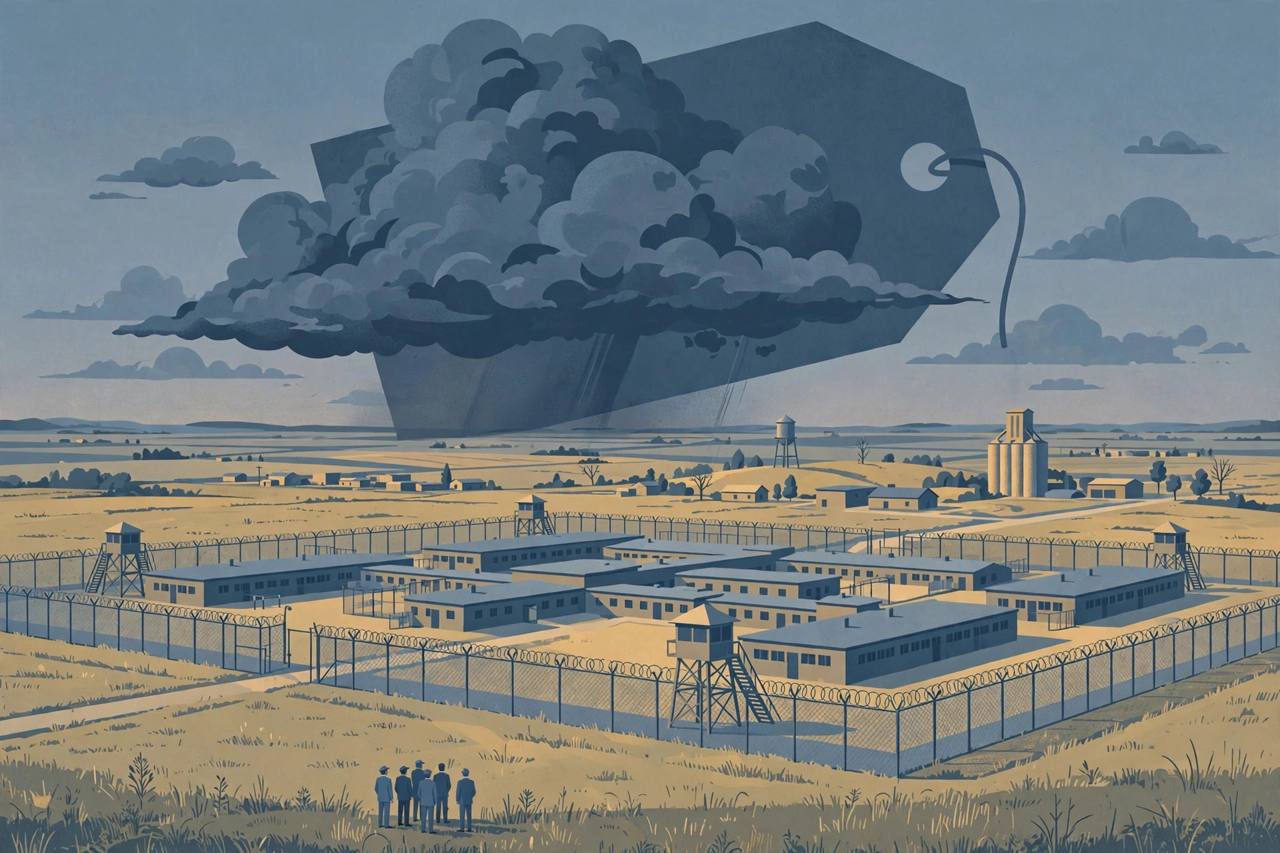
The United States Department of Homeland Security paid $495,639,588 in August for an empty private prison in Appleton, Minnesota — the Prairie Correctional Facility — even though its owner, CoreCivic, had offered to sell the same prison to the State of Minnesota a year earlier for $75 million, including the upgrades needed to reopen it. The price, recorded in the seller's own filing with the Securities and Exchange Commission, is now at the centre of a growing political fight in Minnesota, two days before midterm elections that will decide which party controls Congress and its investigation committees.
Source: KARE 11 Investigates
The figures come from an investigation published on October 29 by KARE 11, the NBC station in Minneapolis. Using an open-records request, the station obtained a May 7, 2025 email in which CoreCivic representative Kelly Durham told the Minnesota Department of Corrections: “Yes, we would be willing to sell the facility to the State.” The asking price was $75 million, “inclusive of the upgrades CoreCivic has identified would be needed to re-activate the facility.” Minnesota declined. Fifteen months later, a purchase agreement dated August 4, 2026 sold the same facility to the United States, through the Department of Homeland Security, for $495,639,588 — about six and a half times the earlier offer, a difference of $420.6 million.
A prison that has sat empty for 16 years
Prairie Correctional Facility is a 34-year-old private prison in Appleton, a town of fewer than 1,400 people in western Minnesota, roughly a three-hour drive from Minneapolis–St. Paul. It held up to 1,600 inmates at its peak, but it has been closed for 16 years — empty since 2010. Minnesota's own 2018 architectural assessment had also listed CoreCivic's proposed price at about $74.1 million. State officials told KARE 11 they passed on the $75 million offer because of what it would take to run a prison in such a remote place: about 500 employees would be needed, staffing was expected to be difficult, and housing those workers would be costly. Those are the same problems the federal government now has to solve if the facility is to hold ICE detainees, which is the purpose DHS bought it for, according to the reporting.
Minnesota Corrections Commissioner Paul Schnell, the official who turned the offer down, told KARE 11 investigative reporter A.J. Lagoe that he was “stunned” by the federal price, calling it “unexplainable” and “beyond comprehension.” KARE 11 reported that the $420.6 million difference alone is larger than the estimated losses in the Feeding Our Future fraud case — the Minnesota benefits-fraud scandal that the Trump administration has cited repeatedly this year as it announced its own “war on fraud.”
Asked about it at a ‘war on fraud’ briefing, Bessent called the question ‘a waste of our time’
On October 30, Treasury Secretary Scott Bessent held a press event in St. Cloud, Minnesota, to announce the administration's “War on Fraud” agenda. KARE 11 reporter Lou Raguse asked him: “If the administration has declared war on waste and fraud, could you explain the $420 million overpayment for a prison in Appleton, Minnesota, when the company offered it to the state of Minnesota for $75 million?” Bessent answered: “I don't know anything about that. What we are here to do is to prosecute criminal fraud, and any question like that, that deflects away from it, I think is a waste of our time, thanks.” KARE 11 reported that it had also sought comment from Homeland Security Secretary Markwayne Mullin before publication and that neither Mullin nor his agency responded.
Minnesota Attorney General Keith Ellison has called on Congress to investigate. “I'm calling on House and Senate Homeland Security Committees, and the House Oversight Committee, to immediately begin investigating why Trump paid almost half a billion to a Trump donor for a prison worth just $75 million,” Ellison said, according to the reporting. Federal records reported by KARE 11 show CoreCivic donated $500,000 to the Trump–Vance inaugural committee. To be clear about what is and is not established: the donation, the two prices and the email offer are documented in records and filings. No court or investigator has found that the donation caused the price, or that any law was broken in the sale — those are the questions Ellison is asking Congress to examine.
CoreCivic, the Tennessee-based private prison operator, has defended the price. In a written statement to KARE 11, the company said independent appraisers used a cost-based methodology and that “the federal government ultimately determined the sale price following its assessment process.” Reporting on the company's position adds that CoreCivic argues the two numbers measure different things — that the federal price reflected a replacement-cost appraisal and the renovations ICE required, rather than the price it had quoted the state.
Appleton is one of four prisons — and the bill does not end at purchase
Appleton was not a one-off deal. According to the reporting, CoreCivic sold four facilities to the federal government this summer for a combined total of more than $2.2 billion — two in California for about $1.47 billion, one in Kansas for about $238 million, and Appleton. The company has also kept the work of running Appleton: it holds a separate five-year contract to operate the facility for ICE and projects roughly $75 million a year in revenue from it once it is fully activated — in other words, about the state's entire 2025 purchase offer, every year, in operating fees. In September, a Government Accountability Office review of ICE's detention expansion called for a comprehensive strategic plan for the build-out; DHS agreed, and ICE has said it does not expect to finish that plan until August 31, 2027, according to reporting on the review.
For Awaaz Punjab's readers — Punjabi families across the Midwest and the truckers who run I-94, I-35 and I-90 through Minnesota — this is not an abstract Washington spending story. Detention capacity decides how many people picked up in immigration enforcement in the region can be held, how long they stay in custody, and how far they are held from their families and lawyers. A detention centre in a town of 1,400, three hours from the Twin Cities, would hold people far from both. How it is staffed, when it opens, and what it ultimately costs are questions that will be answered in the same congressional budget and oversight process that Ellison is now asking to examine the purchase.
Attorney General Ellison's request now sits with the House and Senate Homeland Security committees and the House Oversight Committee — who controls those committees after Tuesday's November 3 midterm elections will decide how hard the $495.6 million question is pressed. Watch for: a formal committee response or hearing announcement; any DHS or ICE explanation of the appraisal that produced the federal price; and ICE's activation and staffing plan for Appleton, the problem that made Minnesota walk away at $75 million.