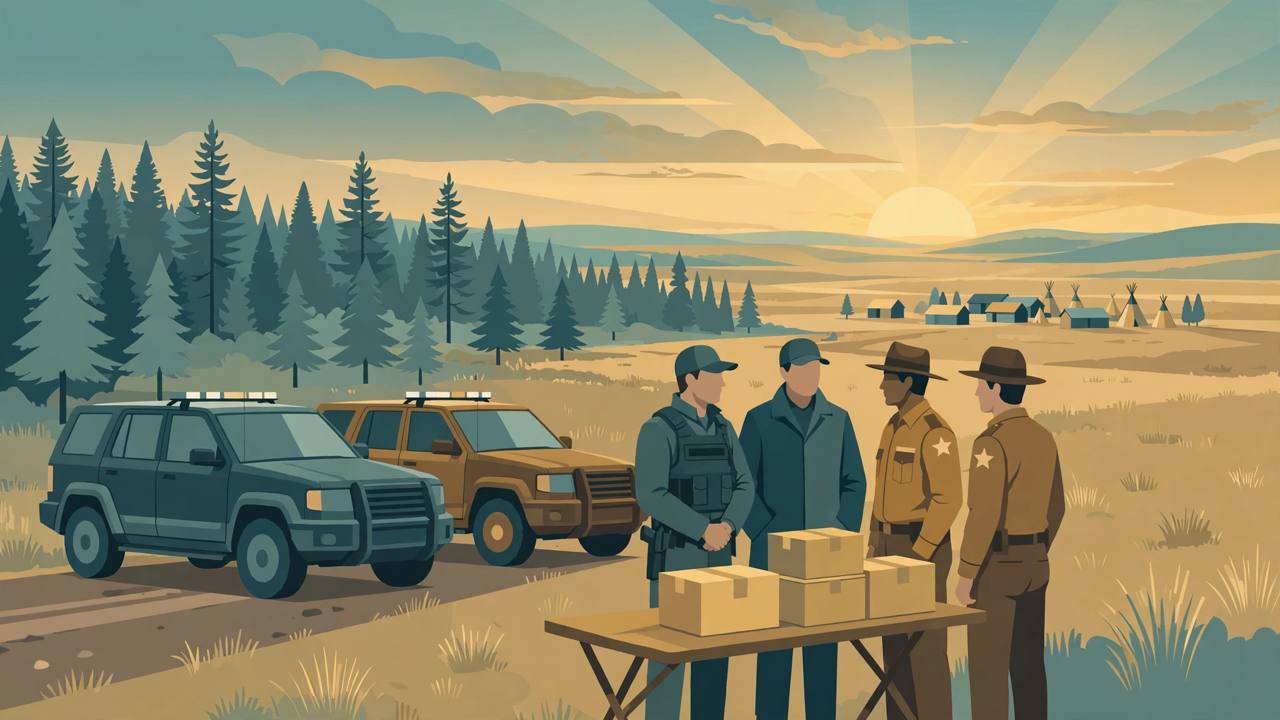
The FBI's Minneapolis field office and the United States Attorneys for Minnesota, North Dakota and South Dakota have announced the results of Operation Steadfast Promise, a six-month surge against violent crime and drug trafficking in Indian Country that produced 168 arrests, 234 new federal investigations and combined sentences totalling nearly 625 years across the three states.
Source: FBI Minneapolis — Operation Steadfast Promise results announcement
The announcement covers the period from April 1, 2026, to September 30, 2026. FBI Minneapolis said it and its law enforcement partners initiated 234 new federal investigations in Indian Country and made 168 arrests, and that prosecutors filed 65 criminal charging documents — indictments, informations or criminal complaints — resulting from investigations submitted for prosecution.
The FBI said its Minneapolis Indian Country program work resulted in a combined sentencing total of 7,494 months, or nearly 625 years, in addition to a life sentence imposed in a murder case and a life sentence imposed in a child sexual abuse case.
Four operations inside the surge
Operation Ballistic Backlog tackled a forensic backlog: FBI and Tribal partners, supported by the Bureau of Alcohol, Tobacco, Firearms and Explosives (ATF), examined 1,407 firearms held in Tribal law enforcement custody that may be connected to other crimes. Test firing produced 860 cartridge casings that were entered into the ATF's National Integrated Ballistic Information Network (NIBIN), and those entries generated 10 connections to active law enforcement investigations. The FBI said technical and forensic review of the firearms is ongoing.
Operation Trusted Trails was the drug and gang arm of the surge. Safe Trails Task Forces across the three-state area seized 136 firearms and $199,610 in currency, and investigators seized 115,466 grams of narcotics, including 2.71 kilograms of fentanyl. The FBI release notes, citing the Drug Enforcement Administration, that a kilogram of fentanyl has the potential to constitute approximately 500,000 fatal doses — meaning the fentanyl seized alone represents, on that measure, well over a million potentially fatal doses kept off Tribal lands.
Operation Not Forgotten, now in its fourth year nationally, brought 15 FBI special agents from field offices across the country to FBI Minneapolis for assignments at six Indian Country resident agencies covering 16 federally recognized tribes in the three-state territory. The bureau described the deployments as part of a historic nationwide surge this summer, adding to the 400 personnel already dedicated to Indian Country around the nation.
Operation Resolute Arrow focused on children. FBI Minneapolis and its task force partners identified 28 child victims of crime and located or recovered 36 child victims on Tribal land in the three-state area. Nine subjects were charged and seven arrests were made in investigations involving physical abuse of a child, and 19 subjects were charged or arrested in cases involving sexual abuse of a child. No child is named or identified in the announcement.
What the officials said
"The work being announced today comes from more than an annual initiative, it's part of a lasting promise to victims of crime and the tribal communities we serve," said Christopher D. Dotson, Special Agent in Charge of the FBI's Minneapolis field office. "The results of this initiative are a starting point for the work we will continue to do to bring justice to victims of crime, their families, and the tribal communities that are impacted by these crimes."
Daniel N. Rosen, the U.S. Attorney for the District of Minnesota, said protecting vulnerable children and communities in Indian Country and holding those who commit violent and heinous offenses accountable "remains my office's highest priority." Nicholas W. Chase, the U.S. Attorney for North Dakota, credited the partnership with Tribal leaders and law enforcement across his state, and Ron Parsons, the U.S. Attorney for South Dakota, pointed to targeted operations against drug trafficking organizations, the clearance of ballistic backlogs that has already generated new leads, and the prosecution and imprisonment of child predators.
The results were produced through FBI-led Safe Trails Task Forces, which unite federal, state, local and Tribal agencies. The FBI says the model evolved from Operation Safe Trails, a 1994 partnership with the Navajo Department of Law Enforcement in Flagstaff, Arizona, and that there are now 30 Safe Trails Task Forces nationwide.
Background: why Indian Country policing is different
Violent crime and drug trafficking on Tribal lands sit in a complicated jurisdictional space in the United States, where federal, state and Tribal authorities share — and sometimes dispute — responsibility, and where federal agencies such as the FBI and the Bureau of Indian Affairs carry a direct role that they do not have in most American communities. Federal officials say gangs, cartels and other criminal enterprises exploit that complexity to traffic drugs into Tribal communities, which is why the surge combined drug enforcement with forensic work on firearms already in Tribal custody and with dedicated investigators for missing and murdered persons and child victims.
What happens next
The 65 charging documents now move through the federal courts in Minnesota, North Dakota and South Dakota, and the FBI says the forensic review behind the ballistic backlog — and the 10 new investigative connections it produced — is still ongoing. The bureau describes the results as a starting point rather than an endpoint, and it asks anyone with information about crimes in Indian Country to contact a local FBI field office, submit a tip at tips.fbi.gov, or call 1-800-CALL-FBI, where callers can remain anonymous.