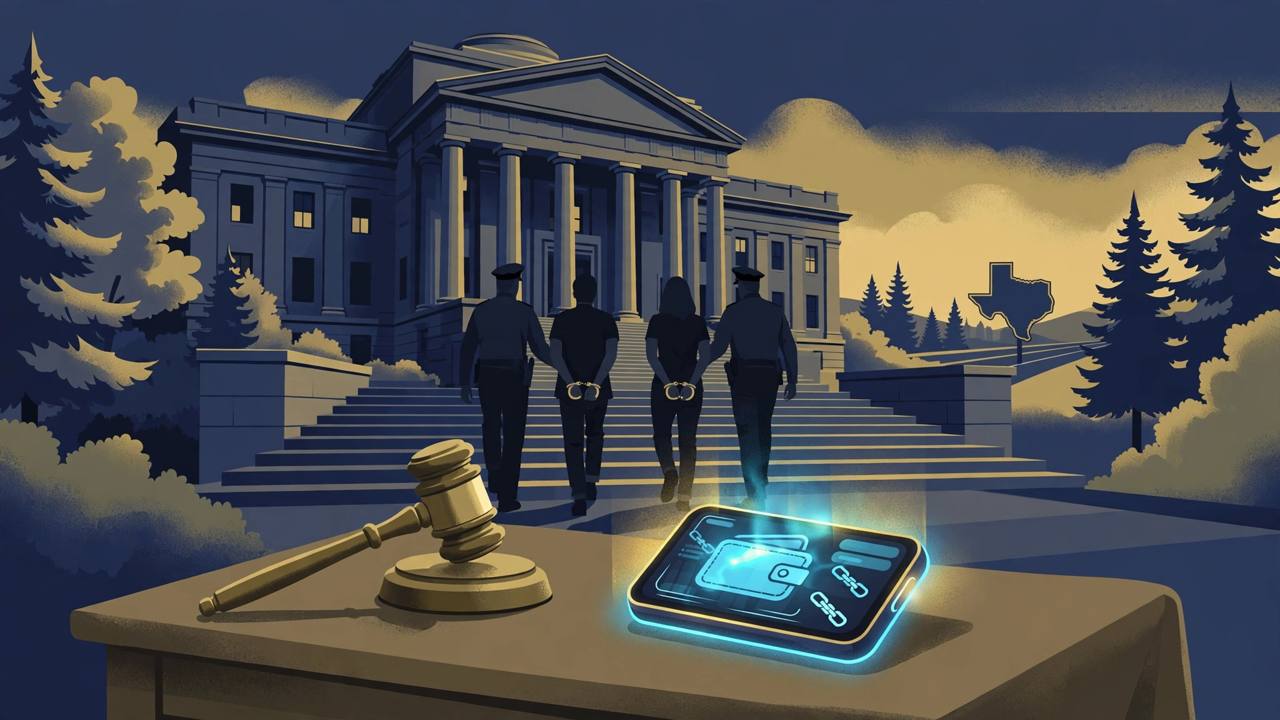
Two brothers from Waller, Texas, who travelled to Minnesota, held a family at gunpoint for more than nine hours and forced the transfer of more than $8 million in cryptocurrency have been sentenced to a combined 326 months in federal prison, the U.S. Attorney's Office for the District of Minnesota announced on October 29, 2026.
Raymond Christian Garcia was sentenced to 180 months — 15 years — and his brother Isiah Angelo Garcia to 186 months, or 15 years and six months. Both men were sentenced before U.S. District Judge Donovan W. Frank in St. Paul on October 29, 2026, after pleading guilty on June 18, 2026, according to the Justice Department.
Source: U.S. Department of Justice
What happened in Grant, Minnesota
According to court documents cited by prosecutors, the brothers travelled from Texas to Minnesota and, on September 19, 2025, forced their way into a family home in Grant, a small community in Washington County. They zip-tied the family, held them at gunpoint for over nine hours and demanded access to the main victim's cryptocurrency accounts.
When the first transfers did not produce the amount the brothers expected, they forced the victim to drive Isiah Garcia to the family's cabin in northern Minnesota. There, under threat, the victim was made to retrieve additional cryptocurrency storage devices — the hardware wallets where digital assets are kept offline — and transfer more funds. In total, the defendants compelled transfers of more than $8 million in cryptocurrency.
The ordeal ended when the victim's son managed to call 911. The brothers fled the area, but investigators identified them and they were later arrested near Houston, Texas, the Justice Department said.
What the officials said
"The Garcia brothers committed a brazen and calculated act of violence against the victim and his family. My office will continue to pursue those who use intimidation and threats to exploit victims, no matter where they flee," said United States Attorney Daniel N. Rosen.
FBI Minneapolis Field Office Special Agent in Charge Christopher D. Dotson said the brothers "violated the sanctity of a home, abducted a victim, terrorized a family at gunpoint for hours, and disrupted an entire community in a brazen act of violence and greed," adding that he hoped the sentence would be "an important step toward healing for the victims."
Background: a guilty plea in June, and the rise of 'wrench attacks'
The sentencing closes the court case that began with the brothers' guilty pleas on June 18, 2026. In the Justice Department's June announcement of those pleas, the brothers admitted their roles in the robbery and kidnapping; the charge they pleaded to, interference with commerce by robbery, carried a maximum of 20 years in prison, and reporting on the plea said they had agreed to pay more than $8 million in restitution.
Source: CoinMarketCap / DOJ plea announcement
Security experts describe crimes like this one as 'wrench attacks' — physical robberies in which criminals bypass all of cryptocurrency's digital security by simply threatening the person who holds the keys. Because hardware storage devices kept at home can be seized in person, cases like the Grant home invasion have become a warning to digital-asset holders everywhere: wealth that can be moved in minutes, under duress, is difficult to recover once it is gone.
The case crossed three states — planned in Texas, carried out in Minnesota, and ended with arrests near Houston — and it shows why federal agencies, not just local police, now handle violent cryptocurrency robberies. For Punjabi and other immigrant families in the U.S. who hold savings in digital assets, the lesson from investigators is blunt: never keep large holdings' access devices in an easily reached place at home, and treat any threat as a police matter immediately.
What happens next
With sentencing complete, both brothers now begin serving their federal prison terms — 15 years for Raymond Garcia and 15 and a half years for Isiah Garcia. The case was investigated by the FBI and the Washington County Sheriff's Office and prosecuted by Assistant United States Attorney Rebecca E. Kline. The victims' names have not been released by authorities, and the family has not made a public statement.