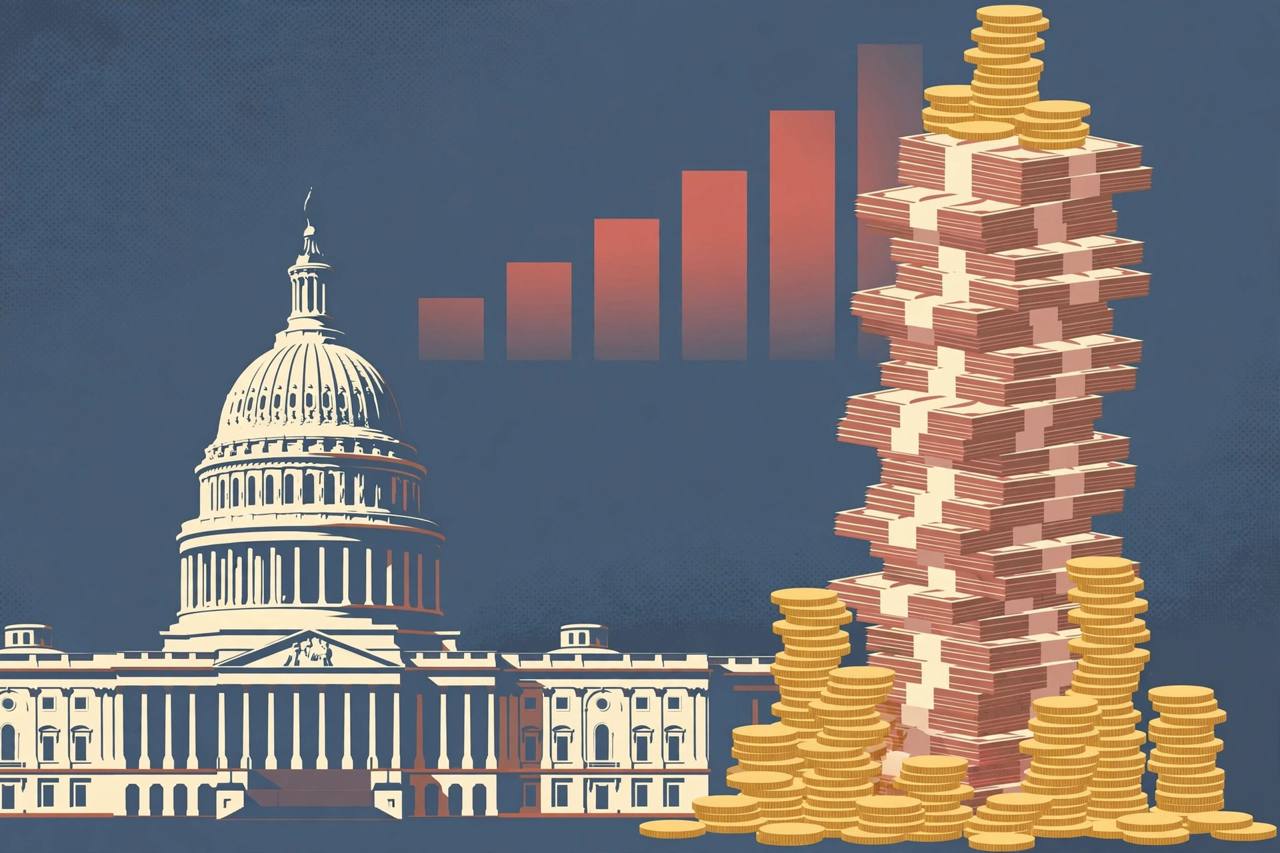
WASHINGTON — For the first time since 1946, the United States ended a fiscal year owing its public lenders more than the entire American economy produces in a year. Debt held by the public stood at $32.2 trillion on September 30, the close of fiscal 2026, equal to 100.03 percent of gross domestic product, The Wall Street Journal's Richard Rubin reported from government data — a figure The Fiscal Times named its 'Number of the Week' on Friday.
Source: The Fiscal Times
The milestone only became calculable this week. The Treasury Department had already reported on October 16 that the fiscal 2026 budget deficit totalled $1.992 trillion, or 6.2 percent of GDP. What was missing was the final size of the economy itself — and when the Commerce Department's Bureau of Economic Analysis published its advance estimate of third-quarter GDP on Thursday, the arithmetic settled: the debt ratio had crossed 100 percent at a fiscal year-end for the first time in 80 years.
The climb has been long and steep. The ratio stood at 99.4 percent a year earlier, at the end of fiscal 2025 — and at just 33.7 percent in 2000. It rose through successive crises, tax cuts and spending increases under administrations of both parties, briefly touching 100.2 percent at the end of this year's first quarter before settling just above the line at the fiscal close. The only higher reading in American history is the 106 percent recorded in 1946, when the country was paying off the cost of World War Two.
Interest now costs more than defence
The most concrete burden is the interest bill. Net interest costs reached $1.052 trillion in fiscal 2026, up 8.2 percent from $970 billion a year earlier — and interest now absorbs more of the federal budget than defence spending. The arithmetic is unforgiving: the Journal noted that if interest rates run just 0.1 percentage point above Congressional Budget Office projections, interest costs would rise by another $379 billion over 10 years. Add the roughly $8 trillion the government owes its own accounts, and total federal debt has already passed $40 trillion.
What is solid
- Debt held by the public was $32.2 trillion on September 30, 2026, equal to 100.03% of GDP, per government data reported by The Wall Street Journal.
- The Treasury put the fiscal 2026 deficit at $1.992 trillion (6.2% of GDP) on October 16, and net interest at $1.052 trillion, up 8.2% year on year.
- The Congressional Budget Office projects publicly held debt reaching about 120% of GDP by 2036 on current policies.
What is only claimed
- What the milestone means in practice: economists note the United States borrows in its own currency at rates the market still accepts, so 100% is a warning light, not a default trigger.
- How fast the burden grows from here depends on the Federal Reserve's rate path and on Congress — neither is settled, and the two parties blame opposite causes: spending growth versus tax cuts.
One deadline inside the numbers drew particular attention in the Journal's reporting: without congressional action, Social Security's finances would be exhausted in 2032, triggering automatic benefit cuts — a date now closer than the CBO's 2036 projection for debt to reach 120 percent of GDP. Neither figure is a forecast of collapse; both are measures of how little room for manoeuvre Washington has left itself.
Strong growth, heavy debt — two headlines at once
The debt milestone landed in the same news cycle as an economy performing better than expected. GDP grew at a 3.4 percent annualized rate in the July–September quarter, the Bureau of Economic Analysis said Thursday — above the 3.2 percent economists polled by Reuters had forecast, and well up from 2.2 percent in the second quarter. Consumer spending, which accounts for more than two-thirds of the economy, rose at a 3.8 percent pace, and heavy business investment in artificial intelligence — data centres and technology — provided the other main engine. It was the last major reading on the economy before Tuesday's midterm elections decide control of Congress.
Households, however, are feeling a squeeze the headline number hides. Prices rose 3.6 percent in the year to September on the Commerce Department's PCE measure — the Federal Reserve's preferred gauge, still well above its 2 percent target. The personal saving rate slipped to 3.8 percent in September from 4.1 percent in August, and after-inflation disposable income actually fell 0.3 percent in September. The Fed held its benchmark rate at 3.75 to 4 percent on Wednesday, and Chair Kevin Warsh said economic activity was 'expanding at a strong pace' while insisting 'it's our responsibility to get inflation down' — with traders putting the odds of a December rate hike above 80 percent.
The Commerce Department revises the third-quarter GDP estimate on November 25. The federal government is funded only through December 11 under a short-term continuing resolution, so a spending fight returns right after the midterms — alongside a Pentagon budget request of $1.5 trillion for fiscal 2027 that officials already expect to be trimmed toward $1.1 trillion, per Politico reporting cited by The Fiscal Times. The Federal Reserve's December meeting will decide whether borrowing costs rise again.
For Awaaz Punjab's readers in the United States — families running trucking businesses, buying homes and financing equipment on credit — the 100.03 percent figure matters less as a headline than through what it pushes on: a government borrowing this heavily competes for the same money households and businesses borrow, which helps keep interest rates higher for longer. With interest alone now costing Washington more than defence, every future budget — and every loan rate quoted to a trucker in Fresno or a family in Edison — is being written in the shadow of that $32.2 trillion.