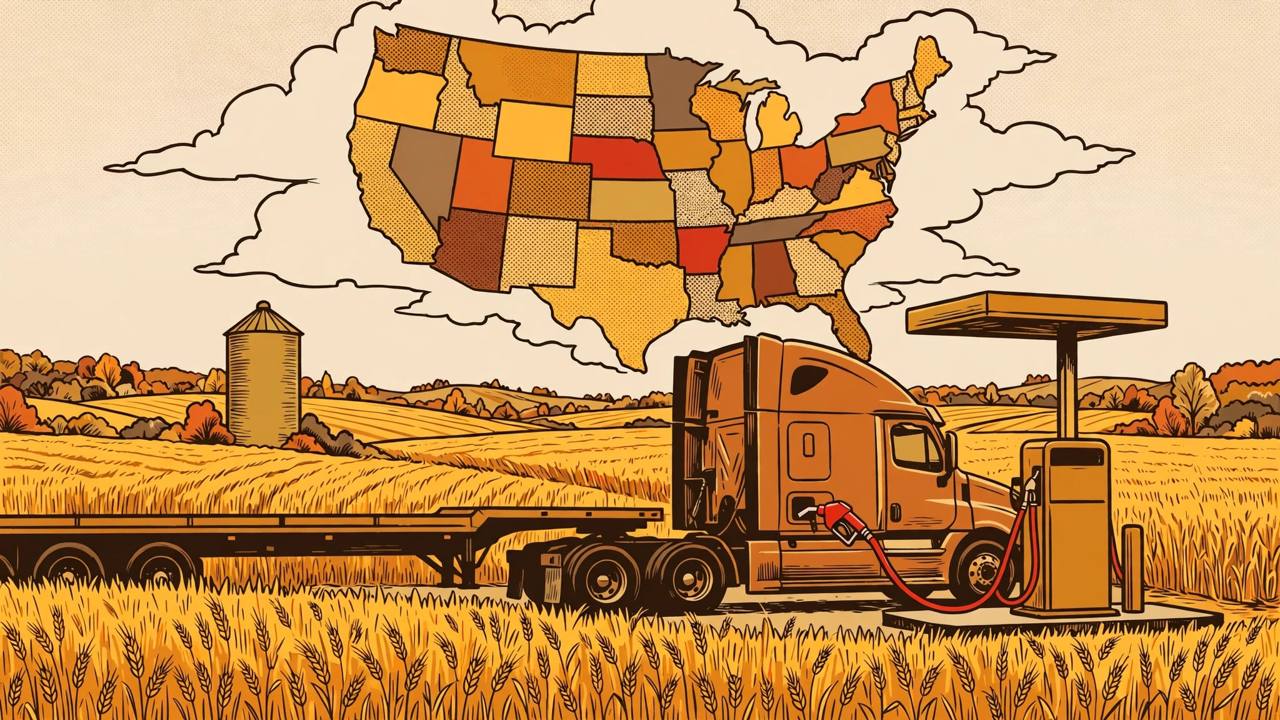
Thirty-one states have now enacted their own orders backing the federal waiver that lets farmers, ranchers and truckers run on red-dyed diesel on public highways, the U.S. Department of Agriculture says — and Agriculture Secretary Brooke Rollins has written to the remaining 19 governors urging them to do the same before the harvest season ends. The federal waiver took effect on October 5, suspending the national 24.4-cent-per-gallon diesel tax and federal penalties for on-highway use of dyed fuel, Land Line Media reported on Friday, October 30.
Source: Land Line Media, Oct. 30, 2026
“Savings are maximized when states take corresponding action to suspend certain penalties, modify enforcement practices or take other actions intended to reduce unnecessary burdens on agricultural producers and transportation operators with respect to dyed diesel,” Rollins wrote in the letter commending the governors who have already acted and asking the other 19 to follow. “Together we have an opportunity to provide our mutual constituents with real relief for the remainder of this harvest season and beyond.” In a post on X on October 29, Rollins said the combined federal and state relief could save more than $640 million, calling on the remaining governors: “Let's get this relief to the producers who keep America fed and moving.”
Source: Land Line Media / Secretary Brooke Rollins on X, Oct. 29, 2026
What red-dyed diesel is — and why this is unusual
Diesel sold for off-road use — on farms, at construction sites and for other non-highway work — is dyed red to mark it as tax-exempt, and using it in a truck on a public highway has normally drawn penalties, because highway fuel carries the taxes that pay for roads. The October 5 federal action temporarily flipped that rule during a period of extreme fuel prices: dyed diesel may now be used on-highway without federal penalties and without collection of the federal diesel tax. But federal action alone does not erase state penalties — which is why the state-by-state orders matter, and why the USDA says the savings are only “maximized” when a state takes the corresponding step of suspending its own penalties and adjusting enforcement.
The relief is not automatic everywhere: the federal waiver covers the 24.4-cent federal tax and federal penalties, but state penalties depend on your state having issued its own order — 31 have, 19 have not yet. The IRS has published an FAQ page on the relief covering tax records, filing returns, interstate travel and dyed biodiesel mixtures — the interstate-travel answers matter most for long-haul drivers crossing between states that have acted and states that have not.
The price pressure behind the waiver
The national diesel average was $6.32 per gallon, according to AAA, when the waiver was issued — and as of Friday, October 30, that average remained exactly the same, Land Line reported. FleetOwner's weekly trucking roundup put the national average on-highway diesel price at $6.35 per gallon on Energy Information Administration data, or $6.33 on AAA's figures, after an 8-cent weekly rise — two measures, one picture: diesel is holding above $6 a gallon deep into the harvest and freight season, squeezing owner-operators whose fuel is their single largest running cost. For Punjabi and other immigrant owner-operators running I-5, I-80 and I-40 corridors, a 24.4-cent federal saving per gallon — where their state has matched it — is real money on a 100-plus-gallon fill, but only if the paperwork and the state line are handled right.
Source: FleetOwner, Oct. 30, 2026
On the ground: Iowa's fuel-terminal queues
Relief on paper is meeting pressure at the pump. KCCI-TV in Des Moines recently reported that truck drivers in central Iowa are dealing with significant delays at fuel terminals, with high demand forcing the closure of some terminals in the state. Fuel, harvest and avian-flu emergency orders remain in effect in Iowa. The USDA said it will continue working with state leaders to support implementation and ensure farmers, ranchers and transportation operators have access to the relief available under federal and state law. The state-by-state rollout has been building for weeks — West Virginia, for example, earlier declared a 60-day fuel emergency letting trucks run on red-dyed diesel — and the 31-state tally announced this week marks the point where the exception has become the majority rule.
What happens next
The open question is whether the remaining 19 states act while the harvest-season relief window is still open, and whether the IRS guidance settles the practical questions drivers are asking — how to document dyed-fuel purchases, how returns are filed, and what happens on an interstate run that starts in a waiver state and ends in one that has not acted. The USDA's letter frames the relief as lasting “for the remainder of this harvest season and beyond,” but no end date for the federal waiver was stated in this week's reporting. Until diesel falls back from the $6-plus range, expect the waiver map — and the terminal queues in states like Iowa — to stay live issues for every trucker buying fuel this fall.