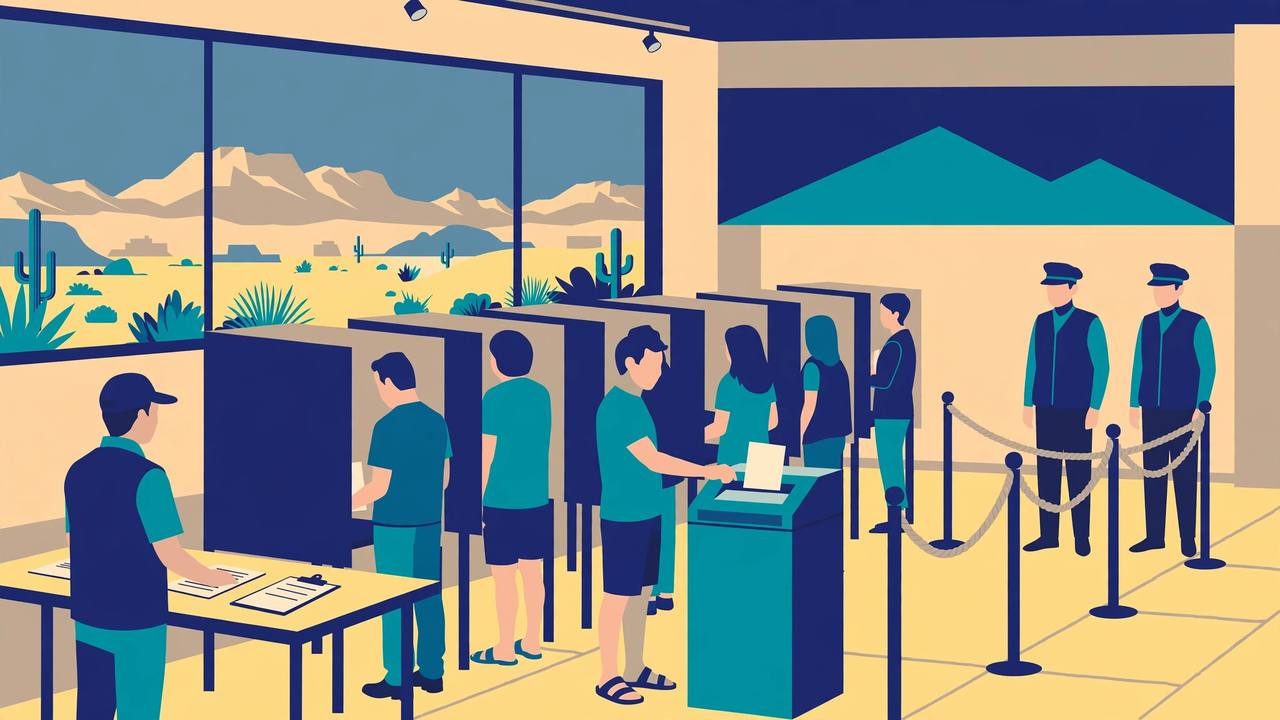
LAS VEGAS, Nevada — The U.S. Department of Justice will station election observers at polling sites in Clark County on Election Day, Tuesday, November 3, according to a letter the department sent to Nevada Secretary of State Cisco Aguilar's office, FOX5 Vegas reported on Thursday evening, October 29. The report did not name the specific polling locations where observers will be stationed.
Source: FOX5 Vegas via Vegas Daily Wire
Clark County is Nevada's most populous county — home to Las Vegas, Henderson, North Las Vegas and Boulder City — and its vote routinely decides statewide races in one of the country's most closely divided states. Nevada's early voting period runs from October 17 to October 30, and Election Day follows on Tuesday, November 3, with control of Congress at stake in the midterms.
What the observers can — and cannot — do
Under the rules described in the FOX5 report, observers must stay in a designated observer section at each voting site. From there they can watch voters check in, go into voting booths and feed ballots into scanners, but they may not interrupt the process. They must show up as individuals, with no sign of affiliation with any group.
Nevada's own observer rules, summarised in earlier state reporting, add the detail: any person may observe after signing an acknowledgement of the rules; observers may not speak with voters about their choices, use phones or computers inside the polling place, advocate for or against a candidate, challenge an election worker's decision or otherwise interfere with voting; and a county or city clerk may remove an observer who violates those conditions. Federal civil-rights enforcement remains a separate responsibility from the observer role itself.
Source: The American Quorum (Reuters background)
Aguilar: observers are welcome — law enforcement is a different matter
“Under Nevada law anyone can be an observer,” Aguilar said, as long as they follow the law, stay in the observer area and respect poll managers and poll workers. He drew a clear distinction between DOJ observers and federal law enforcement: he said he would not speculate on whether ICE or other federal agents might disrupt voting, but that any such disruption would violate state law. Registrars and poll managers would assess any situation at a site, with local law enforcement stepping in if needed.
Aguilar also described the state's Election Integrity Task Force, made up of the Secretary of State's office, the Governor's Office, the Attorney General's Office and local and state law enforcement. The group will monitor the state from a central location on Election Day and respond together to verified incidents.
The national backdrop: the largest DOJ monitor deployment in its history
The Clark County letter lands inside a much bigger national plan. Reuters reported on October 21 that the Justice Department plans to deploy about 1,000 monitors across all 50 states on Election Day — roughly triple the number in the last midterm election and the largest observation effort in the department's history. DOJ spokesperson Kiersten Pels said the monitors will be trained not to interfere with election processes and will focus on countering voter intimidation and protecting access. Department officials said priorities include areas with a history of voter-access issues and places with competitive races.
Source: Reuters via KWSN
States are preparing to watch the watchers. When DOJ staff monitored Minnesota's primary this summer, the state deployed about 40 state employees, working in pairs, to track the federal lawyers through two counties; Minnesota's secretary of state said the shadowing is likely to continue on November 3, and California has launched a similar program. In Nevada, Aguilar said earlier this month that local law enforcement will be trained to remove any DOJ monitor who breaks the rules or refuses to leave a polling place when asked. For decades the monitor program, run by the DOJ's Civil Rights Division, has documented problems such as polling places lacking Spanish-language ballots or disability access; Reuters reported the administration has reshaped that division, with a new focus on election fraud and voting by non-citizens.
Nothing changes about how you vote: check in, vote and scan your ballot as usual. Observers are there to watch, not to question voters, and they cannot stop anyone from voting. If you have a problem at a polling place, tell the poll manager on site. Official voting locations and hours are posted by the Clark County Election Department and the Nevada Secretary of State. Expect extra traffic and parking demand around vote centers on Tuesday, especially in the morning and after-work rush.
What happens next
Election Day is Tuesday, November 3. The Justice Department has not named the Clark County sites its observers will cover, and the practical test will come only if a dispute develops at a specific polling place. Separately, the U.S. Attorney's Office in Nevada set out an election-integrity plan on October 16 directing civil-rights complaints to the Justice Department's Civil Rights Division and potential criminal violations to the FBI. Nevada voters with questions about locations, mail ballots or registration should go to the state and county election offices.