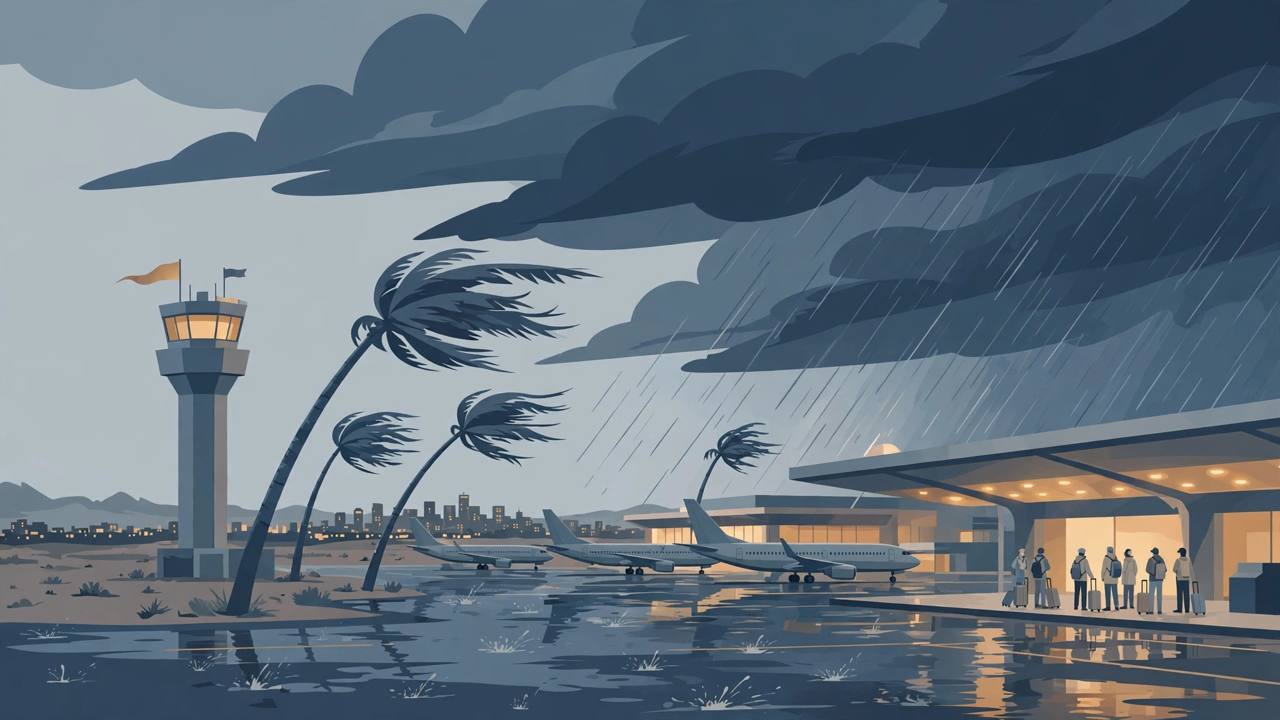
The Federal Aviation Administration stopped flights bound for Las Vegas on Sunday afternoon, November 1, after strong winds cut the number of planes Harry Reid International Airport could safely land. The ground stop took effect at about 1:20 p.m. Las Vegas time, holding Las Vegas-bound aircraft at their departure airports across the country while a line of severe thunderstorms swept Clark County. It was the fourth straight day of weather trouble at the airport, in a weekend that had already brought flash flooding to parts of the valley.
Source: The Contrail (FAA ground-stop timeline)
On the ground, the National Weather Service issued several severe thunderstorm warnings for the Las Vegas area on Sunday afternoon, including one covering central Clark County — Las Vegas, Henderson, North Las Vegas and Harry Reid International Airport itself, FOX5 reported. The warning cautioned about damaging wind gusts of up to 60 mph, large hail and torrential downpours, and officials urged people to shelter inside sturdy buildings, stay away from windows and hold off on travel until the storms passed.
Source: FOX5 Las Vegas via Vegas Daily Wire
By early evening the airport was moving again, but slowly. In its 5:52 p.m. Las Vegas-time update, The Contrail reported that flights headed to Las Vegas were departing their origin airports again after the ground stop, while departures from Harry Reid were averaging about 45 minutes late and arrivals close to an hour late — both still climbing as the evening rush built. About one in four Las Vegas flights was delayed on Sunday, though only four were cancelled. The FAA's National Airspace System snapshot at 7:08 p.m. Eastern on Sunday listed Las Vegas among eight of the 30 monitored major airports with active delays or ground stops, under a wind-related ground delay program averaging about 49 minutes.
A fourth straight day of airport trouble
Sunday's ground stop capped a stormy stretch that began on Thursday, October 29, when strong winds forced the FAA to put Las Vegas under a ground delay program until 11:59 p.m. Pacific; that afternoon, inbound flights were being held at their departure airports for an average of 2 hours and 21 minutes. On Friday, October 30, thunderstorms pushed Las Vegas departures to more than an hour late by the evening. Saturday was milder, with no ground stop at either Las Vegas or Phoenix, before Sunday's winds brought the disruption back.
The same storm system had a harder edge earlier in the weekend away from the airport. On Friday, heavy rain and hail flooded streets in parts of the Las Vegas valley; around 1 p.m. three swift-water rescues were reported in Henderson, NV Energy said more than 4,000 customers were without power by about 1:40 p.m., and lightning forced a ground stop at Harry Reid through at least 3 p.m. A flash flood warning also covered North Las Vegas and the northwest valley on Halloween night. The Las Vegas Review-Journal reported that October 2026 finished as the second-wettest October in the city's history.
Why wind alone can stop arrivals
Desert airports such as Las Vegas and Phoenix are built for sunshine, and their schedules assume it. Gusty winds force controllers to space arriving planes further apart, which cuts the number of flights the airport can land each hour; lightning near the field forces ground crews off the ramp, stopping loading, fueling and pushback. When an airport cannot handle its normal schedule, the FAA holds flights at their departure airports rather than letting them circle — which is why a storm in Las Vegas can delay a flight that has not yet left Chicago. The delays then cascade, because every late plane and crew is late for its next flight too.
Measured on the ground, Sunday's storm was more wind than rain at the airport: Harry Reid picked up about a quarter inch of rain, with heavier totals in other parts of the valley and in Mesquite, according to the FOX5 forecast update. Outflow winds gusted above 60 mph in the Spring Mountains and near 50 mph in North Las Vegas — gusts strong enough to make driving difficult for high-profile vehicles such as trucks and RVs on exposed desert roads, and to leave debris and standing water on valley streets after the cells passed.
Las Vegas was not alone. Phoenix Sky Harbor, the other big desert hub, steadied at about half an hour late by Sunday evening, but more than a third of its flights ran behind and 13 were cancelled; earlier in the day the FAA had put its average delays at 37 minutes and growing. Farther east, the FAA's Sunday snapshot showed a ground delay program averaging about 56 minutes for arrivals at Fort Lauderdale because of thunderstorms, and departure delays of about 30 minutes at Dallas Fort Worth because of low visibility, while 22 of the 30 monitored major airports — including Los Angeles, San Francisco, Denver and the New York airports — were running on time.
Check your flight in your airline's app before leaving for the airport — departure times can change even when a flight still shows as on time. US airlines do not owe compensation for weather delays, but if your flight is cancelled and you choose not to travel, you are entitled to a refund. Early-morning flights usually have the best chance of leaving on time after a disrupted day.
What happens next
The wet pattern is ending. Forecasters say drier air is moving back into Southern Nevada as the subtropical moisture pulls away and high pressure builds, with a cooler week ahead — the warmest day of the coming week is expected to be next Sunday, at about 73 degrees — and patchy fog possible Sunday night into Monday morning. Drivers are advised to watch for debris, standing water and dark traffic signals after the storms and to leave extra room in any morning fog, and never to drive through flooded roads. One caution for flyers elsewhere: as colder air moves in early this week, the same system could slow flights at Salt Lake City and Denver. And a small trap for travellers' clocks — standard time began at 2 a.m. Sunday in Las Vegas, while Phoenix does not observe daylight saving time, so Las Vegas is now an hour behind Phoenix.