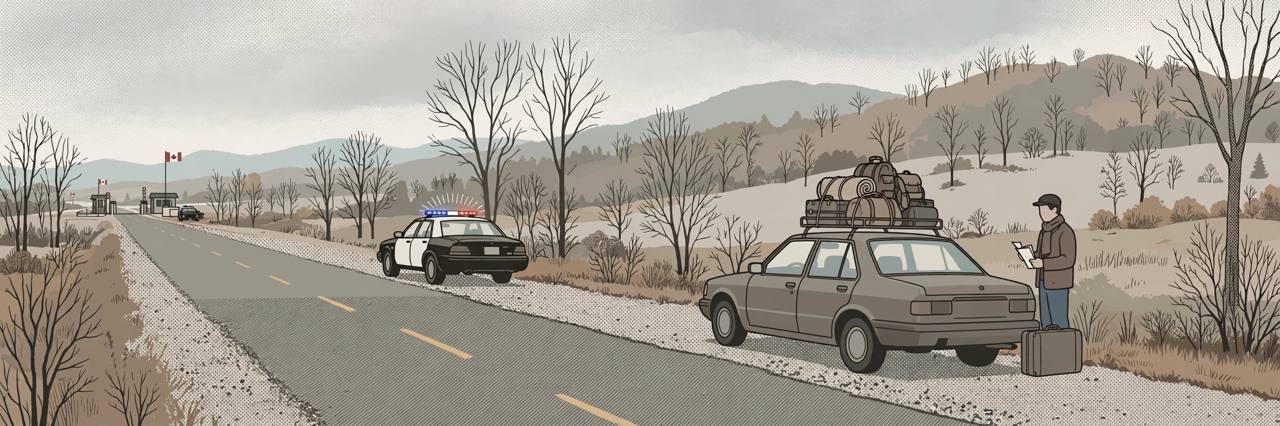
A 28-year-old man who was driving to Canada to start a new life — with his Canadian citizenship papers in his packed car — was stopped by police near Colebrook, New Hampshire, handed to U.S. Immigration and Customs Enforcement (ICE), and held for two nights before officers drove him to the Canadian border in Vermont on Friday morning, October 30, and released him into Canada, WMUR News 9 reported. The man, Jessie Laurel Tepler-Mujambere, is originally from Burundi and had lived with his adoptive family in Maine for the past decade.
Source: WMUR News 9 (New Hampshire), Oct 30, 2026
His adoptive mother is Denise Tepler, a state senator in Maine. She told News 9 her son's car was packed for the move when he set out: “His car was packed, completely packed, totally ready to go. He's like, I'm moving to Canada. I'm 28 years old now to start my life.” The stop happened on Wednesday, October 28, as he drove north through Colebrook, a small town in Coös County close to the Canadian border, according to a Particle News roundup of the coverage, which independently confirmed the Wednesday stop, the roughly two days in custody and the Friday release into Canada.
Source: Particle News roundup of Maine/New Hampshire coverage, Oct 30, 2026
Two accounts of the stop
The Department of Homeland Security (DHS) told News 9 that Tepler-Mujambere was pulled over for speeding and that officers determined he was illegally present in the United States. His family gives a different account of the stop itself: they said he was not told why he was pulled over. Both versions agree on what happened next — he was taken into ICE custody.
Source: WMUR News 9 (New Hampshire), Oct 30, 2026
In its statement to News 9, DHS set out its legal position in full: “Tepler-Mujambere first entered the United States at the Dulles International Airport on November 10, 2014, with permission to stay until May 5, 2015. Against our nation's laws, he overstayed his welcome and failed to depart once his legal permission expired.” A DHS spokesperson added: “A pending application does NOT confer legal status in the United States.” The department is encouraging people who are not in the United States legally to self-deport.
Source: WMUR News 9 (New Hampshire), Oct 30, 2026
The two-night custody route
According to his family, the detention became a two-day circuit of northern New England. From Colebrook he was driven to the Strafford County Jail in Dover, New Hampshire, where he spent the first night. The next morning he was brought down to Manchester, then back up to the Strafford County Jail in Dover for a second night. On Friday morning, his family said, officers drove him to the Canadian border in Vermont, where he was ultimately released. Particle's roundup likewise reported that an agent drove him to a border crossing and released him into Canada on Friday.
Source: WMUR News 9 (New Hampshire), Oct 30, 2026
His status on paper
Tepler-Mujambere had a pending asylum case in the United States, his family told News 9, and the federal government did not renew his work permit in June. In parallel, Canada had approved his citizenship in July — Particle's roundup puts the approval date at July 22 — but the citizenship paperwork and passport arrived only in the last week of October, days before he set out. Particle also reported that DHS says he asked for an incentivised voluntary departure to Canada while in custody. In other words, by the time of the stop he was, on paper, a Canadian citizen travelling to take up that citizenship — but, under the position DHS applies, his 2014 overstay and pending U.S. application left him illegally present in the United States until the moment he left it.
Source: Particle News roundup of Maine/New Hampshire coverage, Oct 30, 2026
Particle's roundup noted that Colebrook police operate under a 287(g) agreement — a federal programme under which trained local officers may question immigration status during ordinary policing and hand people over to ICE. Critics of the programme say it can turn a routine traffic stop into a federal immigration action; supporters say it helps local police cooperate with federal law. In this case, whatever the reason for the stop, it was the local-to-federal handover that put a man days from emigrating into a county jail for two nights.
Reaction: “a waste of taxpayer dollars”
Senator Denise Tepler called the situation a waste of time, energy and American taxpayer dollars. “He almost was in Canada, and he had his Canadian citizenship papers with him,” she said. “And yet they put him in jail for two nights. That means we're paying to house him and feed him for two nights.” His car, meanwhile, was towed to a New Hampshire garage, with a $150 towing fee and a $100-per-day storage fee, she said. Particle's roundup reported political pushback from U.S. Representative Chellie Pingree of Maine and others, who called the detention a waste of resources, and reported that DHS rejected claims of racial profiling in the case.
Source: WMUR News 9 (New Hampshire), Oct 30, 2026
Why this matters beyond one family
For immigrant families across the United States — including Punjabi families with cases moving through the system — the case underlines three practical facts that both sides of this story actually agree on. First, under the rule DHS states openly, a pending application does not by itself give legal status. Second, in towns whose police work under 287(g) agreements, an ordinary traffic stop can become an immigration custody case within hours. Third, a person's paperwork in another country — even approved citizenship, with documents in the car — does not stop U.S. enforcement before the border is crossed. Families in similar positions should take case-specific legal advice before travelling; this report is general information, not legal advice.
What happens next
Tepler-Mujambere is now in Canada, the destination he set out for on Wednesday — the move completed, in the end, in federal custody rather than in his own packed car. His car remains at a New Hampshire garage accruing the $100-a-day storage fee his mother described, until the family retrieves it. Neither WMUR nor the coverage rounded up by Particle reported any criminal charge against him arising from the stop, and DHS has not announced any further action in the case; what happens to his pending U.S. asylum application now that he has left the country was not addressed in the reporting.