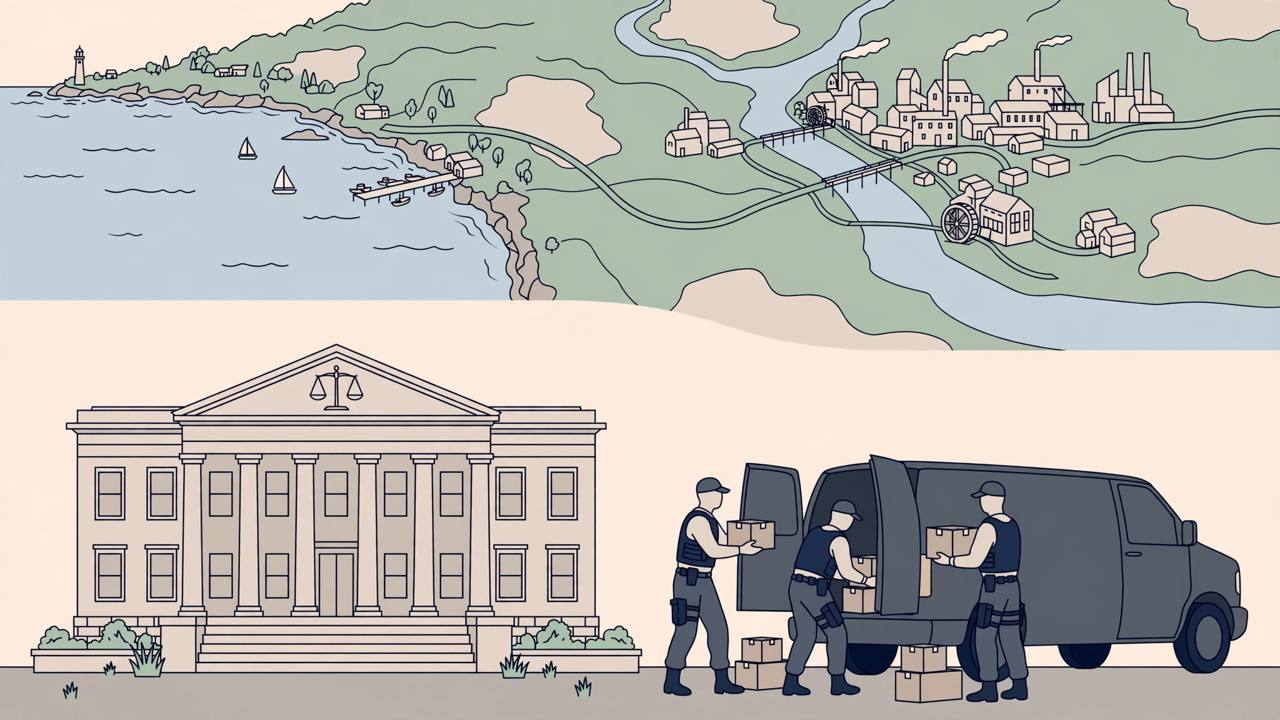
The leader was the last to fall, and he drew the longest sentence of the ring. Jose Luis Guerrero Nunez, 47, was sentenced on Thursday, October 29, in federal court in Concord, New Hampshire, to 100 months in federal prison — more than eight years — followed by three years of supervised release, for leading a Methuen, Massachusetts-based drug trafficking organisation that distributed large quantities of methamphetamine, cocaine and fentanyl across New Hampshire's Seacoast, the U.S. Attorney's Office for the District of New Hampshire announced. Chief U.S. District Judge Samantha Elliott imposed the sentence. Guerrero Nunez, a Dominican national whom the Justice Department described as being in the United States illegally, had previously pleaded guilty to conspiracy to distribute controlled substances, including methamphetamine, cocaine and fentanyl.
Source: U.S. Attorney's Office, District of New Hampshire, Oct. 30, 2026
How the ring worked — and how undercover officers mapped it
According to court documents and statements made in court, Guerrero Nunez served as a leader of an organisation based in Methuen, a Massachusetts mill city on the New Hampshire border, that moved large quantities of methamphetamine and fentanyl — and, in the conspiracy he admitted, cocaine as well — into New Hampshire's Seacoast, the state's short Atlantic coastline and the towns behind it. The case against him was built the slow way: in late 2023 and early 2024, he organised 10 controlled purchases of fentanyl and methamphetamine with people he believed were customers but who were in fact undercover law enforcement officers. He was also recorded by undercover officers making plans for larger distributions in the future — evidence, prosecutors said, that the 10 sales were not the whole of the operation but a window into its scale.
Source: U.S. Attorney's Office, District of New Hampshire, Oct. 30, 2026
The Drug Enforcement Administration led the investigation, with assistance from five local and state agencies that map the ring's own geography: the Seabrook, Hampton and Portsmouth police departments on the New Hampshire Seacoast, the Methuen Police Department at the organisation's Massachusetts base, and the New Hampshire State Police. Assistant U.S. Attorneys Matthew Vicinanzo and Yasir Sadat prosecuted the case in the District of New Hampshire.
Source: U.S. Attorney's Office, District of New Hampshire, Oct. 30, 2026
The road to 100 months: a guilty plea in February, a sentence in October
Guerrero Nunez pleaded guilty in federal court in February 2026 to one count of conspiracy to distribute controlled substances, the DEA and the U.S. Attorney's Office announced at the time — Methuen-based, distributing large quantities of methamphetamine and fentanyl in the Seacoast, built on the same controlled purchases. At the plea stage, three of his co-conspirators had already pleaded guilty and been sentenced, and charges against the fourth were still pending. Thursday's sentencing in Concord closed his own case: 100 months is the longest term imposed on any member of the organisation whose sentences have been announced.
Source: DEA / U.S. Attorney's Office, Feb. 9, 2026
Four co-conspirators, four shorter sentences
The rest of the ring was dealt with first, and their outcomes show how the court ranked Guerrero Nunez's role. Juan Carlos De Los Santos Romero, a Dominican national who previously lived in Massachusetts, was sentenced on July 13 to 30 months in federal prison and three years of supervised release by the same judge, Chief Judge Elliott, after pleading guilty to conspiracy and to distribution of methamphetamine and fentanyl; prosecutors said he would be removed from the United States after his prison term. Carlos Alejandro Chevalier Santos received three years in federal prison, and Eddy Mendez Carmona was sentenced in January to 28 months and three years of supervised release. Luis Guerrero Cabral, the fourth co-conspirator named by the Justice Department, has also already been prosecuted and sentenced, the department said in Thursday's announcement. Against those terms — 28, 30 and 36 months — the leader's 100 months stands out as the court's verdict on who ran the operation.
Source: Granite State Times, July 13, 2026
“The defendant led an organization that trafficked large quantities of methamphetamine, cocaine and fentanyl into New Hampshire and will now be spending significant time behind bars,” said U.S. Attorney Erin Creegan. “We will continue to work with our state, local and federal law enforcement partners to identify, prosecute and disrupt the illicit drug trade and criminal networks infiltrating our state with these dangerous substances.” Jarod Forget, Special Agent in Charge of the DEA's New England Field Division, said the organisation “flooded communities along New Hampshire's Seacoast with dangerous quantities of methamphetamine, cocaine, and fentanyl, putting countless lives at risk,” and that the sentence of more than eight years “sends a clear message that those who profit from distributing these deadly drugs will be held accountable.”
Source: U.S. Attorney's Office, District of New Hampshire, Oct. 30, 2026
Why a Seacoast drug case matters beyond two small states
The geography of this case is the geography of the Northeast's drug trade in miniature. Methuen sits in Massachusetts' Merrimack Valley, minutes from the New Hampshire line; the Seacoast towns where its police departments helped the DEA — Seabrook, Hampton, Portsmouth — lie along the Interstate 95 corridor that carries traffic, legal and illegal, up the coast. Fentanyl and methamphetamine moving from a Massachusetts base into smaller New Hampshire coastal communities is a pattern federal and local agencies in New England say they confront repeatedly, which is why a case built on 10 undercover buys drew five police departments, a state police force and the DEA. The Justice Department said the prosecution is part of Operation Take Back America, its nationwide initiative aimed at cartels and transnational criminal organisations — the department's own framing of how it connects a Seacoast trafficking ring to its wider enforcement campaign.
Source: U.S. Attorney's Office, District of New Hampshire, Oct. 30, 2026
New Hampshire's Eagle-Tribune, the Merrimack Valley's regional paper, independently reported the same outcome on October 30: the leader of the Methuen-based trafficking organisation was sentenced Thursday to more than eight years in federal prison, after his earlier guilty plea to conspiracy to distribute controlled substances including methamphetamine, cocaine and fentanyl.
What happens next
With Thursday's sentence, every member of the five-man organisation named by prosecutors has now been prosecuted and sentenced, and the Methuen-to-Seacoast pipeline described in court is, as a court case, complete. Guerrero Nunez now begins a 100-month federal term; the three years of supervised release that follow mean his conduct will remain under federal supervision into the next decade. Whether the undercover recordings of 'larger distributions in the future' lead to any further cases is not something prosecutors have announced — the sentencing release names no further defendants and no pending charges in the matter. For the Seacoast departments that worked the case, the stated mission continues in Creegan's words: to identify, prosecute and disrupt the networks still moving fentanyl and methamphetamine into New Hampshire.