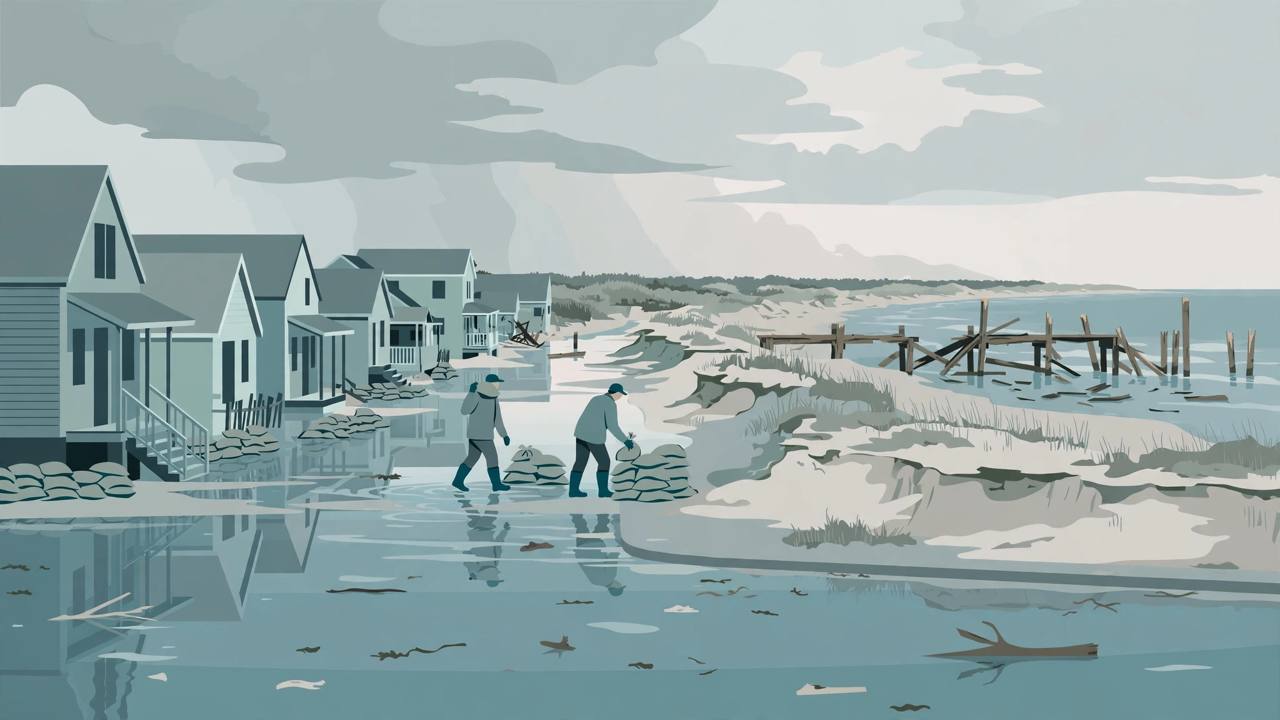
TRENTON, New Jersey — Governor Mikie Sherrill has formally asked President Donald Trump to declare a major disaster in three Jersey Shore counties, in a letter sent on Monday, October 26, seeking federal help for communities still repairing damage from the unusually severe nor'easter that struck New Jersey in late September. The request covers Monmouth, Atlantic and Cape May counties, the Governor's Office said in a statement released on October 27.
Source: Office of the Governor of New Jersey, via EIN Presswire
If the President grants a major disaster declaration, the state and the affected counties could pursue FEMA Public Assistance grants to reimburse storm-related costs, and the request also seeks Hazard Mitigation Grant Program funding for projects that strengthen communities against future storms, the Governor's Office said. A separate development followed on Tuesday, October 27: Rep. Frank Pallone led members of New Jersey's House delegation in their own letter to President Trump urging him to approve the Governor's request, according to the delegation's press release.
Source: ROI-NJ
What the September nor'easter did to the Shore
The storm swept through New Jersey over the last weekend of September and into the following Monday, bringing significant coastal flooding, power outages and high-tide risks, ROI-NJ reported. Atlantic City and surrounding shore towns saw two to three feet of floodwater sweep through homes and vehicles, with major dune loss reported on the beaches. Surf City had street flooding and some homes were inundated; Manasquan also reported flooded roads; and in Sea Bright, officials encouraged voluntary evacuations in low-lying areas.
Anticipating the worst, Governor Sherrill declared a State of Emergency on September 25 in eight counties — Atlantic, Burlington, Cape May, Cumberland, Middlesex, Monmouth, Ocean and Salem — and the order was lifted on September 29, ROI-NJ reported. The state's Department of Environmental Protection, through its Office of Coastal Engineering, later assessed that while many beaches withstood the storm, it left heavily sloped erosion, exposed groins — the coastal protection structures built perpendicular to beaches — and more frequent wave run-up reaching upper beaches, seawalls and dunes, according to the Governor's Office.
“We are working to ensure our coastal communities have the resources they need to recover from the September Nor'easter,” Governor Sherrill said. “New Jersey sends billions more in federal tax dollars to Washington than we receive in return, and now we hope the Administration will do its part so these communities can rebuild. I thank OEM and our local and county partners for moving quickly to document the damage and complete the assessments needed to pursue federal assistance.” — Office of the Governor, October 27
Why the damage figures matter: FEMA's threshold test
A major disaster declaration is not automatic sympathy money; it turns on documented damage measured against FEMA's per-capita indicator, a benchmark scaled to each county's population. All three counties greatly exceeded their indicators — by nearly three times in Monmouth County and up to thirty times in Cape May County — the Governor's Office said. Together the FEMA-validated preliminary damage across the three counties totals $26,976,037, roughly $27 million (yaani about Rs 239 crore). Rep. Pallone's delegation release put the figure at nearly $27 million in damage, including flooding, erosion, and damage to homes, businesses, piers, bulkheads and other infrastructure.
The Sherrill administration had already gone to Washington once over this storm. Last week it separately requested federal assistance under Public Law 84-99 to repair eligible U.S. Army Corps of Engineers projects damaged by the nor'easter. The Governor's Office said FEMA Public Assistance would cover the damaged areas of the coast that are not under Army Corps authority — the two requests are designed to fit together rather than overlap.
What is solid
- Governor Sherrill sent a letter on Oct 26 asking President Trump for a major disaster declaration for Monmouth, Atlantic and Cape May counties
- FEMA-validated preliminary damage: Cape May $13,779,935; Monmouth $8,469,403; Atlantic $4,726,699
- A State of Emergency ran Sept 25–29 across eight counties including Middlesex
- Rep. Frank Pallone led a House delegation letter on Oct 27 urging approval
What is only claimed
- Whether the President will grant the declaration — no decision had been announced when these reports were published
- Final repair costs — the figures are FEMA-validated preliminary assessments and can change as full assessments are completed
What this means for New Jersey's diaspora communities
New Jersey is one of the largest Punjabi diaspora states in the US — Middlesex County, home to Edison and its large South Asian population, was itself under the September State of Emergency, though it is not one of the three counties in the federal declaration request. The link for diaspora families is practical rather than direct: shore towns employ thousands of immigrant workers in hospitality, restaurants and small businesses, Punjabi families own homes and businesses along and near the coast, and every dollar of federal reimbursement is a dollar shore municipalities do not have to raise locally to rebuild boardwalks, roads, piers and flood defences before the next storm season.
What happens next
The decision now sits with the White House, acting on FEMA's recommendation process. If the declaration is granted, the three counties and the state can begin drawing Public Assistance reimbursements for eligible cleanup and repair costs and apply for hazard-mitigation money for projects such as dune rebuilding and flood protection. If it is denied, New Jersey can appeal with additional documentation. No timeline for the President's decision was announced alongside the request, and neither the Governor's Office statement nor the delegation's letter reported any response from the administration as of October 27.