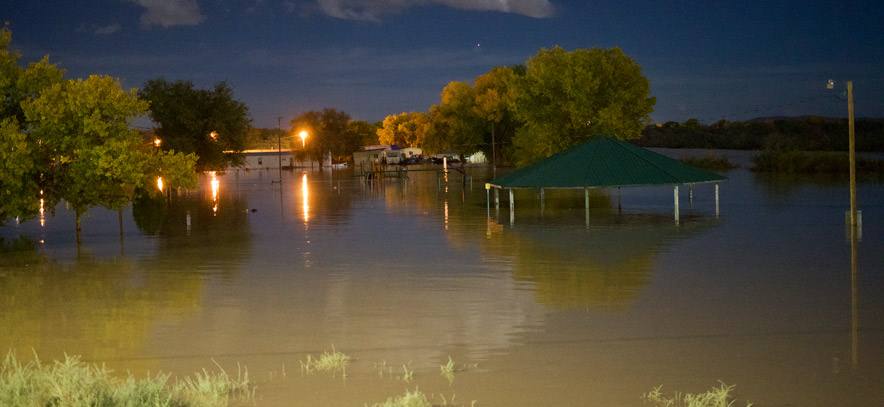
SHIPROCK, New Mexico — Untreated sewage has entered the flooded San Juan River, Navajo Nation officials said on Saturday, October 24, warning that contamination could remain in the mud and residue long after the water recedes. "The water in the river right now is contaminated," Navajo Nation Police Deputy Chief Donnie Kee said at an evening debrief in Shiprock, according to the Navajo Times. "Sewage plants in Bloomfield, Farmington, and Shiprock have been impacted and sewage has been released into the water." Kee advised residents to stay out of the river and wash thoroughly if they came into contact with the water.
Source: Navajo Times (republished by Bytes Europe)
At the Navajo Nation's October 24 incident-command briefing in Shiprock, Navajo Tribal Utility Authority (NTUA) Shiprock district manager Wilfred Franklin Jr. likewise reported that wastewater facilities and holding ponds in Farmington and Bloomfield were damaged by flooding, resulting in sewage releases into the San Juan River, the Gallup Sun reported. NTUA has not yet determined the volume released; Franklin noted the holding ponds can store up to one million gallons per day.
Source: Gallup Sun Weekly — incident command briefing, Oct. 24-25
In Shiprock itself, the NTUA plant supervisor, James Fitzhugh Jr., told the Navajo Times the plant — which normally treats about one million gallons in 24 hours — was put into bypass mode at 11:30 on Friday, diverting wastewater into a holding pond. "Now that holding pond is completely compromised," he said. Neither Navajo Nation nor county officials had an estimate of the amount of sewage released.
The accounts differ on the New Mexico county side. San Juan County spokesman Devin Neeley said Saturday night that sewer systems on the county side were operating again after floodwater inundated Bloomfield's treatment plant, and that Farmington's plant never shut down, although some of its lift stations had problems; Farmington public works officials had earlier reported two lift stations shut off and some neighbourhoods evacuated. Awaaz Punjab is presenting both accounts as officials gave them; what is agreed is that sewage reached the river and the released amount is unknown.
Health officials urged caution beyond the river itself. Brad Greenberg, medical director of emergency preparedness at San Juan Regional Medical Center, said floodwater can contain sewage, animal waste, fuel, pesticides and household chemicals, and that safety cannot be judged by looking at or smelling the water; anyone exposed should remove wet clothing, wash with soap and clean water and check that tetanus vaccinations are current. Navajo EMS field operations manager Sylvester Nez advised livestock owners to give animals windmill or hauled water instead of river water, and not to butcher animals that have been drinking from the river. NTUA said its treated drinking water remained safe, with no boil order planned; Farmington shut off its reservoir intakes.
Separately, NTUA reported on Saturday evening, October 24, that flooding had also caused a sewage spill in Kayenta, Arizona, where untreated wastewater entered a wash south of the Kayenta Unified School District, near the community's wastewater treatment facility, the Navajo Times reported. The utility warned residents downstream to avoid contact with the affected wash and keep pets and livestock away.
The Shiprock Bridge on U.S. Highway 64, closed at about 3 a.m. Saturday, had by Saturday evening reopened to alternating groups of 10 vehicles with emergency vehicles given priority; crews found cracks in two bridge pillars, although officials said the cracks may have existed before the flooding. The National Weather Service's October 25 bulletin maintained a flood warning along the San Juan River between Four Corners and Mexican Hat through 6 a.m. MDT on Tuesday, October 27, including Aneth, Montezuma Creek and Bluff, according to the Range Report's October 26 morning brief, which also reported livestock assistance — hay, kennels and vaccines — through Incident Command at 928-730-8365.