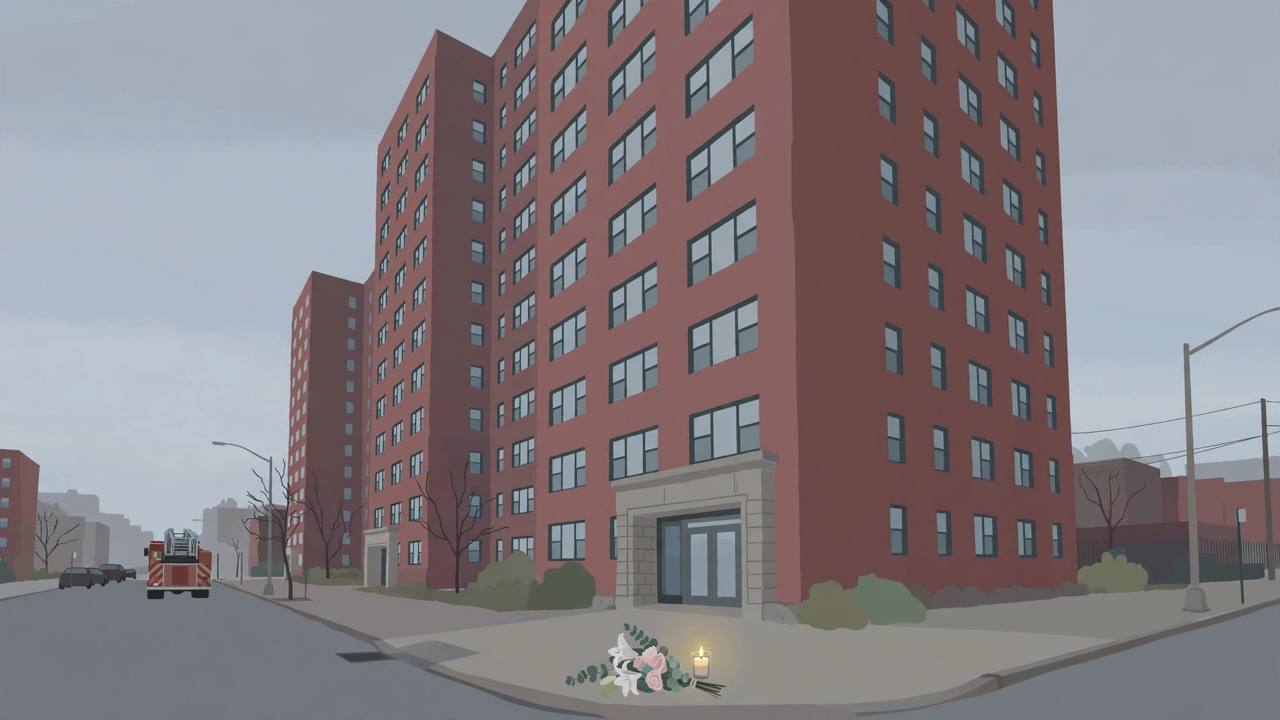
The death toll from the e-bike battery fire at the Patterson Houses in the Bronx has risen to four. Three more members of the same family — two teenage boys, aged 15 and 16, and a 33-year-old woman, the mother of the 16-year-old — died on Friday, October 30, from injuries they suffered in the fire early on Wednesday, October 28, according to CBS New York, NY1 and ABC7, citing police and fire officials. Awaaz Punjab first reported this fire on October 29, when an 11-year-old boy had died and four relatives were being treated in critical condition; three of those four have now died, and the family's only survivor, a 37-year-old man, the father of two of the boys, remains in hospital. In line with Awaaz Punjab policy, this report does not name the children who died.
Source: THE CITY, Oct. 30 update, citing CBS New York, NY1 and ABC7
What happened on the night of the fire
The New York City Fire Department (FDNY) received the call at about 12:50 a.m. on Wednesday, October 28, for a fire in an 11th-floor apartment at 320 Morris Avenue, in the Mott Haven section of the Bronx — an apartment in the Patterson Houses, a public housing development run by the New York City Housing Authority (NYCHA). Mayor Zohran Mamdani, speaking at a news conference that morning, said firefighters responded within four minutes to the all-hands fire and brought it under control by about 2 a.m. Fire Commissioner Lillian Bonsignore said the fire started in the kitchen, where an e-bike sat in the path to the exit door. Five people were rescued from the apartment; two firefighters suffered minor injuries while fighting the blaze, the FDNY said.
Source: Mayor Mamdani and FDNY Commissioner Bonsignore, Oct. 28 news conference
Investigators say the device — described by officials as an e-bike or e-scooter — was charging near the apartment's front door in the kitchen, and the flames blocked the family's only exit. Firefighters had to force the apartment door open and crawl past the flames to search inside, fire officials said, and one victim was found directly behind the door. The 11-year-old boy died after the fire on Wednesday; his two teenage brothers and the 33-year-old woman died two days later, on Friday. Reports differ on the survivor's exact condition: NY1 reported the 37-year-old man was in stable condition, while NBC New York said the FDNY described him as critical. What is agreed is that he is the family's only survivor and remains hospitalised.
Source: THE CITY update; Particle News summary of FDNY and police reports, Oct. 30-31
The rules NYCHA chose — and how little they have been enforced
The Patterson fire has put NYCHA's battery policy itself under scrutiny. THE CITY reported on Friday that after several fatal fires in 2023, the housing authority weighed banning e-bikes from its property altogether, but backed off after objections that many residents depend on the bikes for work — delivery riders among them use the machines to earn a living. The compromise was a set of charging rules: each household may charge only one battery at a time; batteries must be safety-certified; charging is banned in front of an entrance door or anywhere that could block an escape route; and an adult aged 18 or older must be awake while a battery charges. Breaking the rules is a lease violation.
Source: THE CITY, Oct. 30 — NYCHA charging rules
Enforcement, however, has been minimal, THE CITY found. NYCHA told the outlet it has started only three termination-of-tenancy cases over the charging rules. Battery charging does not appear on the authority's annual apartment inspection form, nor on the 'Five Alive' checklist its workers fill out during repairs; staff are instead told to report problems verbally to a supervisor, who then talks to the tenant. NYCHA also noted that the Patterson apartment had a routine maintenance check in March, and staff did not see improper charging at that time. Since the rules took effect, NYCHA has counted 53 e-bike battery fires in its properties — 13 in 2024, the first year of the rules, and 22 so far in 2026.
Source: THE CITY, Oct. 30 — enforcement record and NYCHA fire counts
What officials said — and what the authority promises now
NYCHA chief executive Lisa Bova-Hiatt told reporters that charging a battery at an entryway is a lease violation, but that the authority's main goal is to keep people housed, THE CITY reported. The authority said it will provide relocation services to the family and repair the damaged apartments, and that it mails the FDNY's battery-safety bulletin to every household each year. City officials have also pledged building checks, safety outreach and a review of the charging rules after this fire, according to summaries of official statements. Mayor Mamdani, who called the first child's death heartbreaking on Wednesday, said the FDNY would conduct a thorough investigation, as it does after every fire.
Source: THE CITY, Oct. 30; Mayor Mamdani, Oct. 28 news conference
Background: a citywide battery-fire problem that is still growing
The Patterson deaths land on top of a citywide trend the FDNY has been warning about for several years. Lithium-ion batteries have caused 401 fires in New York City so far this year, with 74 injuries and six deaths — figures Commissioner Bonsignore gave at Wednesday's news conference, before the Patterson family's deaths are added to the toll — compared with 292 fires, 51 injuries and one death last year. Fire officials say damaged or uncertified lithium-ion cells can enter 'thermal runaway,' igniting suddenly and spreading fire within seconds, which is why a battery charging beside a door can turn an apartment into a trap before a family can react. It is also why officials say the question is no longer only how residents charge, but whether safe charging space exists at all in dense public housing: regulated charging options and pilot charging sites are now being considered, according to reporting on the official response.
Source: FDNY Commissioner Bonsignore, Oct. 28; Particle News, Oct. 30-31
Charge and store devices and batteries outside when possible. Never let a device or battery block a door, exit or window. Do not charge while you are asleep or out of the room. Buy batteries certified by a national testing laboratory such as UL, use the manufacturer's charger, and stop using any battery that is leaking, damaged or smoking. (FDNY Commissioner Lillian Bonsignore, Oct. 28)
Why this reaches far beyond one Bronx building
For working families across New York — including the city's Punjabi and South Asian delivery riders, for whom an e-bike is often the tool that earns the day's wages — the Patterson fire states the dilemma in its starkest form. The bike is income; the battery, charged overnight beside the only door because the apartment has no other space, can become the fire that seals that door. NYCHA's own numbers show the risk is not falling: battery fires in its buildings have risen from 13 in 2024 to 22 already this year, even under the charging rules. Until public housing offers a safe place to charge, officials and advocates agree the same choice — work or safety — will be made in thousands of small apartments every night.
What happens next
The FDNY's investigation into the fire's exact sequence continues, and the department's citywide battery-fire tally will be updated to include the four Patterson deaths. NYCHA says relocation help for the surviving family member and repairs to the damaged apartments are under way, alongside the pledged building checks and safety outreach. The larger decision now sits with the city and the housing authority: whether the charging rules — one certified battery at a time, never blocking an exit, never while asleep — are enforced, rewritten, or replaced with an outright ban or with supervised charging facilities, a debate THE CITY's reporting shows has been running since the fatal fires of 2023 without a settled answer. Awaaz Punjab will update this story when the FDNY investigation findings and NYCHA's review are announced.