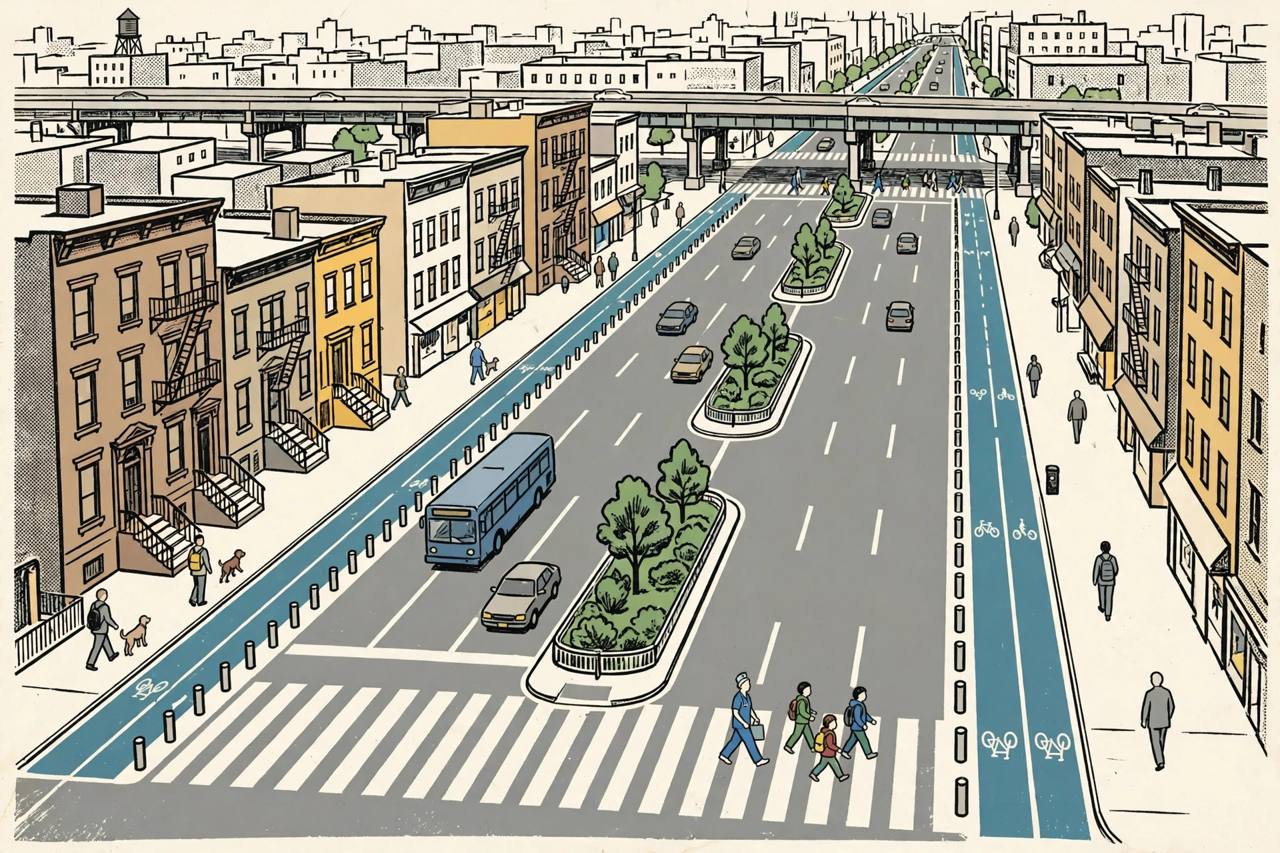
Nearly two months after a nurse was killed by a hit-and-run driver on one of Brooklyn's most dangerous roads, Mayor Zohran Mamdani announced on Wednesday, October 28, 2026, that the New York City Department of Transportation will overhaul a 2.1-mile stretch of Third Avenue in Sunset Park, from 62nd Street to 20th Street, with pedestrian islands, improved intersections and protected bike lanes. The plan answers years of calls from Sunset Park residents for safety improvements after multiple fatal crashes — demands that failed to move forward under former Mayor Eric Adams.
Source: 6sqft
"Too many New Yorkers know someone who never made it home. I am tired of learning the names of New Yorkers only after they were killed in preventable crashes," Mamdani said at Wednesday's press conference, standing on a road where, he said, "traffic screams past pedestrians and people are frankly afraid to cross it." He recalled the words of a woman who saw the crash that took nurse Jiayi Zheng's life: "I feel so bad. I can't take it anymore."
Source: Streetsblog NYC
What will change on the avenue
Third Avenue currently carries six to eight lanes of vehicle traffic, with parking lanes on both sides. Under the redesign, the roadway will be reduced to four car lanes, with a barrier-protected bike lane added in each direction; the parking lanes on both sides will remain. New pedestrian islands and curb extensions at intersections will make crossing safer. In some sections, including between 32nd and 37th Streets, the avenue is roughly 150 feet wide — about half the length of a football field — and Mamdani said the redesign will cut that crossing distance by up to half, using pedestrian islands as well as sidewalk and median extensions.
The work will be phased. The first phase, starting next year, targets the corridor's most dangerous section, between 62nd and 43rd Streets. It will also add a two-way, parking-protected bike lane on 60th Street between Second and Fourth Avenues, connecting a gap between protected bike lanes and improving safety near two local schools. DOT officials say work on the remaining stretch, from 43rd to 20th Streets, will begin in 2028.
A decade of deaths
Over the last decade, 17 people have been killed in crashes along this stretch of Third Avenue, more than half of them pedestrians or cyclists, according to figures reported by Gothamist. In 2025, two elderly pedestrians were killed by hit-and-run drivers. In 2020, Clara Kang, a nurse at NYU Langone, was killed by a motorcyclist while riding her bike on the avenue. Officials responded at the time by lowering the roadway's speed limit to 25 mph, but no broader redesign followed: the DOT under Adams presented the local community board with several redesign plans, yet the administration never moved forward with any of them.
Two months ago, another fatal hit-and-run killed Jiayi Zheng, also a nurse at NYU Langone, reigniting calls for an urgent redesign and putting pressure on Mamdani. The driver responsible for Zheng's death has not been found, and no arrests have been made.
The community push behind Wednesday's announcement
Earlier this month, more than 270 Sunset Park residents signed a public letter demanding immediate safety improvements and a timeline for the long-delayed project, according to Patch. On October 18, community members and elected officials held a "safety walk" from Martin Luther Playground to 60th Street, calling for better lighting, high-visibility crosswalks and curb extensions. Council Member Alexa Avilés said Third Avenue was once the "heart" of Sunset Park, and traced growing safety fears to the construction of the Gowanus Expressway under Robert Moses beginning in the late 1930s. "Since the implementation of this infrastructure, for decades, Third Avenue has been a source of tremendous fear and grief in our community," Avilés said. "We have experienced devastating heartbreak and traffic violence, including the loss of so many community members." She added that the plan takes local business owners' input into account — businesses along the corridor had previously raised concerns about a protected bike lane in front of their storefronts — and said: "We know that these changes will balance safety, access, and community needs."
Part of Vision Zero Reimagined
Mamdani said the project complements his administration's Vision Zero Reimagined plan, released last month, which builds on the original 2014 initiative's goal of eliminating traffic deaths and serious injuries and outlines 100 policy goals for the next decade. "This work is part of our larger commitment to building a New York City where traffic deaths are no longer part of daily life," Mamdani said. "Where dangerous drivers are no longer allowed to speed with impunity. Where the same business-as-usual approach that has killed too many of our fellow New Yorkers is no longer treated as normal." Third Avenue is the latest Adams-era project the new administration has revived, after redesigns of Greenpoint's McGuinness Boulevard, Manhattan's Madison Avenue and Astoria's 31st Street.
What happens next
Construction on the southern, most dangerous stretch begins next year, with the northern section following from 2028. For the families, nurses, schoolchildren and shopkeepers who cross Third Avenue every day — and for the drivers and delivery and truck crews who run the corridor under the Gowanus Expressway — the permanent change to plan for is a four-lane avenue with protected space for cycling and far shorter, island-broken crossings. Residents who campaigned for the redesign for years will be watching whether the timeline announced on Wednesday holds, after earlier plans presented under the previous administration went nowhere.