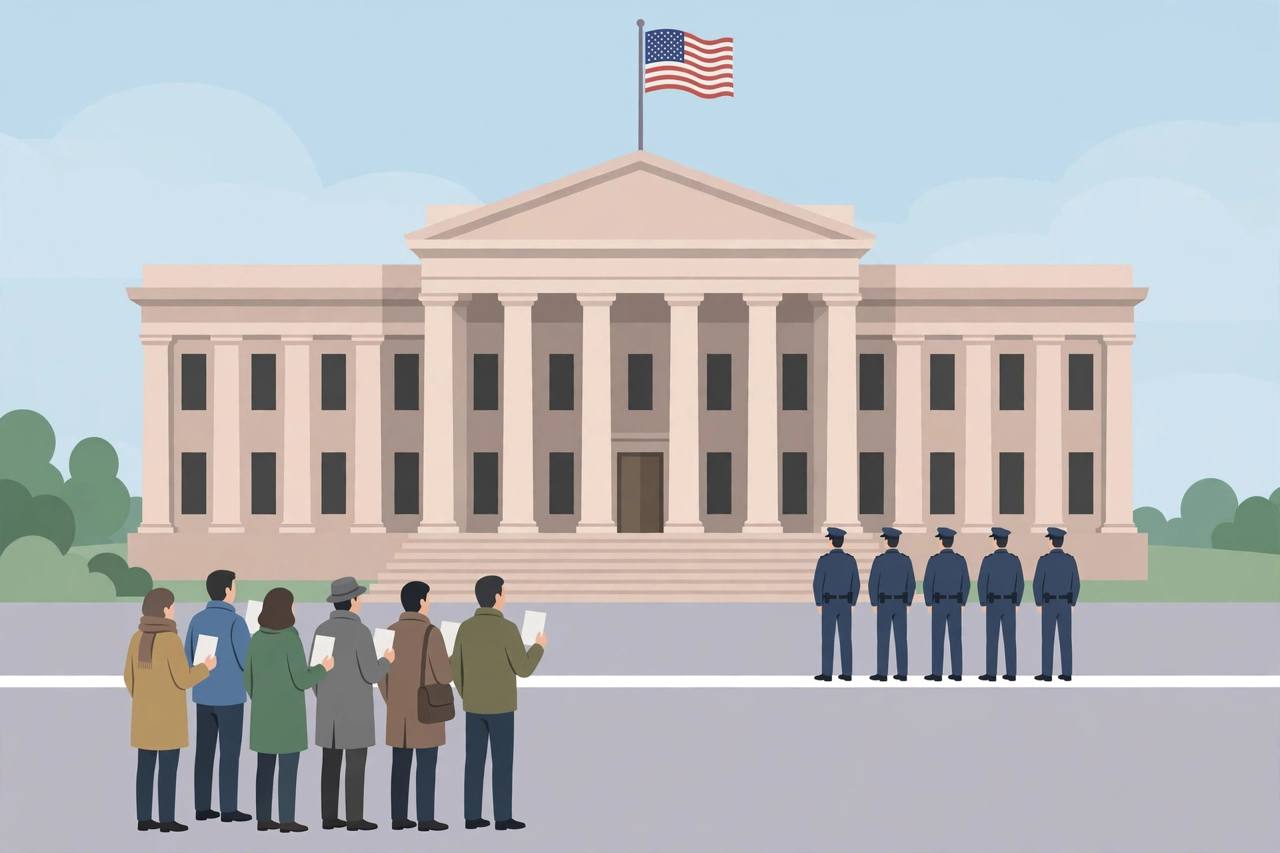
The full U.S. Court of Appeals for the Ninth Circuit has refused to rehear the case over the Department of Homeland Security's 'Unlawful Voter Initiative,' leaving in place the block on the federal government's door-to-door voter-fraud operations in nine states through Election Day, according to the court's order reported on Saturday, October 31, and a dissent published the same day. The refusal is a genuinely new development: it follows, and goes beyond, Friday's unanimous three-judge panel decision that had denied the Trump administration's request to resume the program.
Source: Election Law Blog
Moments after the panel's order was published, an unnamed Ninth Circuit judge asked for a vote on whether the case should be reheard by the full court, en banc. The next day the circuit rejected that request, Democracy Docket reported, meaning the administration's remaining route is now likely an appeal to the U.S. Supreme Court. Seven judges dissented from the refusal to rehear.
Source: Democracy Docket
The seven dissenters
Judge Eric Tung, a Trump appointee, wrote the dissent. He was joined by Judges Ryan Nelson, Daniel Collins, Daniel Bress, Patrick Bumatay and Lawrence VanDyke — all Trump appointees — and Judge Consuelo Callahan, a George W. Bush appointee. Five other Trump appointees on the court did not join the dissent, Politico's Josh Gerstein noted, though how each judge voted on rehearing was not disclosed. A dissent from a refusal to rehear does not change the law in force: the panel ruling, and the injunction beneath it, remain fully in effect.
What Friday's panel actually decided — the earlier development
On Friday, a three-judge panel of the Ninth Circuit denied the administration's attempt to pause a lower court's ruling blocking the practice in nine states, Bloomberg Law reported. Joining in that opinion were Judges Sidney Thomas and Kim Wardlaw, Clinton appointees, and Judge Anthony Johnstone, a Biden appointee. The judges said the government had not carried its burden for the emergency relief it sought.
Source: Bloomberg Law
The panel upheld the district court's determination that DHS's activities likely violated Section 11(b) of the Voting Rights Act, the federal ban on voter intimidation, according to the Election Law Blog's summary of the ruling. In the panel's own words, quoted by Democracy Docket: 'The declarants' fear is reasonably exacerbated by two years of highly visible aggressive conduct by federal agents in immigration enforcement operations under this administration.' The panel concluded the federal government had failed to demonstrate it would suffer irreparable harm if the program were paused through Election Day.
The panel also criticised the timing of the government's enforcement 'Surge.' It noted the administration had over a year and a half to investigate past voter fraud but escalated operations just as early voting began, and it wrote: 'To the extent that Federal Defendants are focused on preventing illegally registered noncitizens from voting in the upcoming election, Defendants' delay in beginning the Surge has rendered it no longer practicable to prosecute anyone they could identify before Election Day.'
The program at the centre of the case
The legal battle centres on DHS's 'Unlawful Voter Initiative,' launched to investigate alleged illegal voting by noncitizens. According to court documents described by Democracy Docket, the program used artificial intelligence and unverified commercial data to generate target lists, leading to door-to-door interrogations by armed Immigration and Customs Enforcement (ICE) agents — a description drawn from the plaintiffs' case and the court record, which the government disputes as a characterisation of lawful enforcement. Pro-voting groups, together with the city of San Francisco and Santa Clara County, California, argued in their lawsuit that the investigations are a form of voter intimidation.
Among the plaintiffs are the California Nurses Association and National Nurses United (CNA/NNU), suing on behalf of members — many of them naturalized citizens — who, the unions say, have been afraid to participate in election-related activities because of the highly publicized raids. That fear, and whether federal agents may question people at their homes about their voting on the eve of an election, is the human core of a case that is otherwise fought over injunctions, panels and rehearing votes.
The preliminary injunction blocks DHS from conducting door-to-door investigations to interrogate individuals about alleged voter fraud before Election Day in California, Connecticut, Georgia, Missouri, Nevada, New York, Pennsylvania, Washington and Wisconsin. It is set to expire automatically when polls close on Election Day, Tuesday, November 3. It does not decide the underlying lawsuit, and it does not bar ordinary criminal prosecution of any individual actually accused of illegal voting — separate Nevada charges against five permanent residents this month show that individual cases continue through the courts.
Why this matters for diaspora voters
Four of the nine covered states — California, New York, Washington and Pennsylvania — are among the largest homes of the Punjabi diaspora in the United States, and naturalized citizens are exactly the voters the plaintiffs say the door-to-door program frightened. A naturalized citizen has the same right to vote as any other citizen, and no injunction was needed to create that right; what the courts have decided, in sequence — district court, three-judge panel, and now the full circuit declining to intervene — is that federal agents may not run a pre-election doorstep interrogation program in these nine states while the intimidation claim is litigated. For a naturalized voter in Fresno, Queens, Seattle or Philadelphia, the practical position through November 3 is unchanged and clear: you may vote, and DHS door-to-door voter-fraud visits in your state remain blocked until the polls close.
What happens next
Democracy Docket reported the administration will now likely appeal to the U.S. Supreme Court, the only court that could revive the program before Tuesday — and even there, the injunction is built to expire when polls close on Election Day, so any emergency application faces a clock measured in hours and days, not weeks. The underlying lawsuit over whether the Unlawful Voter Initiative violated the Voting Rights Act continues in the lower court regardless of the election result. And the seven-judge dissent now on the record gives the administration a ready-made argument — written by judges of its own president's appointment — if and when the case reaches the justices.