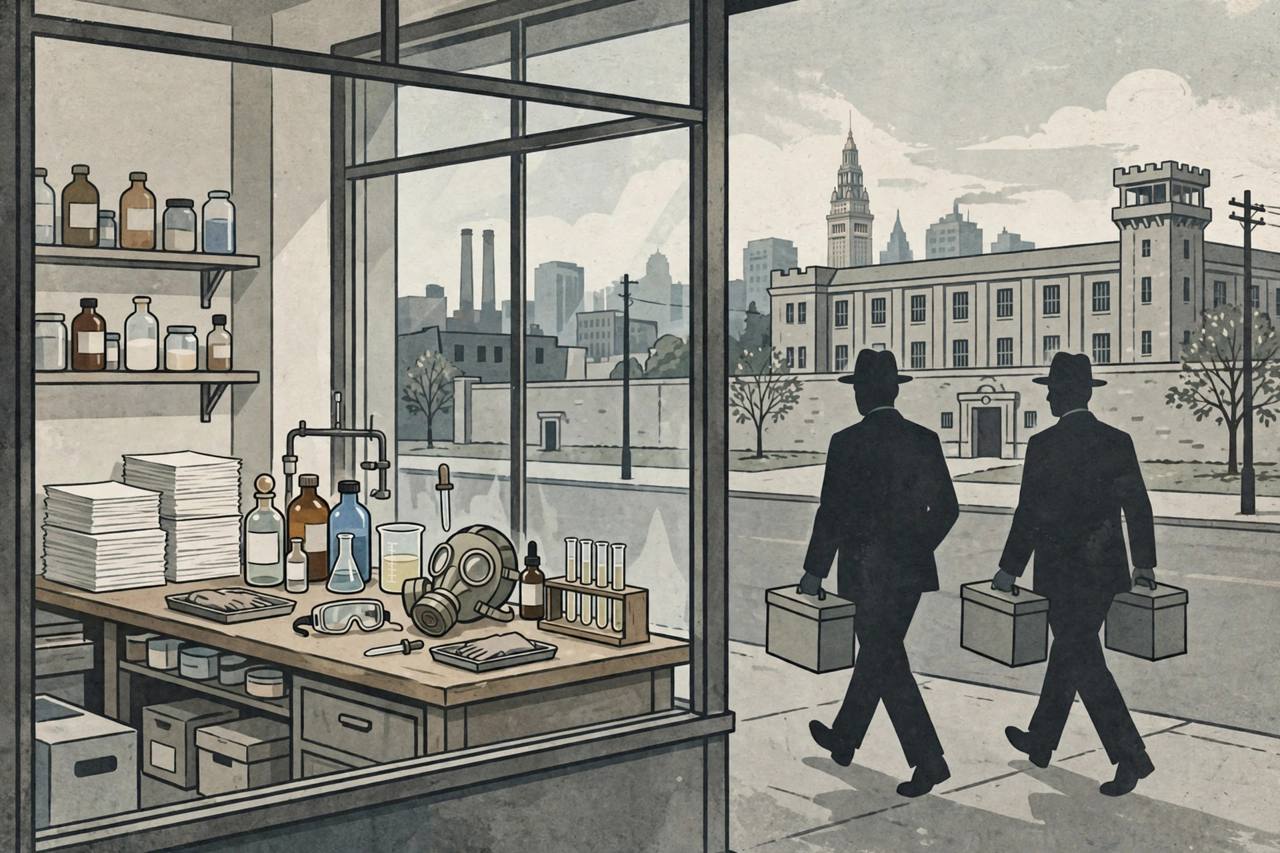
Two Northeast Ohio residents who helped run a laboratory that soaked ordinary paper in illegal drugs — paper that could then be carried into prisons looking like letters or legal documents — have been sentenced in federal court in Cleveland. Thaer Mustafa, 41, of North Olmsted, was sentenced to 120 months (10 years) in prison, and Elyssia Sanabria, 26, of LaGrange, Ohio, was sentenced to 70 months (just under six years), the U.S. Attorney's Office for the Northern District of Ohio announced on October 29, 2026.
Source: U.S. Department of Justice, U.S. Attorney's Office, Northern District of Ohio, October 29, 2026
U.S. District Judge Dan Aaron Polster imposed both sentences. Mustafa and Sanabria had each pleaded guilty in April to one count of conspiracy to distribute controlled substances, according to the Justice Department's announcement of the sentences.
A supply line that ran from Texas to Ohio
Prosecutors described a drug trafficking conspiracy that spanned from Texas to Ohio. Its Ohio end, investigators found, was not a street corner but a storefront in Fairview Park, a suburb west of Cleveland in Cuyahoga County, which the pair used as a lab to manufacture illegal drugs soaked onto paper — product made, the Justice Department said, to be smuggled into prisons and distributed inside them.
Mustafa and Sanabria were identified during a federal investigation into suspected illegal drug activity as the people sourcing the controlled substances used in the paper-soaking laboratories, the department said. The Texas end of the case is reflected in the investigating team itself, which included the DEA's San Antonio office and the FBI's Laredo Resident Agency, on the U.S.–Mexico border.
Caught emptying cocaine into a toilet, prosecutors say
The most vivid detail in the government's account comes from a search warrant executed at an apartment in Cleveland. Agents, the Justice Department said, caught Mustafa and Sanabria in the act of retrieving bags of cocaine and emptying the contents into the toilet. In the same apartment, investigators located powder, reams of soaking paper and a gas mask — the protective equipment paper-soaking operations use because the chemicals involved can be dangerous to breathe.
A second search, at the Fairview Park storefront, revealed bulk amounts of chemicals and equipment that law enforcement recognised as the tools for producing drug-soaked paper for distribution in prisons. Across the investigation, federal agents seized kilograms of controlled substances and $300,000 in cash, and they also seized multiple firearms connected to the drug operation, the department said.
A yearlong investigation by The Marshall Project with USA Today Network Ohio newspapers, published in 2026, found that drug-soaked paper — smoked in confetti-sized pieces — is now the most commonly found drug inside Ohio prisons, fueling violence and accounting for more deaths than any other substance. The chemicals are hard for scanners and dogs to detect, the paper is easy to hide among mail, and the outgoing director of the Ohio Department of Rehabilitation and Correction, Annette Chambers-Smith, called it the most troubling development within state prisons in 30 years. Smugglers, the investigation reported, can make up to $5,000 for a single delivery.
Five offices, two states: who investigated
The case was investigated by the Drug Enforcement Administration's Detroit Division Cleveland Field Office, the FBI's Cleveland Division, the U.S. Postal Inspection Service's Cleveland and Newark offices — postal inspectors are routinely involved because contraband bound for prisons often moves through the mail — together with DEA San Antonio and the FBI Laredo Resident Agency. Assistant U.S. Attorney Segev Philips led the prosecution for the Northern District of Ohio.
Source: U.S. Department of Justice (investigating agencies and prosecutor)
What the sentences close — and what they do not
With Judge Polster's sentences, the two Ohio defendants identified as the sourcing and manufacturing end of the operation now face a combined 190 months — nearly 16 years — in federal prison; there is no parole in the federal system, although earned credits can reduce time served. The Justice Department's announcement did not publish supervised-release terms or a restitution figure for either defendant, and Awaaz Punjab is not assuming any.
What happens next is the wider fight the sentences sit inside: Ohio prison officials and federal agents continue to treat soaked paper as the contraband problem of the moment, because a sheet that looks like a legal letter can carry a dose worth far more inside a prison than the drugs cost outside. For readers — including the many Punjabi families in Ohio whose relatives work in corrections, trucking and warehousing along the Cleveland corridor — the case is a reminder that the storefront in an ordinary suburban plaza can be the visible tip of a supply chain that runs from the Texas border to a prison yard.