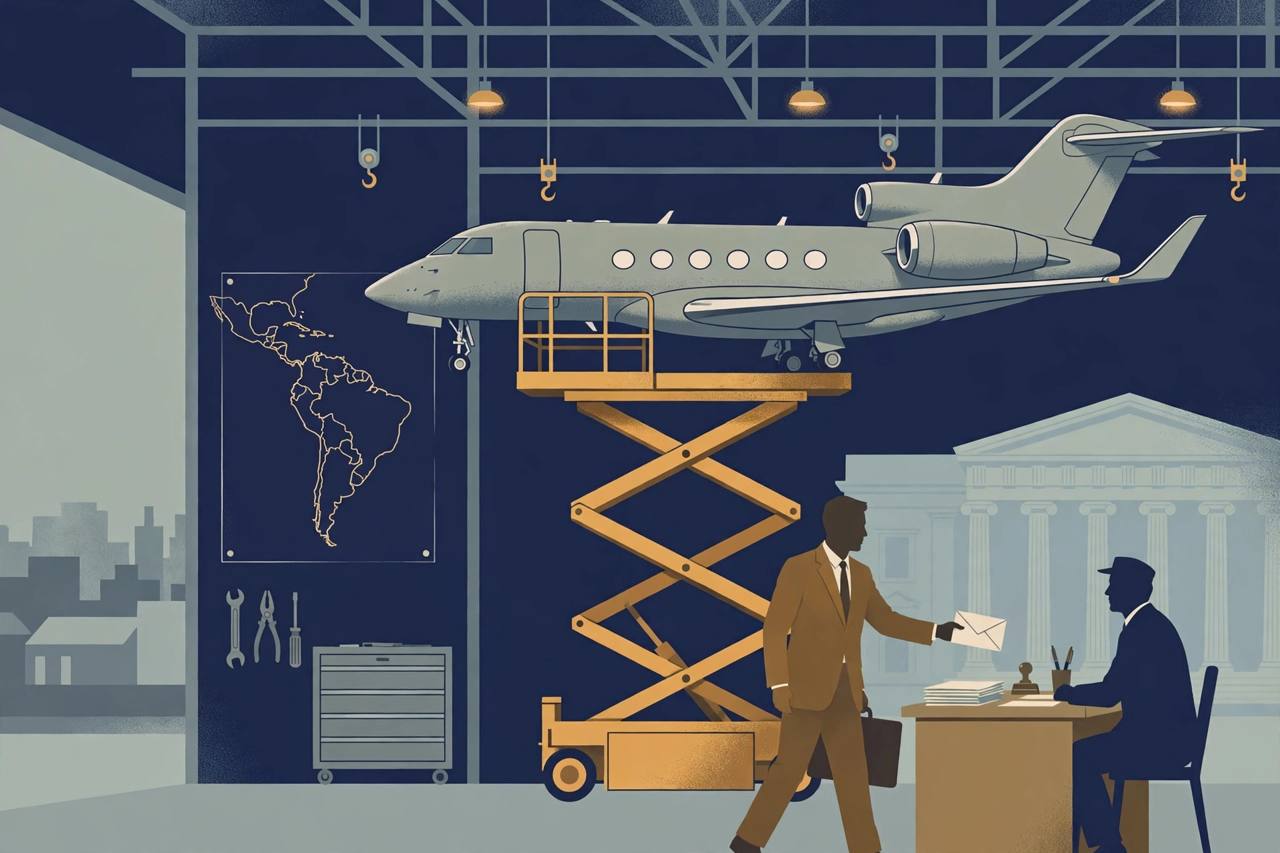
A bribery case that began under seal in 2012, was unsealed in 2013 and then waited more than a decade for its last defendant has finally reached a guilty plea. Jald Jensen, 73, of Panama City, and previously of Van Nuys, California, pleaded guilty for his role in connection with a scheme to pay bribes to government officials in Latin America to secure business for BizJet International Sales and Support Inc. (BizJet), the U.S. Department of Justice announced on October 30, 2026.
Source: U.S. Department of Justice, press release, October 30, 2026
Jensen was a former sales manager at BizJet, an aircraft maintenance, repair and overhaul (MRO) provider based in Tulsa, Oklahoma, and a U.S. subsidiary of Germany's Lufthansa Technik AG. MLex, which covered the plea from the court records, reported that Jensen pleaded guilty in the federal case in Tulsa to his role in a foreign bribery and money laundering scheme, more than a decade after the charges against him were filed.
Source: MLex, Samuel Rubenfeld, October 29, 2026
A case that waited more than a decade
The timeline is the story. An 11-count indictment of Jensen was unsealed in 2013, after being filed under seal in January 2012, according to court reporting on the case. For years Jensen was believed to be living abroad and remained at large while the rest of the case moved without him. MLex reported that he made his initial appearance in Tulsa federal court in September 2026, and that court records had him expected to change his plea in late October — the step the Justice Department announced on October 30.
That makes Jensen the last of the four indicted BizJet executives to plead guilty, closing the individual prosecutions that grew out of one of the best-known Foreign Corrupt Practices Act (FCPA) cases in the U.S. aviation services industry. The FCPA is the U.S. law that makes it a crime for U.S.-linked companies and their executives to bribe foreign government officials to obtain or keep business.
How the scheme worked, according to prosecutors
In the original charges, unsealed on April 5, 2013, prosecutors alleged that BizJet executives paid bribes to officials employed by the Mexican Policia Federal Preventiva, the Mexican Coordinacion General de Transportes Aereos Presidenciales — the Mexican president's air fleet — the air fleets for the Mexican states of Sinaloa and Sonora, the air fleet for the Brazilian state of Roraima, and the Republica de Panama Autoridad Aeronautica Civil, in exchange for help securing contracts for BizJet to perform maintenance, repair and overhaul work.
Prosecutors said the bribes were paid in two ways: directly to foreign officials, and funnelled through a shell company, Avionica International & Associates Inc., which was owned and operated by Jensen. According to the Justice Department's earlier releases in the case, Avionica operated under the pretence of providing aircraft maintenance brokerage services but in reality laundered money connected to BizJet's bribery scheme. In the company's books, case reporting noted, the payments were described in terms such as “commissions,” “incentives” and “referral fees.”
BizJet itself resolved the corporate case years before its last executive pleaded guilty. On March 14, 2012, the company entered a deferred prosecution agreement with the Justice Department and paid an $11.8 million criminal penalty over the Latin America bribery scheme, and its parent Lufthansa Technik AG entered a related agreement with the department. The individual executives were prosecuted separately — and, in Jensen's case, much later.
The other three executives pleaded guilty long ago
Peter DuBois, BizJet's former vice president of sales and marketing, and Neal Uhl, its former vice president of finance, pleaded guilty on January 5, 2012, to FCPA conspiracy charges (DuBois also to a substantive FCPA violation). Both were sentenced in federal court in Oklahoma to probation and eight months of home confinement. Bernd Kowalewski, the former president and chief executive, was arrested on a provisional arrest warrant in Amsterdam on March 13, 2014, waived extradition that June, and pleaded guilty in Tulsa on July 24, 2014, to conspiracy to violate the FCPA and a substantive FCPA violation — the third executive to plead guilty, according to the FBI's release at the time.
Source: FBI / U.S. Attorney's Office release, July 24, 2014 (case background)
Why a 14-year-old bribery case matters now
For readers in the United States who run, work for or sell to American companies — including the many immigrant-owned trucking, logistics and aviation-services businesses in Awaaz Punjab's audience — the Jensen plea is a concrete reminder of how long U.S. corruption cases can run. The conduct was investigated in the early 2010s, the company settled in 2012, three executives pleaded guilty by 2014, and the fourth was still answering the indictment in 2026. A sealed indictment, prosecutors and courts have shown in this case, does not expire because a defendant stays abroad.
What happens next: Jensen's case now moves to sentencing in federal court. The Justice Department's October 30 announcement did not publish a sentencing date, and no sentence should be assumed — the plea establishes guilt on the counts he admitted, and the court will set the punishment at a later hearing. With this plea, the last individual case from the 2013 BizJet unsealing is resolved at the guilt stage, more than 13 years after the charges became public.