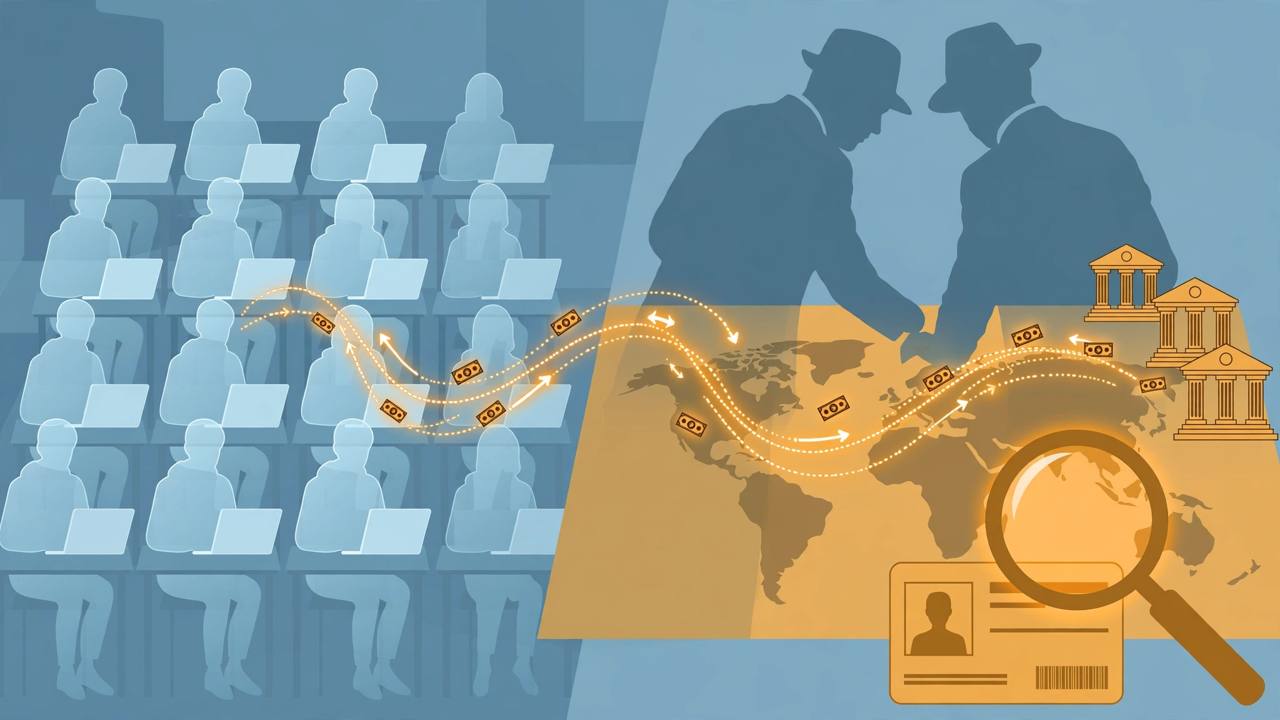
The U.S. Justice Department on Thursday, October 29, 2026, announced the first charges from Operation Ghostbusters, a nationwide investigation into a large-scale federal student-aid fraud in which criminals allegedly used stolen American identities to create Free Application for Federal Student Aid (FAFSA) accounts and enrol 'ghost students' - people who never existed as real students - at colleges and universities. Five defendants are charged in three separate cases in New Jersey, Virginia and Nebraska, and investigators seized more than $750,000 in cryptocurrency in Kenya in what the department called the first international seizure of its kind in that country. All five are presumed innocent unless proved guilty in court.
Source: U.S. Department of Justice - Operation Ghostbusters ghost student indictments, October 29, 2026
This is the major new development that follows this site's earlier coverage of the same fraud wave: on October 21 we reported that the Treasury Department's Financial Crimes Enforcement Network (FinCEN) had flagged about $270 million in suspicious activity potentially linked to student-aid fraud and referred its findings to investigators, with no arrests announced at that time. Eight days later, the referral has turned into arrests, indictments and an asset seizure on another continent.
What the Justice Department announced in Alexandria
The announcement was made in Alexandria, Virginia, by the department's National Fraud Enforcement Division together with the U.S. Attorney's Offices for the Eastern District of Virginia, Nebraska and New Jersey. 'Today, we are announcing the first results of Operation Ghostbusters - a nationwide effort to stop a major fraud scheme targeting federal student aid, low-income Americans, and the American taxpayer,' said Assistant Attorney General Colin M. McDonald of the National Fraud Enforcement Division. 'If you steal American identities, if you steal taxpayer dollars, if you exploit programs meant to help students build a future - we will find you. Whether you are in Nebraska, New Jersey, Virginia, or Nairobi, we will pursue you.'
Source: U.S. Department of Justice - Operation Ghostbusters ghost student indictments, October 29, 2026
According to the Justice Department, the scheme worked in stages. Fraudsters obtained stolen identity information belonging to U.S. citizens, used it to submit fraudulent FAFSA applications in those people's names, and enrolled the fake students at educational institutions. When loans and grants were disbursed, the refund portion - the money left after tuition is paid - was diverted to bank accounts controlled by foreign actors, moved through U.S.-based 'money mules' who kept a cut and sent the rest overseas. The ghost students never actually attended the classes the aid was awarded for.
Source: U.S. Department of Justice - Operation Ghostbusters ghost student indictments, October 29, 2026
New Jersey: three arrested, $1.5 million intended loss, and a safari-company link
In the District of New Jersey case (criminal complaint 26-16210), Mabed Patricia Utate-Alberto, Patricia Arisleydi Perez and George Arturo Alfau Mendez are charged with conspiring to commit wire fraud. Prosecutors allege that from about March 2021 through at least January 2026 they acted as witting money mules for conspirators in Kenya, receiving student-aid funds obtained through fraudulent FAFSA applications using stolen American identities and transferring the money - after taking their cut - to co-conspirators in Kenya associated with a purported Kenyan safari company. All three have been arrested, the department said, and the government says it will seek to charge two Kenya-based co-conspirators as the case continues. The case is being prosecuted by Assistant U.S. Attorney Francesca Liquori.
Source: U.S. Department of Justice - Operation Ghostbusters ghost student indictments, October 29, 2026
The FBI agent's sworn complaint, reviewed in detail by Radio Purple News, puts individual figures on the New Jersey accounts: Utate-Alberto's accounts allegedly took in more than $1 million tied to more than 300 ghost students, Perez's more than $250,000 tied to at least 88, and Alfau Mendez's more than $119,187 tied to more than 40. The complaint describes the three as residents of Burlington and Camden counties in New Jersey. The Justice Department lists the New Jersey case at $1.5 million in intended loss - money prosecutors say the scheme aimed to steal, which is not the same as the amount ultimately lost.
Nebraska and Virginia: a diversity-visa arrival and a sealed indictment
In Nebraska (indictment 4:26CR3089), a federal grand jury on October 19 indicted Francis Mogambi, a Kenyan citizen, on five counts of theft of government money and five counts of aggravated identity theft, carrying 10 years in mandatory minimum sentences based on the alleged use of stolen identities. Prosecutors allege that between November 2025 and May 2026 Mogambi fraudulently obtained federal student aid using stolen identities, working with associates in Kenya, keeping 30 percent of the proceeds and sending the rest to his conspirators. Court documents reflect that he allegedly told a recruit he received $2,000 a week. Mogambi arrived in the United States on May 15, 2024, after winning the Diversity Visa lottery, was issued a permanent resident card shortly after, was arrested promptly after the indictment, and was detained pending trial based on his risk of non-appearance. The Justice Department lists this case at $20,000 in intended loss, and the case is prosecuted by Assistant U.S. Attorney Daniel Packard.
Source: U.S. Department of Justice - Operation Ghostbusters ghost student indictments, October 29, 2026
In the Eastern District of Virginia, a federal grand jury on October 21 returned a sealed, multi-count indictment charging an unnamed Kenyan national with conspiracy to commit wire fraud and student aid fraud. According to the indictment as summarised by the Justice Department, the defendant received more than 700 fraudulently obtained student-aid refund deposits totalling approximately $1,439,548 across multiple bank accounts, then moved at least $1.3 million to accounts in the United States and Kenya through thousands of wire and money-service transactions. Because the indictment is under seal, there is no public docket naming the defendant. The case is being prosecuted by Assistant U.S. Attorney Brian Hood.
Source: U.S. Department of Justice - Operation Ghostbusters ghost student indictments, October 29, 2026
How big is the wider fraud? Three official numbers, carefully attributed
The five cases charged on Thursday cover a few million dollars at most. The larger figures are official estimates of the wider scheme, attributed here to the officials who gave them - they have not been proved in court against these defendants.
Assistant Director Heith Janke of the FBI's Criminal Division said the bureau 'has identified more than $32 million in losses, with millions more suspected, in similar ghost student schemes.' First Assistant U.S. Attorney Theophani K. Stamos for the Eastern District of Virginia said investigators there had 'already uncovered hundreds of participants and hundreds of millions of dollars in stolen funds, sending approximately 50 referrals to 26 FBI field offices across the country.' The Justice Department's own release says estimates put the scale of the overall fraud 'well over $200 million,' and that in September and October 2026 investigators identified 830,840 potentially fraudulent Federal Student Aid IDs relating to nearly $130 million and recommended the Department of Education disable those IDs. There are now more than 40 open cases across 26 FBI field offices and more than 20 U.S. Attorney's Offices, and investigators believe the fraud has run since at least 2021, when community colleges and universities first began identifying fraudulent applications.
Source: U.S. Department of Justice - Operation Ghostbusters ghost student indictments, October 29, 2026
The department also says fraudsters used what it calls 'super intelligence' to place fake students in online classrooms and complete required coursework so the enrolments looked real. That description comes from the Justice Department's account of the wider scheme: Radio Purple's reading of the New Jersey complaint and the Nebraska indictment notes that neither charging document itself mentions artificial intelligence, and both instead describe identity theft and money movement. Readers should treat the AI claim as the department's description of the broader network, not as a charge proved against these five defendants.
The victims: people who never went to college, billed for someone else's loan
The human cost falls first on the Americans whose identities were stolen. The Justice Department says fraudsters exploited Americans who had never been to college - many known victims hold only high school diplomas - precisely because the Education Department had no prior student record to cross-check. Victims have reported being shocked to learn of a faked attendance at an institution hundreds of miles away, with a student loan attached to their name and their credit at risk. The FBI has sent letters to many identified victims. Under Secretary Nicholas Kent of the Department of Education said the department, under President Trump and Secretary Linda McMahon, 'has saved taxpayers more than $2 billion in attempted student aid theft' - a figure the department itself provided - adding that 'every dollar that falls into the hands of a fraudster is a dollar that will not go to a student in need.'
Source: U.S. Department of Justice - Operation Ghostbusters ghost student indictments, October 29, 2026
For Punjabi diaspora families in the United States - in California's Central Valley, New Jersey, New York and other hubs this site serves - the case lands close to home for two practical reasons. FAFSA is the gateway form that diaspora parents and their children file for grants and loans, and a stolen identity used on a FAFSA can surface years later as a mystery loan when a real student applies. And the crackdown has a flip side for genuine applicants: tighter identity checks are now part of the process, so families should keep their Federal Student Aid IDs, documents and login details secure, file only through the official FAFSA channel, and treat any message offering to file or 'fix' an application for a fee as a warning sign. Anyone who believes their identity was used can report it through the Department of Education's Office of Inspector General hotline complaint form, as the Justice Department advised on Thursday.
Source: U.S. Department of Justice - Operation Ghostbusters ghost student indictments, October 29, 2026
The Kenya connection and what happens next
In September, representatives of the Fraud Division and its partner agencies visited Kenya to promote extradition, prosecution and the return of stolen assets. With assistance and intelligence from Kenyan law enforcement - the Directorate of Criminal Investigations, the Asset Recovery Agency and the Office of the Director of Public Prosecutions - investigators seized more than $750,000 from a cryptocurrency account belonging to a Kenyan national connected to the scheme, which Capital FM in Nairobi also reported on Thursday. The Justice Department says the operation is assisted by the FBI, the Education Department's inspector general, the State Department, U.S. Customs and Border Protection and the White House Task Force to Eliminate Fraud, chaired by Vice President J.D. Vance.
What happens next: the three New Jersey defendants face proceedings on the criminal complaint, Mogambi is detained pending trial in Nebraska, the sealed Virginia case will move when it is unsealed, and prosecutors say they intend to charge the two Kenya-based co-conspirators in the New Jersey case and to pursue further cases among the more than 40 already open nationwide. McDonald framed Thursday as a beginning, not an end: these are, in the department's own words, 'the first results of Operation Ghostbusters.' An indictment, information or complaint is merely an allegation, the department noted, and all defendants are presumed innocent until proven guilty beyond a reasonable doubt in a court of law.
Source: U.S. Department of Justice - Operation Ghostbusters ghost student indictments, October 29, 2026