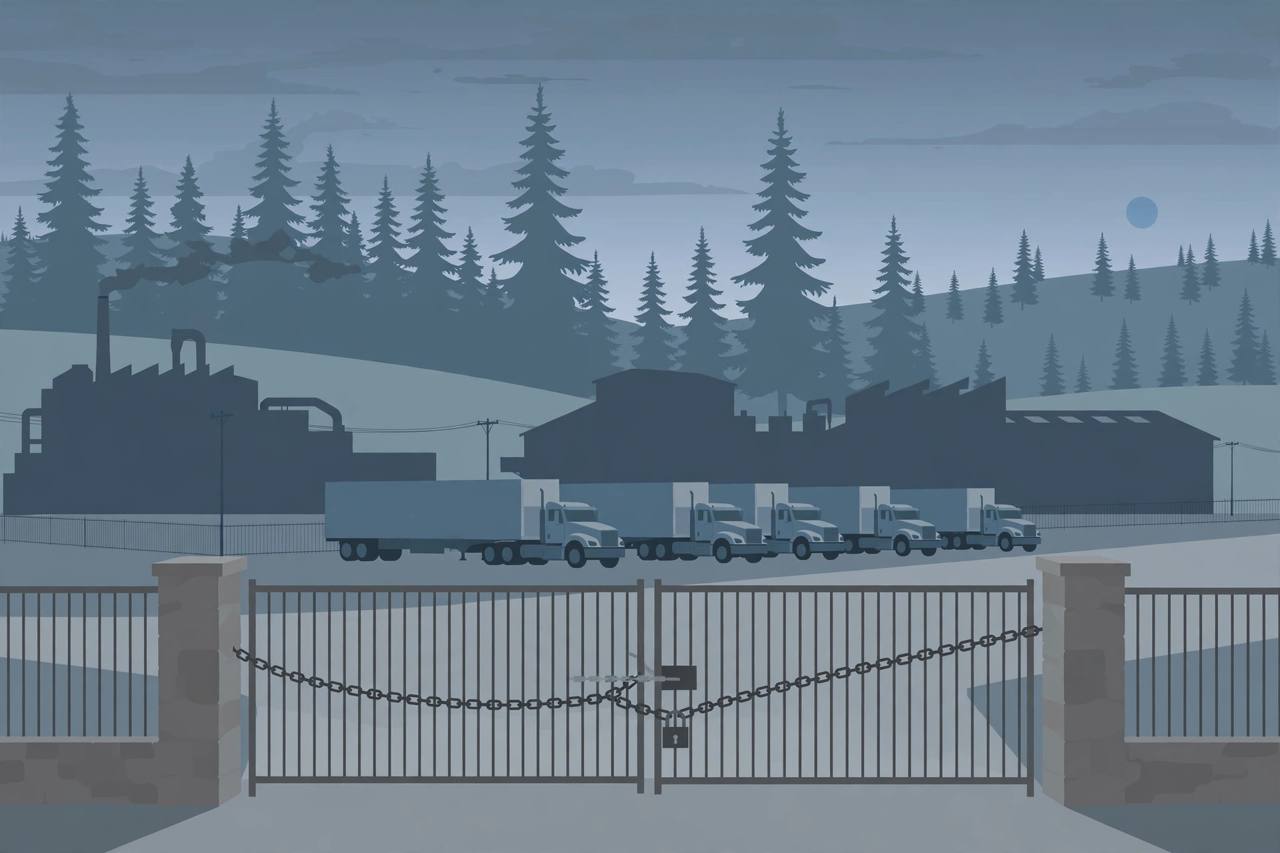
Portland's long run as a truck-building city is over. Daimler Truck North America (DTNA) closed its Swan Island manufacturing plant in Portland, Oregon, on Friday, October 30, ending production at a factory that had built Freightliner and Western Star trucks since 1969. The company says about 375 jobs are affected; Oregon's official layoff notice puts the number at 387 employees.
Source: Transport Topics
The shutdown is permanent and covers four Portland-area sites: the main plant at 6936 North Fathom Street on Swan Island, plus a nearby drop lot, warranty-recovery operations and the company's CTS operations, according to the closure plan reported when it was announced in July. Production of the Western Star X-Series and the battery-electric Freightliner eCascadia and eM2 trucks is moving east, to Daimler plants in North Carolina and South Carolina.
Source: We Are Main Street
The numbers behind the closure
A company spokesman told Transport Topics when the closure was announced: “This decision was not made lightly. The Portland team has played a critical role in DTNA's success for decades, and we are deeply grateful for the dedication, expertise and contributions of our employees. We are committed to supporting impacted team members throughout the transition, including severance benefits, transition assistance, opportunities to explore internal openings and access to additional support resources.”
Source: Transport Topics
Who loses their jobs
The workforce breakdown reported by the Northwest Labor Press counts 214 members of Machinists Local 1005, 101 Teamsters from Local 305, 10 Painters from Local 1094 and 9 SEIU Local 49 members, plus 44 non-union office staff — 378 workers in the union-side count, close to but not exactly the 387 in the state WARN notice filed in late July. The International Association of Machinists and Aerospace Workers (IAM) District W24 and Local 1005 said bargaining over the effects of the closure would begin in early August; the Machinists' contract covers severance, retiree health care and benefit extensions for laid-off members.
Where the truck building is going
The Carolinas are now the centre of Daimler's North American truck building. North Carolina hosts the Cleveland Truck Plant — Freightliner's largest manufacturing plant in the United States — the Mount Holly plant, which opened in 1979 and builds medium-duty trucks, and the Gastonia plant, which handles stamping, fabrication and subassembly of cab and chassis parts. Thomas Built Buses builds school buses in High Point, North Carolina, and Freightliner Custom Chassis operates in Gaffney, South Carolina. DTNA has about 9,000 employees in the Carolinas across manufacturing, sales, distribution and financial services, according to TruckNews. Mount Holly is even expanding: the company planned to bring back 400 employees laid off in July 2025 and hire about 200 more by the end of 2026 for a second shift.
Source: Trucking Dive
The closure ends truck manufacturing in Portland, not Daimler's presence there. Portland remains DTNA's North American headquarters and engineering base: the company opened a new headquarters on Swan Island in 2016 and a $40 million engineering and training facility in July 2026.
Background: truck building in Portland since 1947
Freightliner was born in Portland. Founder Leland James started building trucks locally in 1947 at the original plant on Northwest Quimby Street, and the Swan Island plant that opened in 1969 was the company's third Portland factory. Daimler acquired Freightliner in 1981. This is the second time the Swan Island plant has faced closure: Daimler announced in 2008 that it would shut by 2010, but granted a reprieve in 2009. This time there was no reprieve — the July announcement held, and the plant closed on schedule on October 30.
The closure is a restructuring, not a collapse. When it announced the move in August, DTNA had just raised its full-year 2026 truck and bus sales guidance by 10,000 vehicles, to between 160,000 and 180,000. Its second-quarter 2026 sales were 41,687 vehicles, up 8 per cent from a year earlier and up 41.6 per cent from the first quarter — the first quarterly sales increase in six quarters. The shift continues a long move of truck production away from the West Coast: about 2,000 DTNA production workers in Mount Holly, Gastonia, Detroit, Portland and Saltillo, Mexico, were laid off in July 2025 during the freight downturn, and the surviving work is being concentrated in the Carolinas. DTNA also says selection of a new US manufacturing site is in its final stages, with operations expected in 2029.
Source: Transport Topics
What happens next
For the roughly 380 Portland workers, the transition now runs through the severance, benefit extensions and internal-transfer support the company promised and the unions bargained over. For the trucking industry — including the many Punjabi owner-operators and fleets who run Freightliner Cascadia and Western Star trucks — the change sits behind the scenes: the trucks will keep coming, but every one of them will now be built in the Carolinas rather than on the West Coast. Portland, which built trucks for 79 years, keeps the headquarters, the engineers and the history — but not the assembly line.
What is solid
- DTNA's Swan Island plant in Portland closed on October 30, 2026, ending truck production there; production of the Western Star X-Series and the Freightliner eCascadia and eM2 moves to North Carolina and South Carolina
- Oregon's WARN notice lists 387 employees laid off across four Portland-area sites; the company puts the jobs affected at about 375
- Portland remains DTNA's North American headquarters and engineering base
What is only claimed
- The exact final headcount differs by source: 387 in the state WARN filing, about 375 in company statements, and 378 in the union-side breakdown reported by the Northwest Labor Press