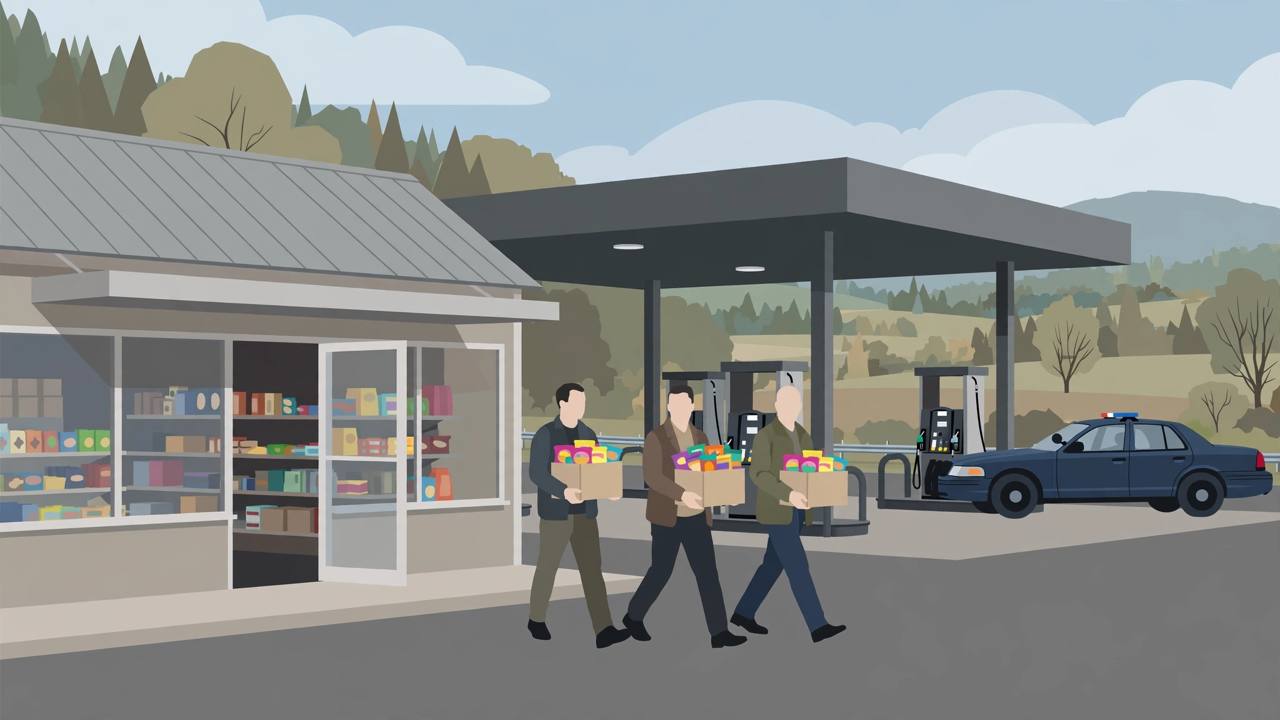
Pennsylvania's Attorney General has charged the owner of two Fuel On gas station and convenience stores in northcentral Pennsylvania, and two of his employees, with felony drug-dealing offences — alleging that the stores sold products that were pure marijuana or contained illegal levels of THC, over the counter, every day, in packaging that included designs meant to attract children.
Attorney General Dave Sunday announced the charges on Friday, October 30. Majid Syed, 45, owner of the two Fuel On stores in Cameron and Elk counties, is charged with felony corrupt organizations, possession with intent to deliver, and dealing in proceeds of illegal activity. Two employees of the Elk County store in Ridgway — Adnan Pillay, 33, and Haji Afzal, 64 — face the same charges in connection with that business. All three surrendered for arraignment on Friday morning.
Unsecured bail means the defendants were released after arraignment without having to post the money up front; the amount becomes payable if they fail to appear or violate their conditions. The cases will be prosecuted by the respective district attorneys' offices — Cameron County and Elk County — and the Attorney General's office stresses that the charges are allegations: all three men are presumed innocent unless and until proven guilty.
What investigators say was happening inside the stores
According to the Attorney General, a collaborative, long-term investigation concluded that the defendants knowingly sold the illegal products, which were either pure marijuana or contained THC levels above what Pennsylvania law allows. “Residents recognized these stores as scourges on their communities and called on law enforcement to act — we did, and these are the results,” Sunday said. “These illegal products, which included packaging designed to attract children, were sold every day out of these two store fronts. As of today, that illegal activity is over.”
Investigators seized numerous products from the stores and more than $10,000 in cash. The investigation was run by the Attorney General's Bureau of Narcotics Investigation with the North Central Drug Task Force, the Emporium Borough Police Department, the Ridgway Borough Police Department, the Pennsylvania State Police, and the Cameron County and Elk County district attorneys' offices — Emporium being the Cameron County community and Ridgway the Elk County borough where the two stores operate.
Background: the ‘legal hemp’ grey zone Pennsylvania is cracking down on
Recreational marijuana remains illegal in Pennsylvania — only medical marijuana is lawful — but a grey market has grown up around hemp-derived products since the federal 2018 Farm Bill. Attorney General Sunday has argued that bad actors exploited a perceived loophole in that law to sell super-potent, unregulated THC products — including synthetic cannabinoids such as Delta-8, Delta-10 and THC-O — from gas stations, convenience stores and smoke shops, often in packaging that appeals to children. Last year he joined 38 other state attorneys general in urging Congress to clarify the federal definition of hemp and close the loophole.
The scale of the grey market was documented in a 2025 grand jury report in southeastern Pennsylvania: investigators who bought 144 products undercover, marketed as legal hemp, found that 93.75 per cent were actually marijuana containing illegal levels of THC — frequently above 5 per cent, against a 0.3 per cent legal hemp threshold. That report called the lack of state oversight a community and public-health emergency. Earlier this year, Sunday's office announced charges and statewide seizures of illegal THC and marijuana products in Westmoreland County, in what it describes as an ongoing campaign against shops knowingly selling the products.
Pennsylvania prosecutors are treating over-the-counter sales of products marketed as ‘legal hemp’ as felony drug dealing when testing shows pure marijuana or illegal THC levels — with corrupt-organizations charges on top. For Punjabi and other South Asian families who run gas stations and convenience stores across Pennsylvania and the wider US, this case is the clearest warning yet that a supplier's ‘legal’ label is no defence: the product on the shelf is the owner's legal risk.
What happens next: with arraignments done and bail set, the two county cases move toward preliminary hearings in Cameron and Elk counties, where prosecutors will have to show the evidence behind the corrupt-organizations, possession-with-intent and proceeds charges. No hearing dates were announced in the Attorney General's release. The statewide campaign also continues, so other stores selling similar products should expect the same scrutiny that began with community complaints in Emporium and Ridgway.