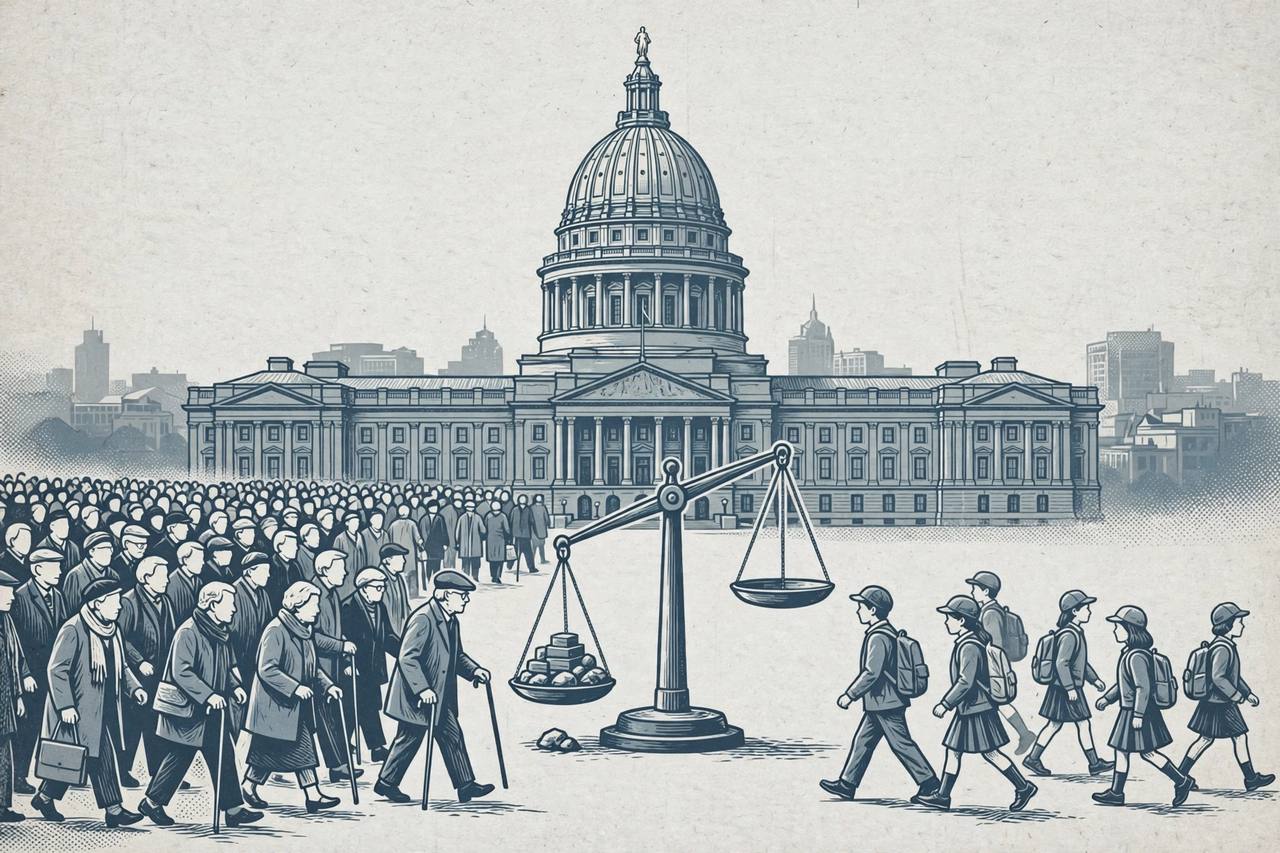
Pennsylvania is getting older and younger at the same time — older in its population, and smaller in the number of children who will replace today's workers. A new demographic outlook from the state's Independent Fiscal Office (IFO) finds the school-age population shrank by more than 3 percent in the five years ended in 2025 and will shrink at even greater rates between now and 2035, while the state's "advanced age" category increased by nearly 10 percent in the same stretch and will keep growing at a rate of 18 percent or more, The Center Square reported on Monday, November 2. The report, the IFO's Pennsylvania demographic outlook, puts fresh official numbers behind a trend Harrisburg lawmakers have discussed for years: on average, the state continues to turn gray.
Source: The Center Square via Main Line Now
The timing matters because of who has to pay for it. Legislators who begin a new two-year session in Harrisburg in early 2027 will be confronted by a structural deficit of roughly $5 billion, The Center Square reported. At the same time, the IFO shows the number of working-age people between 20 and 64 — the group that supplies a huge chunk of the state's tax revenue — shrank in the latest five-year period and is expected to continue that trend, so the state faces rising costs for older residents from a narrowing base of working taxpayers.
Source: The Center Square via Main Line Now
The numbers behind the shift
The age-by-age projections show the squeeze at both ends of life. Children between 10 and 14 numbered about 775,000 in 2020 and are expected to decline to 684,000 by 2035. At the other end, people between 80 and 84 numbered about 291,000 in 2020 and are expected to increase to 496,000 by 2035 — a rise of roughly 70 percent in the age band that most often needs long-term care. Babies and toddlers are declining too: there were 686,000 children from newborn to four years old in 2020, and the figure for 2035 is projected to be 599,000.
Source: IFO Pennsylvania Demographic Outlook, via The Center Square
Underneath the age shifts is a stark natural balance: deaths outnumbered births by 79,000 between 2020 and 2025, and that gap is projected to increase to 213,000 for the years 2030 to 2035, according to the IFO figures reported by The Center Square. In other words, Pennsylvania is no longer replacing its population through births alone, and the shortfall is projected to nearly triple in the early 2030s.
Source: IFO Pennsylvania Demographic Outlook, via The Center Square
Why it squeezes the budget from both sides
Nathan Benefield, chief policy officer at the conservative Commonwealth Foundation, told The Center Square the trends underscore big financial challenges for the state: the growing number of elderly residents adds to government costs for Medicaid and long-term care, while the declining number of working-age people crimps revenue. Pennsylvania, he said, has a "long ways to go" in ridding such programs of waste, fraud and erroneous reporting, pointing to the 2025 release of an audit that found hundreds of thousands of government dollars were erroneously paid out under a UPMC Health Plan arrangement, including some payments to people who had passed away.
Source: The Center Square via Main Line Now
Benefield also said state lawmakers have been reluctant to reduce spending on schools even though enrollment, like the state's school-age population in general, is diminishing. Putting in more money when there is a decline in the number of students "really stretches the taxpayers and really isn't a good funding model," he said — an argument that sets up a direct fight in the next session between districts facing falling rolls and a state treasury facing the roughly $5 billion structural gap.
Source: The Center Square via Main Line Now
The other response: a seniors plan already on paper, and quality of life
Bernie Gallagher, executive director of the progressive Keystone Research Center, pointed The Center Square to a policy answer that already exists: the 10-year strategic plan for improving services to seniors that Governor Josh Shapiro's administration unveiled more than two years ago, dubbed "Aging Our Way, PA," which laid out initiatives on Alzheimer's disease, long-term care, licensing at skilled nursing facilities and digital literacy, among others. "There is already a policy directive that is out there," Gallagher said. On the departure of young people, he argued it could be addressed by embracing concepts like the parental-leave policy approved in Allegheny County recently, billed as the nation's first county-level mandate that employers of a certain size provide leave for new parents. "It is the quality of life that people are weighing," Gallagher said.
Source: The Center Square via Main Line Now
Fewer school-age children and many more residents over 80 means the state's big fights of the next decade are already visible: how much to spend per pupil as rolls fall, how to staff and pay for long-term care as the 80-84 group grows from about 291,000 toward 496,000, and how to fund Medicaid from a working-age tax base that is shrinking. For Punjabi and other immigrant families in the Philadelphia, Harrisburg and Pittsburgh corridors — many of them working in trucking, logistics, warehouses and health care — those are not abstract numbers: they are school places for their children, care jobs and care costs for their parents, and the state taxes that pay for both.
What happens next
The IFO outlook now sits in front of the lawmakers who will take their seats for the new two-year session in early 2027, with the roughly $5 billion structural deficit as the first problem on the desk. The projections run to 2035, so the choices made in the next budget cycle — on school funding formulas, Medicaid and long-term-care capacity, and how to keep or attract working-age residents — will be made against a population curve that, on the IFO's numbers, keeps tilting the same way: about 684,000 children aged 10 to 14 and about 496,000 residents aged 80 to 84 by 2035, with deaths exceeding births by a projected 213,000 in the first half of the 2030s.
Source: IFO Pennsylvania Demographic Outlook; The Center Square