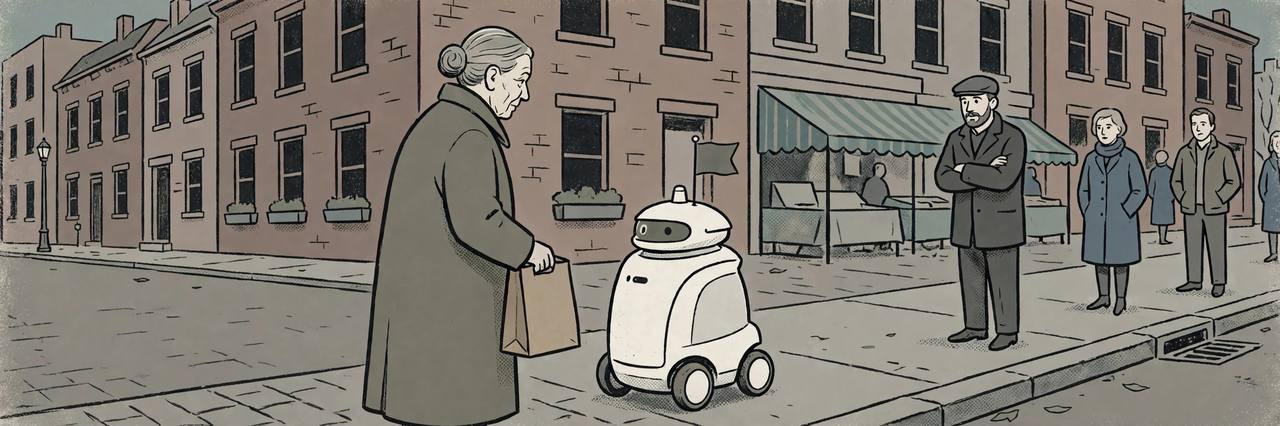
A 78-year-old retired University of Pennsylvania professor has been arrested in Philadelphia for doing something she had made a quiet habit of for months: stepping in front of an autonomous food-delivery robot on a city sidewalk and refusing to let it pass. Carolyn Marvin, a retired communications professor and First Amendment scholar, was handcuffed, put in the back of a police car and cited for disorderly conduct on October 14 after she blocked one of the wheeled robots in Center City, CNN reported on October 31. Marvin is unrepentant. Asked whether she plans to go back to blocking robots now that she has been arrested once, she answered: 'Oh yeah.'
Source: CNN
Since Uber Eats launched its self-driving robot delivery fleet in Philadelphia in March — making the city the fourth where meals are delivered by robot — Marvin has stood in front of the machines whenever she comes across one and it is, in her words, 'convenient and possible.' She moves as the robot moves, delaying it for 10 or 15 minutes at a time. The only harm, she says, is that an office worker's lunchtime bowl 'might be delayed for about 15 minutes at the most.' What she did not expect was to be arrested for it: 'I wasn't impeding any persons,' she said. 'I was impeding a machine.'
What happened on October 14
Marvin was on her way home from a flu-shot appointment, carrying a jar of enchilada sauce in one hand and chicken biryani takeout in the other, when she came across one of the robots on Filbert Street near Reading Terminal Market and stopped in front of it, as usual. This time a larger-than-normal crowd gathered around her — some supportive, some critical — and Marvin believes someone in the crowd called the police. Officers handcuffed her and put her in the back of a squad car, and she was given a citation for disorderly conduct; local reporting said she was taken to police headquarters before being released.
The Philadelphia Police Department's account, given to CNN in an email, is different in emphasis: officers had responded to a report of 'criminal mischief involving a delivery robot,' and when they arrived they 'encountered a female who was refusing to allow a delivery robot to pass.' 'Police issued multiple commands directing the female to move; however, she refused to comply,' the department wrote. Marvin says a friend summed up her situation this way: 'Well, you got a disorderly conduct charge for impeding capitalism.'
Source: WPVI via CNN reporting
The 2020 law that treats a robot as a pedestrian
What Marvin discovered after her arrest is the legal structure standing behind the machines. In 2020, the Pennsylvania legislature passed a law that classifies autonomous delivery robots — called 'personal delivery devices' in the statute — as pedestrians, not vehicles. That means a car must yield to a delivery robot in a crosswalk just as it would to a person. Democrats, along with labour unions and accessibility advocates, largely opposed the law at the time, arguing that legalising delivery robots could kill jobs and endanger children and pedestrians; Republicans promoted it as an exciting technological advance. Philadelphia personal injury attorney John Mattiacci told CNN that humans still sit at the top of the hierarchy in theory: 'Personal delivery devices must yield to other pedestrians and pedalcyclists in a pedestrian area,' he said. Uber Eats did not respond to CNN's request for comment.
Why she keeps standing in front of robots
Marvin gives three reasons for her one-woman protest: the robots displace low-income delivery workers; they are a physical hazard on crowded sidewalks; and their embedded cameras raise privacy concerns for everyone who passes them. On top of that, she argues, her protest itself is protected: 'I also think that I have a First Amendment right to protest the abuses of corporations in public space, in the same public space that the robots are occupying.' Blocking robots, she says, starts conversations — passersby ask what she is doing, and most, she says, are supportive or curious. She places the mission in a long personal line of protest, for civil rights, abortion rights and Black Lives Matter, and against the Gulf and Vietnam wars: 'It's what we need to do to make sure the government hears the will of the people.'
'I was under the impression that I had more rights than the robot did,' Marvin said, laughing, after her arrest. 'There's a way in which we've surrendered the streets to cars long ago, and I don't think we should surrender the sidewalks to machines.'
A sidewalk fight arriving in city after city
Philadelphia is not the only place where the little food vessels have met resistance. CNN noted that in Philadelphia and elsewhere, videos show people sitting on the robots, vandalising them or kicking them as they roll along. The machines are a visible symbol of a much larger argument about automation: unlike an algorithm, a robot on a sidewalk can be seen, stopped and argued with. For readers who earn their living in delivery and gig work — a common first rung for immigrant families in American cities, including many Punjabi households — Marvin's central complaint will sound familiar even to those who disagree with her method: every delivery a machine completes is a delivery a person is not paid to make.
What happens next
Marvin says she intends to fight the disorderly conduct citation in court, which would turn a sidewalk standoff into a legal test of two questions: how far First Amendment protest rights extend to blocking a machine in a public space, and what rights Pennsylvania's 2020 law actually gives a robot against the pedestrian standing in its way. No court date for her case has been reported yet. In the meantime, she has said plainly that the arrest has not ended the protest — she will keep blocking delivery robots when she comes across them, though now, she adds, she will keep an eye out for the police.