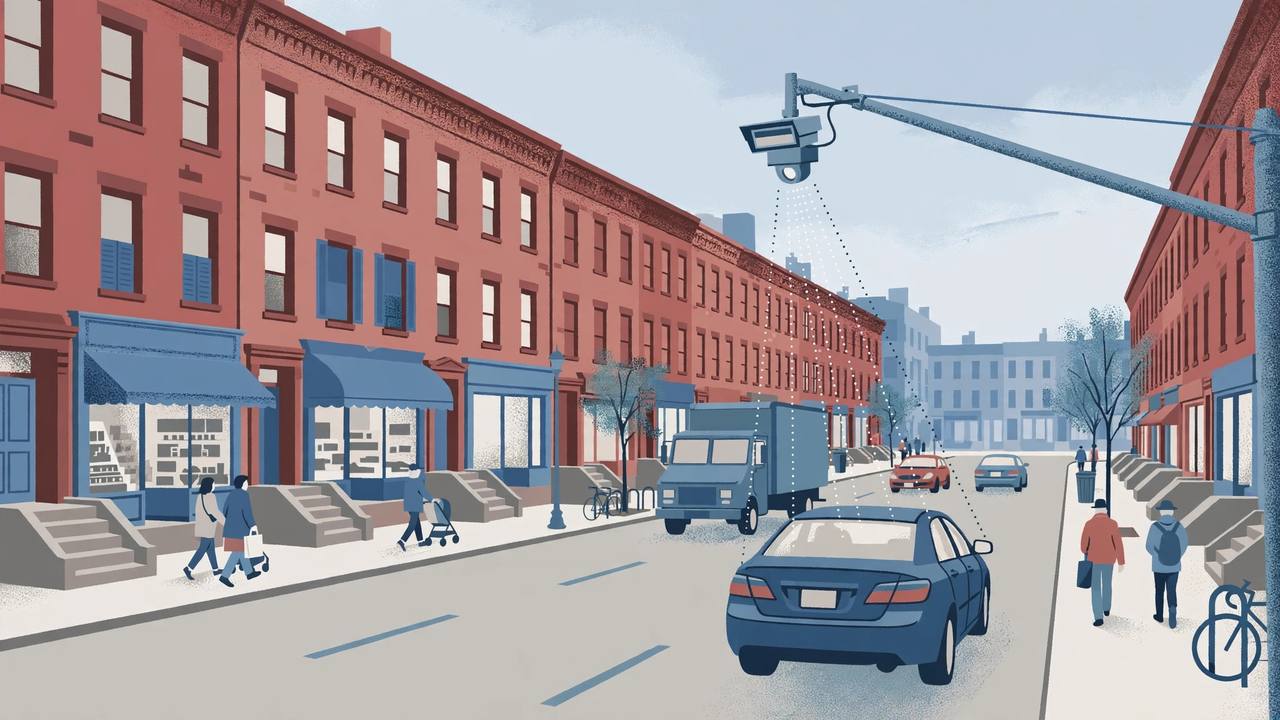
PHILADELPHIA — Drivers on U.S. Route 13 in West and North Philadelphia are now being ticketed by camera. Official ticketing on the final stretch of the city's Route 13 automated speed enforcement cameras began at 12:01 a.m. on Friday, October 30, 2026, the Philadelphia Parking Authority (PPA) announced — ending a 60-day warning period that began on August 31, during which speeding drivers received warnings in the mail instead of fines.
Source: Philadelphia Parking Authority (PPA)
The cameras enforce a 25 mph speed limit on this stretch of Route 13, PhillyVoice reported when the cameras were activated. A vehicle recorded travelling 11 mph or more over the posted limit is ticketed. The ticket is a civil violation issued by mail — the cameras photograph the back of the vehicle, and a police officer reviews the photo before a ticket is issued, according to the City's Office of Transportation and Infrastructure Systems (OTIS). No points are assigned to the driver's licence.
Source: PhillyVoice
Exactly where the newly enforcing cameras are
The PPA listed the camera locations on this final stretch of Route 13 as: the 6000, 5600, 4900, 4300 and 4200 blocks of Baltimore Avenue (the 4300 block eastbound, the 4200 block westbound, the others both directions); the 300 block of South University Avenue; the 200 block of North 38th Street; the 400 block of North 34th Street (southbound); the 3300 block of West Girard Avenue; the 2000 block of North 33rd Street; and the 3400 block of Ridge Avenue. PhillyVoice counted the new cameras along 11 blocks of the route, running from Baltimore Avenue in West Philadelphia to Hunting Park and Northeast Philadelphia.
This southern and western section completes the Route 13 rollout. The corridor's Northeast Philadelphia stretch — cameras at 9900, 8300, 7000 and 6400 Frankford Avenue, 3100 Levick Street and 2100 Robbins Street — went through its own warning period in the spring and has been issuing tickets since June 12. Route 13 cuts across the whole city, from Frankford Avenue in the Northeast to Baltimore Avenue in the West, which is why the PPA and OTIS treated it as one corridor in two phases.
Why Route 13 was chosen
The locations were not picked at random. OTIS — the city office that analyses citywide crash, speed and injury data — recommended Route 13 because the corridor showed a concentration of serious injuries, pedestrian crashes and speeding activity, the PPA said. After OTIS selects locations and sets the speed limit, the PPA works with the city and PennDOT to install and activate the cameras, each new stretch starting with the 60-day warning period that has now ended for this final section.
"Speed cameras dramatically reduced speeding along Roosevelt Boulevard by a staggering 95%," said Gabe Roberts, acting executive director of the PPA, when the warning period was announced. "Our goal is to continue saving lives and improving public safety on major traffic arteries in the city." The city's September annual report added that speeding violations on Broad Street had dropped 67% through March 2026, and that tickets on Roosevelt Boulevard — the program's first corridor, launched in 2020 — had fallen sharply as drivers slowed down.
A camera ticket arrives by mail to the vehicle's owner, carries a fine of $100–$150 depending on speed, and adds no points to a licence. The city says the cameras do not generate profit for the city or the PPA: fines go to PennDOT and are awarded back to Philadelphia through traffic safety grants, and PPA revenue above the program's costs is used for more traffic safety improvement programs in the city, OTIS deputy managing director Michael A. Carroll said.
The program this completes
Philadelphia's automated speed enforcement began on Roosevelt Boulevard in 2020, where about 40 cameras now run the length of the boulevard. Last year the PPA installed 31 cameras the length of Broad Street — which had surpassed Roosevelt Boulevard as the city's most dangerous road — bringing the city's total to 80 cameras including the Route 13 cameras, the PPA said at the August announcement. School-zone speed cameras operate under the same program, and their own full enforcement began earlier this year.
What it means for working drivers
Route 13 is a working road, not just a commuter one: it is the surface route delivery vans, trades vehicles and trucks use to cross West and North Philadelphia, and Baltimore Avenue is a busy commercial strip. For professional drivers the practical points are the 25 mph limit, the 11 mph ticket threshold and the mailed ticket — there is no roadside stop, so a driver may not know about a violation until the notice reaches the vehicle's owner, which for fleet and leased vehicles can be an employer. Because there are no licence points, a camera ticket does not by itself threaten a licence, but unpaid fines and repeated violations are recorded against the vehicle.
What happens next
Enforcement on Route 13 is now live in both its phases, and the PPA's data releases will show whether violation numbers on Baltimore Avenue and the North Philadelphia blocks fall the way they did on Roosevelt Boulevard and Broad Street. The expansion does not stop here: the city has identified State Route 2016 (Allegheny Avenue), State Route 1004 (Erie Avenue and Torresdale Avenue) and State Route 2001 (Delaware Avenue, Oregon Avenue east of Broad Street and Moyamensing Avenue) as the preferred corridors for the next speed cameras in the coming years, following the same pattern — OTIS data first, then installation, a 60-day warning period, and then tickets.