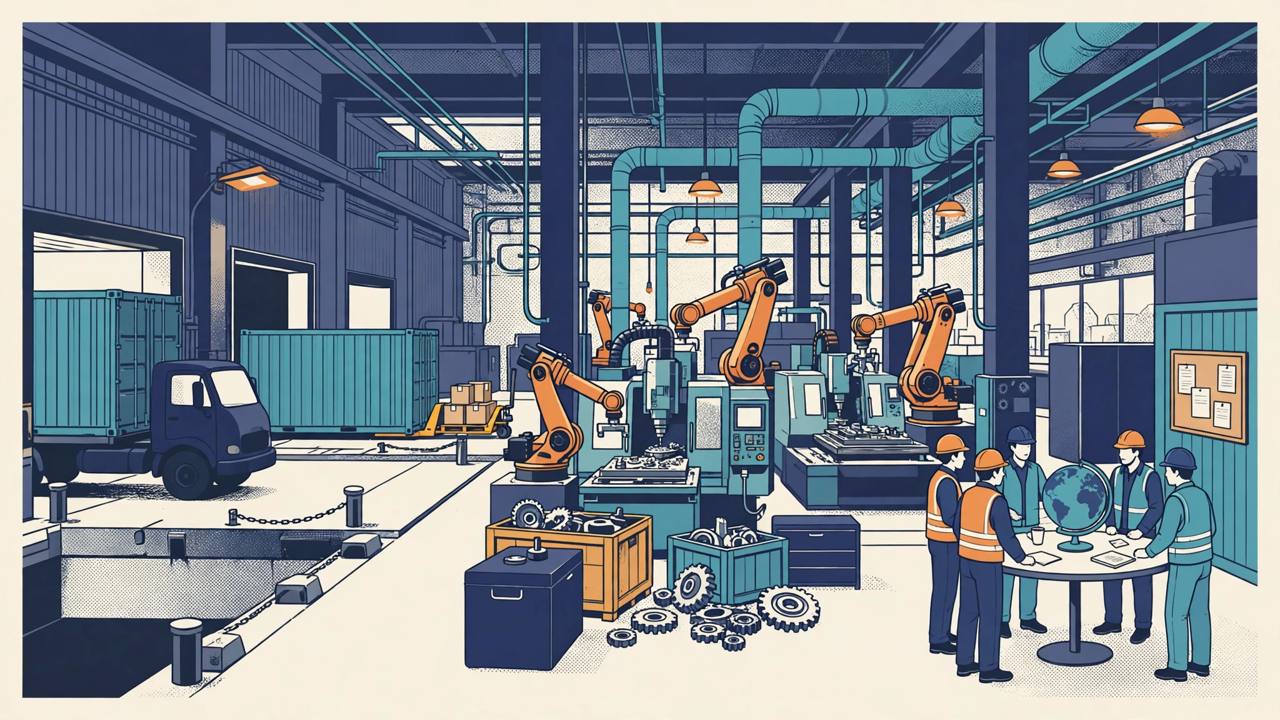
President Donald Trump signed a proclamation on Wednesday, October 28, 2026, formally concurring with a U.S. Department of Commerce finding that imports of robotics, industrial machinery, and their parts and components are entering the United States in such quantities and under such circumstances that they threaten to impair national security. The proclamation does not impose any new tariffs right away. Instead, it orders the administration to negotiate with trading partners first, and keeps tariffs and other import curbs on the table if those talks fail.
Source: KPMG TaxNewsFlash
Under the proclamation's operative terms, the Secretary of Commerce, Howard Lutnick, and the U.S. Trade Representative, Jamieson Greer, must jointly pursue or continue negotiations of agreements with foreign trading partners they deem appropriate, aimed at adjusting the imports. The two officials must report periodically to the President on the progress of the negotiations, with the first joint update due within 180 days of October 28, 2026, Bloomberg Tax reported.
How the case reached the President
The decision caps an investigation that the U.S. government launched in September 2025 into the national-security impact of imported robots and industrial machinery — a process that took more than a year from start to finish. Within the preceding 90 days, the Secretary of Commerce transmitted his investigation report to the President under Section 232 of the Trade Expansion Act of 1962, the statute that authorizes a president to adjust imports of an article being imported in quantities or under circumstances that threaten to impair national security. Trump recorded that he concurred with the Secretary's finding and determined that negotiations were necessary and appropriate.
The scope reaches far beyond the humanoid robots that dominate headlines. The investigation covered programmable computer-controlled mechanical systems, industrial stamping and pressing equipment, machine tools used for cutting, welding and handling workpieces, industrial ovens, high-pressure sterilization equipment, and laser-cutting and waterjet-cutting machinery — the workhorse equipment that turns raw material into finished parts on factory floors across the country.
Why the White House says it matters
According to the White House, robotics and industrial machinery are critical to virtually all modern manufacturing, including defence systems such as aircraft, tanks, ships, weapons and munitions, as well as to all 16 critical infrastructure sectors. The Commerce Secretary's report argued that the United States relies on foreign imports for most types of robotics and industrial machinery and lacks the domestic capacity to meet national-security needs, despite a recent surge in manufacturing investment. Reuters reported that U.S. manufacturers depend on imported equipment across much of this category, which is why an immediate new duty could have raised costs for the very factories the administration says it wants to strengthen.
No new tariff takes effect under this proclamation. Tariffs, duties, quotas and fees — and a possible incentive program for U.S. production — are explicitly held in reserve, to be considered depending on the status or outcome of the negotiations.
What happens next
The proclamation explains that additional import measures may follow if an agreement is not reached within 180 days, is not implemented, or proves ineffective. Depending on how the talks go, the President may consider imposing or modifying tariffs, duties, quotas and fees, and establishing a program to incentivize new investment in U.S. production of robotics, industrial machinery and their parts and components. The Secretary of Commerce must also continue monitoring these imports, in consultation with senior executive-branch officials he deems appropriate, and alert the President to any circumstances that might indicate a need for further action. Any provision of previous proclamations and executive orders that is inconsistent with the new proclamation is superseded.
The robotics order also stands in contrast to the administration's harder line on another category: a separate Section 232 proclamation on August 13 put tariffs of 25% to 100% on imported drones and listed components from September 3. For robots and factory machinery, by contrast, the administration chose negotiation first — a sequence that temporarily shields the many U.S. manufacturers who rely heavily on foreign equipment from a fresh round of tariff shocks, while leaving the policy question unresolved.
For Punjabi diaspora readers who work in U.S. manufacturing plants, warehouses, logistics and trucking, the stakes are practical rather than abstract: the machines covered by this proclamation are the equipment those workplaces buy, maintain and haul. If talks produce agreements, supply chains may adjust gradually; if they fail and tariffs follow, equipment prices and factory investment decisions across the country could change quickly. Awaaz Punjab will follow the 180-day negotiation window and report the first joint update when Commerce and the USTR deliver it.