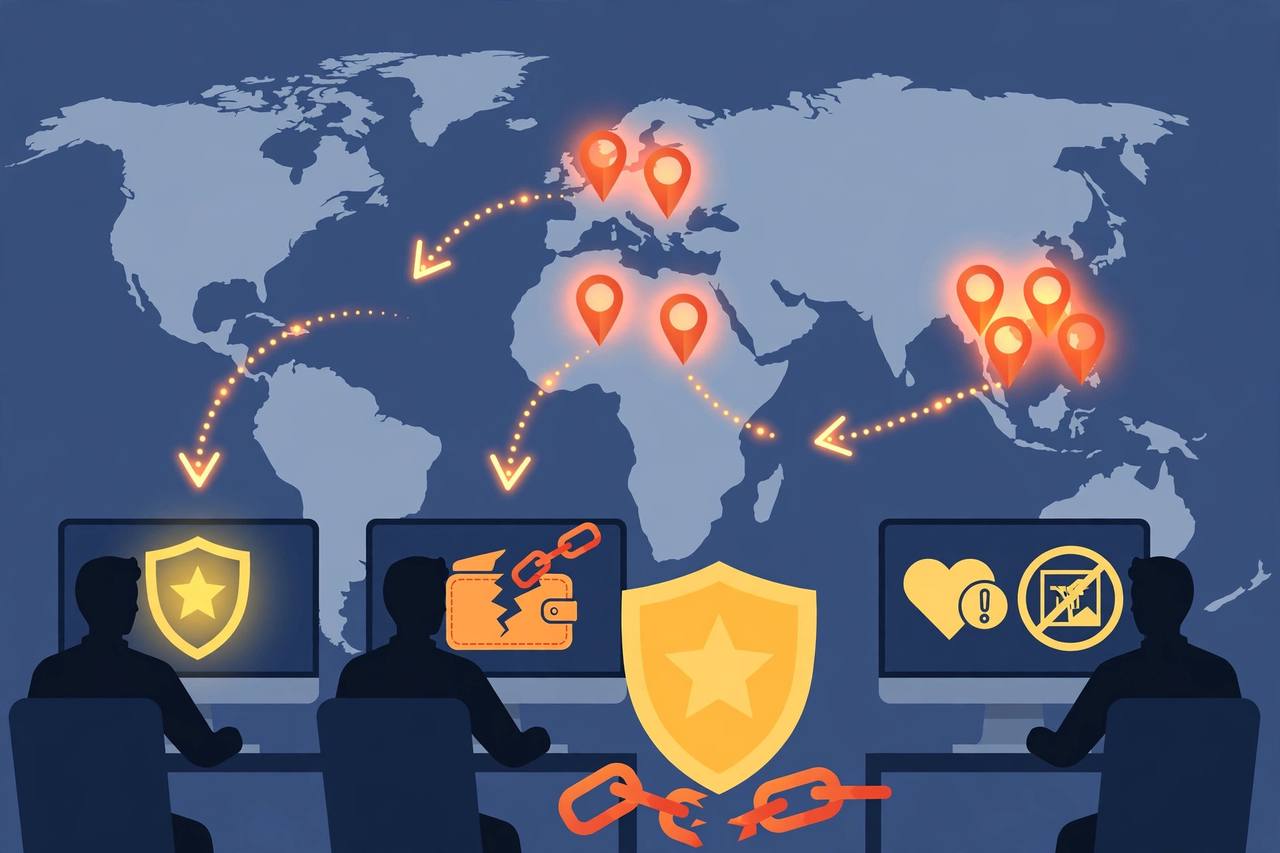
WASHINGTON — The Justice Department's Scam Center Strike Force is going global. On Tuesday, October 27, U.S. Attorney Jeanine Ferris Pirro announced in Washington that the strike force has expanded its personnel and its reach to a worldwide portfolio, charged six Africa-based scammers over a fake NFT investment scheme run from Madagascar, and has now restrained more than $1 billion in cryptocurrency linked to fraud — $1,006,460,156.82, by the department's own exact count.
Source: U.S. Department of Justice, U.S. Attorney's Office for the District of Columbia, Oct 27, 2026
The announcement, joined by U.S. Attorney Michael J. Heyman for the District of Alaska, FBI Criminal Division Assistant Director Heith Janke and U.S. Secret Service Washington Field Office Special Agent in Charge Tara McLeese, marks the strike force's clearest statement yet that the scam compounds it was created to fight in Southeast Asia have spread — following, prosecutors said, the expansion of Chinese-connected transnational criminal organizations (TCOs) into Africa and Europe.
Source: U.S. Department of Justice, U.S. Attorney's Office for the District of Columbia, Oct 27, 2026
How the alleged Madagascar NFT scam worked, step by step
As alleged in affidavits unsealed on Tuesday, a criminal group with connections to Malaysia and China opened scam compounds in Madagascar in early 2025, likely having moved those operations from Cambodia after law-enforcement action there. Scammers posed as beautiful women, met victims on dating websites, built relationships, and eventually persuaded them to connect their cryptocurrency wallets to fraudulent websites tied to fake NFT investments. Once a wallet was connected, prosecutors say, the scammers encouraged victims to keep funding it — and then secretly pulled money out without the victims' knowledge.
Source: U.S. Department of Justice, U.S. Attorney's Office for the District of Columbia, Oct 27, 2026
The affidavit detail reported by CryptoNews shows how the trap worked technically. In a test around August 28, an FBI agent opened the site inftchain.xyz through MetaMask's browser and connected a new wallet; a spending-cap prompt from inftvault.com, if signed, would have allowed a third party to transfer unlimited USDT from that wallet at any time. For one victim in Greenbelt, Maryland, who reported losing $11,926.12, the affidavit describes repeated unauthorized withdrawals — one took 9,067.64 USDT about 33 minutes after the victim deposited the tokens. Investigators traced stolen tokens through intermediary wallets to Binance and OKX; downstream OKX accounts were registered to Chinese users, and USDT was converted into Chinese yuan and sent to Alipay and WeChat Pay accounts, the affidavit says.
Source: CryptoNews, Oct 27, 2026
"Chinese TCOs are sending scammers into your dating network, your social network, and your messaging applications, all to steal Main Street America's bank accounts. For the last year, the Strike Force has fought hard against the compounds in Southeast Asia facilitating these scammers, to the tune of $1 billion in cryptocurrency restrained," U.S. Attorney Pirro said. "My Strike Force will expand and grow, and follow the scammers to Africa, India, Europe, and wherever they try to plant their operations."
The six charged — and what prosecutors say the leader's phones showed
The six defendants are Chui Kok Wa, Gislen Neukeu, Shamusa Ninsiima, Clement Mugiraneza, Merveille Mudacumura and Nicodemus Hingima Monyancha, accused of conspiracy to commit wire fraud, with Wa described as the leader of the NFT scheme, CryptoNews reported from the affidavit. All of these are allegations; the defendants are presumed innocent until proven guilty.
Source: CryptoNews, Oct 27, 2026
According to the Justice Department, Wa's phones contained employment contracts detailing overnight work schedules in Madagascar corresponding to daytime and evening hours in the United States, bonus payments tied to money stolen, a roster with employees' names, passport information, salaries, hours and disciplinary actions, and a list of employee cryptocurrency wallet addresses. The phones also held 'scripts' telling workers, in the guide's own words, that they were committing 'an emotional scam, using the [victim's] feelings for us to get him to invest.' Chainalysis, which assisted the strike force, traced one victim who lost over $30,000, with funds sent to crypto exchanges for cash-out.
Source: U.S. Department of Justice, U.S. Attorney's Office for the District of Columbia, Oct 27, 2026
"The defendants allegedly operated a sophisticated fraud scheme from Madagascar, exploiting the trust of Americans to steal their hard-earned money," said U.S. Attorney Heyman. "Operating from overseas does not place those who target Americans beyond the reach of U.S. law enforcement." Secret Service Special Agent in Charge McLeese added: "Cybercriminals running scam centers wrongly assume they can relocate to escape our reach." FBI Assistant Director Janke said the compounds 'don't stop at borders — they target Americans' vulnerabilities and hard-earned money.'
Source: U.S. Department of Justice, U.S. Attorney's Office for the District of Columbia, Oct 27, 2026
Background: a strike force built for Southeast Asia, now chasing a moving target
The Scam Center Strike Force was officially launched by U.S. Attorney Pirro in November 2025 to address Chinese organized-crime syndicates operating scam centers primarily in Southeast Asia, targeting cryptocurrency investment fraud, cyber-enabled fraud, human trafficking and money laundering. Its partners include the FBI, the U.S. Secret Service, the Justice Department's Criminal Division, the U.S. Postal Inspection Service, IRS Criminal Investigation and Homeland Security Investigations, plus the U.S. Attorney's Offices for Alaska, Hawaii, Eastern North Carolina, Rhode Island and Western Washington. On March 6, 2026, President Trump signed Executive Order 14390, directing the administration to prioritize cybercrime, fraud and predatory schemes against American citizens — the order under which Tuesday's actions were taken.
Source: U.S. Department of Justice, U.S. Attorney's Office for the District of Columbia, Oct 27, 2026
The scale behind the expansion is in the FBI's own Internet Crime Complaint Center (IC3) figures cited by the department: cyber-enabled fraud was responsible for almost 85 percent of all losses reported to IC3 in 2025, and reported losses from cryptocurrency investment fraud rose from $4.57 billion in 2023 to $8.65 billion in 2025 — an increase of 89 percent. The department notes those are only reported losses and likely significantly understate the true total, because most victims never report.
Source: U.S. Department of Justice, U.S. Attorney's Office for the District of Columbia, Oct 27, 2026
Tuesday's announcement also covered two related cases. In South Africa, the D.C. U.S. Attorney's Office and the Secret Service worked with South African police to charge Ifeel Simango, described as a prolific sextortionist who allegedly extorted at least 54 victims; he faces 52 charges in South Africa. And with the Nigerian Police Force's National Cyber Crime Center, following a referral from Microsoft's Digital Crimes Unit, investigators arrested three key players alleged to be behind RaccoonO365, a phishing-kit operation that allegedly stole at least 5,000 credentials from 94 countries and disrupted critical surgical care at U.S. hospitals. Both cases are allegations against the named defendants.
Source: U.S. Department of Justice, U.S. Attorney's Office for the District of Columbia, Oct 27, 2026
Why this matters for Punjabi diaspora readers in the USA
Pirro's warning named the exact channels diaspora families use every day — dating networks, social networks and messaging applications. The Madagascar method did not hack anyone's bank; it persuaded victims, over weeks of romantic conversation, to connect a wallet and sign an approval that quietly allowed unlimited withdrawals later. For Punjabi and other South Asian households in California, New York, New Jersey, Texas and across the U.S. — including older parents who are frequent targets of investment and romance pitches on WhatsApp, Facebook and dating sites — the practical lesson from the affidavit is precise: never connect a crypto wallet to an investment site a stranger sends you, never sign a spending-cap approval you were rushed into, and treat any 'guaranteed' NFT or crypto return as a red flag. The strike force is also running a national consumer-awareness campaign with the Postal Inspection Service, the FBI and the Secret Service, and a study by the Ad Council Research Institute on how scammers target older adults is due in the coming months.
Source: U.S. Department of Justice, U.S. Attorney's Office for the District of Columbia, Oct 27, 2026
What happens next
Pirro called on Madagascar to extradite the six charged defendants. The path is not clean: in August 2026 the FBI deployed to Madagascar at the invitation of its Ministry of Justice and National Police and helped take down 13 scam compounds, but U.S. officials say Madagascar repatriated numerous suspects to China before the investigation was complete, and efforts to interview those involved were stymied. The U.S. government has also obtained a material-witness warrant to interview 15 employees of the scheme who claimed they were human-trafficked and abused by Wa but are believed to be held in jail in Madagascar. The Madagascar case is being handled by Assistant U.S. Attorneys Karen P. Seifert, who directs the strike force, and Mac Caille Petursson of Alaska, with the FBI's Honolulu Field Office. Separately, the strike force says it has seized thousands of Starlink terminals used by scam centers, seized the first Telegram channel used to recruit trafficking victims into scam compounds, and — working with private industry — seen Meta deplatform 17.3 million scam accounts in the last year.
Source: U.S. Department of Justice, U.S. Attorney's Office for the District of Columbia, Oct 27, 2026