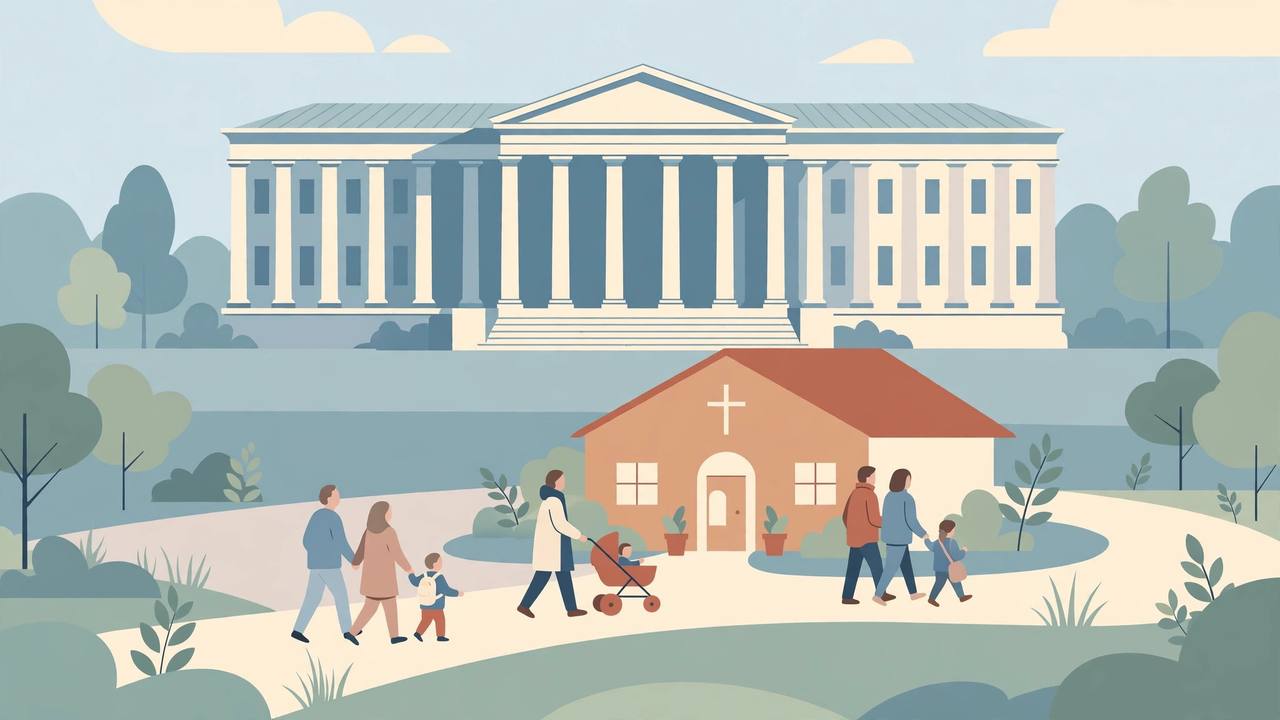
WASHINGTON — The US Supreme Court heard arguments on Tuesday, November 3, in St. Mary Catholic Parish v. Roy, and the court's conservative justices appeared sympathetic to Catholic preschools seeking an exemption from the admissions rules attached to Colorado's publicly funded universal preschool program, Reuters reported. It is the latest step in a case the court agreed in April to hear; a decision is expected by the end of the court's term in June.
Since 2023, Colorado has offered every family 15 hours a week of free preschool in the year before kindergarten — a benefit worth about $6,000 per child, created by a ballot measure voters approved in 2020 and funded through Proposition EE. Parents may choose public or private providers, including religious ones, but every participating preschool must promise “equal opportunity” enrollment regardless of the sexual orientation or gender identity of a child or a parent — two of the eight characteristics the program's rules cover, according to court filings reported by the Associated Press.
Source: Associated Press
The Catholic schools' argument
The case was brought by St. Mary Catholic Parish in Littleton and St. Bernadette parish's Wellspring Catholic Academy in Lakewood, together with the Archdiocese of Denver and parishioners Daniel and Lisa Sheley. The archdiocese oversees 34 preschools, and its policy is to enroll only families who support Catholic teaching, including its positions on same-sex relationships and gender identity. The plaintiffs, represented by the Becket Fund for Religious Liberty, say the state rejected their request for an exemption, that their enrollment has dropped 20 percent since the program started, and that the Sheleys — parents of seven children — have missed out on more than $12,000 in tuition help by choosing a parish preschool, according to the filings and hearing coverage.
“The Archdiocese of Denver schools exist to pass on the faith to the next generation,” Nicholas Reaves of Becket told the justices. He argued that Colorado had “flexibly interpreted” its mandate where secular interests were concerned — the program lets schools give priority to low-income and disabled children, and the plaintiffs count 17 exemptions granted for reasons such as vaccination status and residential location — while calling the same law “a hard limit” when the Catholic schools sought a religious accommodation.
Justice Amy Coney Barrett pressed Colorado's lawyer, deputy solicitor general Helen Norton, on exactly that distinction: “Explain what the difference is between (explicit exclusion of religious schools) and then choosing to impose a condition that you know that those schools will be unable to agree to?” she asked — suggesting the condition may in practice amount to the same thing as exclusion.
Source: Reuters
Colorado's defence — and the hard questions it drew
Norton answered that “Colorado welcomes religious preschools” to the program and asks only that they “comply with the same conditions that every publicly funded preschool must meet, religious and secular alike,” adding that faith-based preschools remain free to teach their religious beliefs, including about sex, gender and marriage, while receiving public funding. State officials have accused the Catholic schools of seeking legal permission to discriminate against 4-year-olds and their families while taking taxpayer dollars.
The challengers, however, also took hard questions. Chief Justice John Roberts told Reaves that the court's earlier rulings in favour of religious schools involved laws that “expressly discriminated against religious schools on its face” — “That's not the case here.” Justice Elena Kagan made a related point: a key earlier case stands for the principle that “you can't treat religious institutions differently,” she said. “That's not the principle that's at issue here. The principle at issue here is: Do you have to treat them better?” Justice Sonia Sotomayor also expressed skepticism toward the challengers' reading of those precedents, Reuters reported.
The 1990 precedent at the centre of the case
Two lower courts have ruled for Colorado — most recently the 10th US Circuit Court of Appeals in September 2025 — relying on Employment Division v. Smith, the Supreme Court's 1990 decision that neutral laws of general application do not violate the First Amendment's Free Exercise Clause merely because they burden religious practice. The Catholic groups have asked the justices to revisit Smith, but when the court took the case in April it declined to consider overruling that precedent. The challengers also rely on later rulings — Fulton v. City of Philadelphia, Tandon v. Newsom and Carson v. Makin — which barred governments from treating religious activity worse than comparable secular activity. President Donald Trump's administration backs the preschools: principal deputy solicitor general Sarah Harris argued on their side, as the US Conference of Catholic Bishops also supports them. Colorado's defence is led by the office of Democratic attorney general Phil Weiser.
This is the hearing trailed in our October 26 report on the Supreme Court's November session, which also previewed the H-2A farm-labour and pipeline land cases being argued this month. Read the earlier report
What happens next
The justices will now vote in conference and assign the majority opinion; a ruling is expected by the end of June 2027. A win for the parishes would not strike down Colorado's program — it would require the state to admit the Catholic preschools without the two contested conditions — but lawyers on both sides agree the reasoning could reach far beyond preschool, to the many public-benefit programs that attach nondiscrimination conditions to public money. Michigan State University law professor Frank Ravitch told the National Catholic Reporter that “the stakes here are much bigger than the issues just in this case.” The First Amendment's Establishment Clause — the church-and-state separation provision — is not directly at issue in the case, Reuters noted.
St. Mary Catholic Parish v. Roy (No. 25-581) — argued November 3, 2026. Question: may Colorado require preschools in its universal program to accept every family regardless of sexual orientation or gender identity, or must it exempt Catholic schools whose faith teaches otherwise?