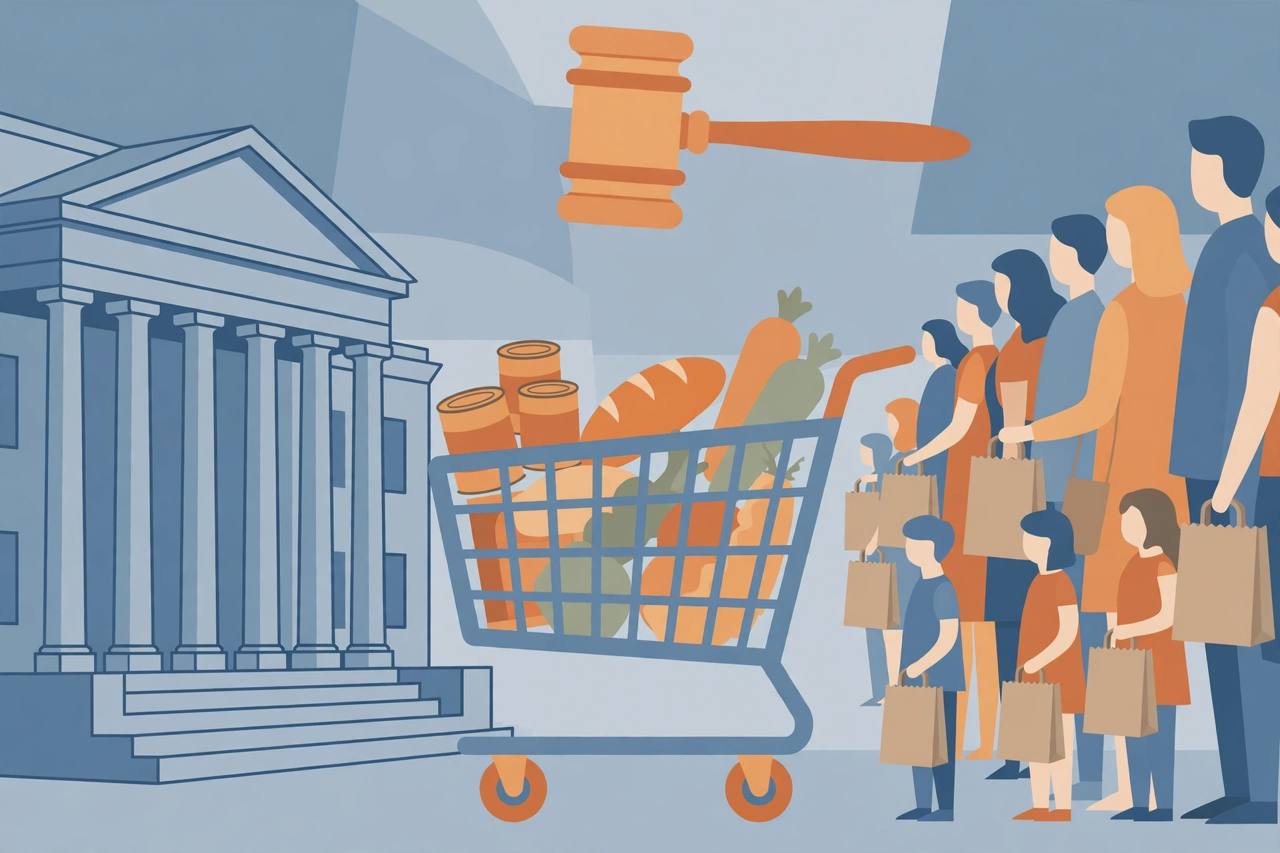
Two federal judges ruled on October 31 that the Trump administration is legally required to use the U.S. Department of Agriculture's contingency fund to keep food assistance flowing during the federal government shutdown — one day before November SNAP benefits were set to lapse for approximately 42 million Americans. In Boston, a federal judge held that the administration's refusal to use the fund is “contrary to law” and called its argument that the money could not be used during a shutdown “erroneous,” according to the National Low Income Housing Coalition (NLIHC). In Rhode Island, U.S. District Judge John J. McConnell Jr. granted a temporary restraining order and said the Agriculture Department must distribute the contingency funds “timely, or as soon as possible, for the November 1 payments to be made.”
Source: National Low Income Housing Coalition
The Supplemental Nutrition Assistance Program — SNAP, known widely as food stamps — helps about one in eight people in the United States buy groceries, in every county in the nation. Most recipients are families with children, people with disabilities, older adults, caregivers, students and low-wage workers: U.S. Department of Agriculture data for fiscal 2023 showed 79 percent of SNAP households included a child, an elderly person or a nonelderly person with a disability, OSV News reported. Benefits arrive on electronic benefit transfer (EBT) cards that work like debit cards for essential foods.
Source: Catholic Review / OSV News
What each judge ordered — and the deadlines
In Massachusetts, Judge Indira Talwani required the administration to explain by Monday, November 3, how it will disperse the benefits as soon as possible, while recognising that the money would not reach people at the very start of the month, Boston University's School of Public Health reported. The Boston ruling orders at least partial payments funded from the contingency reserve. In Rhode Island, Judge McConnell's temporary restraining order gave the administration until the end of November 3 to make full payments, or until November 5 to present a workable plan for partial benefits, according to NLIHC. The two cases arrived by different doors: a coalition of cities and nonprofits sued in Rhode Island, and Democratic state officials sued in Massachusetts, after the administration said last month it would halt November payments if the shutdown was not resolved.
Source: Boston University School of Public Health
The arithmetic explains why “partial” keeps appearing in the rulings. The emergency reserve at the centre of the cases holds more than $4.6 billion, while paying full November benefits costs between $8.5 billion and $9 billion a month. Judges in both cases ordered the government to use the reserve and gave it leeway to tap other money to make full payments. The average monthly SNAP benefit is usually about $190 per person, the Associated Press has reported, and loading benefits onto EBT cards involves steps by federal and state agencies and vendors that can take time even after a court order.
Source: Associated Press reporting, via Press Democrat
Trump says he has asked the courts to clarify; Schumer demands full funding
President Donald Trump addressed the rulings in an October 31 post on Truth Social. “Our Government lawyers do not think we have the legal authority to pay SNAP with certain monies we have available, and now two Courts have issued conflicting opinions on what we can and cannot do. I do NOT want Americans to go hungry just because the Radical Democrats refuse to do the right thing and REOPEN THE GOVERNMENT. Therefore, I have instructed our lawyers to ask the Court to clarify how we can legally fund SNAP as soon as possible,” he wrote, adding that even with immediate guidance, payment “will unfortunately be delayed while States get the money out.” Senate Minority Leader Chuck Schumer replied on X that “USDA has the authority to fully fund SNAP and needs to do so immediately. Anything else is unacceptable,” and called sending only partial benefits “cruel and callous” as Thanksgiving approaches. Both statements are the leaders' own characterisations of a legal dispute the courts are still deciding.
Source: Catholic Review / OSV News
Why a grocery benefit reaches truckers, stores and immigrant families
SNAP is also a working part of the food economy that many Punjabi-American families and truckers serve. “Each dollar of SNAP benefits can generate between $1.54 and $1.80 in total economic activity,” Boston University researcher Stephanie Ettinger de Cuba noted — a suspension would hit “shelf stockers, cashiers, truck drivers delivering food to grocery stores, farmers supplying the food.” For every one meal food pantries provide, SNAP provides nine, she added. Public-health researcher Paul Shafer cautioned that even with the court orders, “millions may still struggle to put food on the table this week while the details are worked out,” because states and food banks cannot replace billions of dollars a month in food purchases. Researchers also warn that eligible immigrant families — lawful permanent residents, refugees and asylees among them — have been pulling back from benefits they qualify for amid stepped-up immigration enforcement, deepening hardship in those communities.
Source: Boston University School of Public Health
Congress has passed neither fiscal 2026 funding bills nor a continuing resolution to keep programs running; Democrats are withholding support to press for an extension of Affordable Care Act tax credits that expire at the end of the year, NLIHC reported. The same shutdown is delaying Low-Income Home Energy Assistance Program (LIHEAP) money — heating help for 6.2 million households — because the HHS staff who administer it were terminated in April 2025 or are furloughed, and a July tax-and-spending law already cuts $186 billion from SNAP over the next decade, separate from the shutdown fight.
What happens next is a dated checklist, not a guess. By November 3, USDA must give the Boston court its plan for issuing at least partial payments, and must meet Judge McConnell's full-payment deadline or pivot to his November 5 partial-benefits deadline. Recipients should expect timing to vary by state, because each state loads its own EBT cards after federal money is released. If Congress ends the shutdown, the court fight over the contingency fund becomes moot for November; if it does not, the judges' orders — and any clarification the administration says it is seeking — will decide how much food money reaches 42 million people, and when.