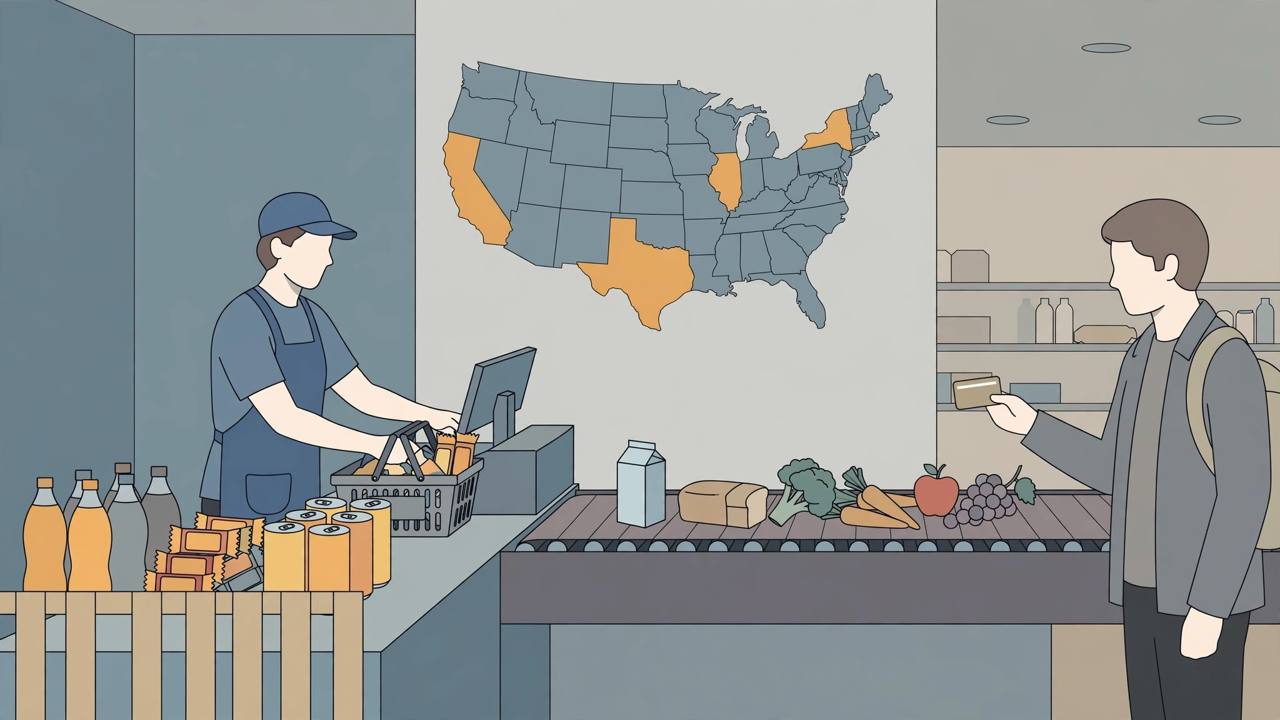
Starting today, Sunday, November 1, 2026, shoppers who pay with SNAP food benefits in Montana, North Dakota, South Carolina and Virginia will find that part of their basket no longer scans through on the benefit card. Under food restriction waivers approved by the U.S. Department of Agriculture (USDA), the four states begin blocking SNAP purchases of soda and other sweetened drinks today — and in three of the four, candy and energy drinks as well. The change is about what the card can buy, not how much is on it: the USDA and the states stress that eligibility and benefit amounts do not change.
Source: USDA Food and Nutrition Administration
What changes today, state by state — no two lists are the same
Montana restricts high-sugar beverages, energy drinks, candy and prepared desserts, according to the USDA's waiver tracker. North Dakota restricts sweetened beverages, energy drinks and candy. South Carolina restricts candy, energy drinks, soft drinks and sweetened beverages. Virginia is the narrowest of the four: it restricts only carbonated sweetened drinks — soda, diet soda, 'zero' soda, carbonated energy drinks, and any carbonated drink with 5 grams or more of added sugar per serving — and does not restrict candy at all, the Virginia Department of Social Services (VDSS) confirms.
Source: USDA Food and Nutrition Administration
The details matter at the register. Diet soda is still SNAP-eligible in South Carolina and Montana but not in Virginia or North Dakota. In Virginia, everything else on the drinks shelf stays eligible, VDSS lists: milk and milk alternatives, juice, infant formula, sports drinks, iced tea, lemonade, iced coffee, kombucha, yogurt drinks, meal replacement drinks and unsweetened seltzer. Virginia's waiver, run by the state as its 'SNAP Healthy' programme, is a demonstration project scheduled to end on March 31, 2028. VDSS states plainly: 'Virginians' eligibility to participate in SNAP and their benefit amount are not affected by this change.'
Source: Virginia Department of Social Services
How it works at the checkout — and why the store's state, not yours, decides
If a restricted item is scanned, the payment system simply will not let SNAP pay for it; the shopper can still buy it with cash, a debit card or a credit card, North Dakota's waiver guidance explains. The rule that applies is the rule of the state where the store sits, not the state that issued the shopper's card — so a family that lives in one state and shops across the line, or a truck driver buying food at a stop on the road, is governed by the store's list. Montana is giving retailers about 90 days to finish implementation and fix product-classification problems, so shoppers there may see some inconsistency in the first weeks while store systems catch up.
Source: Food World News
Background: a state-by-state rewrite of America's food-benefit rules
SNAP — the Supplemental Nutrition Assistance Program, still widely called food stamps — is the federal food benefit that USDA participation data put at about 37 million people in May 2026. Federal law has long set a national list of eligible foods, and these waivers are the mechanism that lets a state carve items out of its own list for a test period. Eight states were already enforcing restrictions before today: Indiana and Utah from January 1, 2026, Idaho and Oklahoma from February 15, Louisiana from February 18, Texas from April 1, Florida from April 20 and Arkansas from July 1 — which makes twelve states with live restrictions after today. Twenty-three states in all have received USDA approval, as part of the 'Make America Healthy Again' agenda championed by Agriculture Secretary Brooke Rollins and Health and Human Services Secretary Robert F. Kennedy Jr., according to the National Association of Convenience Stores (NACS), which tracks the waivers for retailers.
Source: NACS
The court fight running underneath — five waivers already struck down
The programme's legal ground is contested. On June 22, 2026, U.S. District Judge Amy Berman Jackson in Washington, D.C., in the case Aragon et al. v. Rollins et al., vacated USDA's approvals for Colorado, Iowa, Nebraska, Tennessee and West Virginia, ruling that USDA did not have the legal authority to approve them in the first place; USDA has appealed, the USDA tracker notes. That ruling is also why today's start was delayed: South Carolina's waiver was first set to begin August 31 and North Dakota's on September 1, but USDA asked both states to push implementation to November 1 so the federal government could take public comment and review the court decision, Grocery Dive reported from the states' own accounts. Ohio's waiver, set for October 1, remains on hold for the same reason. The June ruling did not apply to the four states starting today, but the pending appeal means the legal status of all of these programmes could still change.
Source: Grocery Dive
Each state runs its own list and its own help channel: Virginia — SNAPHealthy@dss.virginia.gov; Montana — healthysnap@mt.gov; North Dakota — snaphealthychoicewaiver@nd.gov; South Carolina — the state's Healthy Food SC inquiry form. The notice from your state agency is the final word for your card: if a letter from your agency says something different from any general guide, the letter wins.
What it means for families — including newcomer and trucking households
For households that plan a month's food around the benefit deposit, the practical risk is embarrassment and delay at the till, not a smaller benefit: the same dollars arrive, but a soda, an energy drink or — in Montana, North Dakota and South Carolina — a bag of candy now needs a second payment method or goes back on the shelf. That lands hardest in exactly the places these four states' lists differ, because a drink that is blocked in Richmond may be eligible a short drive away in a state with no waiver, and a drink allowed in Columbia, South Carolina, may be blocked in Fargo. The USDA's fiscal 2027 benefit tables, in force since October 1, set the maximum at $306 a month for a one-person household and $1,023 for a family of four in the 48 contiguous states and D.C., with a $25 minimum — none of those figures changes today.
Source: USDA Food and Nutrition Administration
What happens next
Nebraska is next on the calendar: its new waiver is listed by USDA to start December 1, 2026, restricting soda, soft drinks and energy drinks, with candy added on March 1, 2027. Wyoming follows on February 1, 2027, Kansas and Missouri on February 15, 2027, Hawaii and Ohio on April 1, 2027, and Nevada on February 1, 2028, according to the USDA tracker's schedule — and Ohio's date depends on the on-hold review clearing first. Retailers in the four November states will spend the next 90 days finishing checkout-system updates under USDA compliance expectations, and the Aragon appeal will decide whether the whole waiver model survives. For shoppers, the immediate step is simple: check your own state's list before the first November shop, and expect the register — not the shelf — to enforce it.