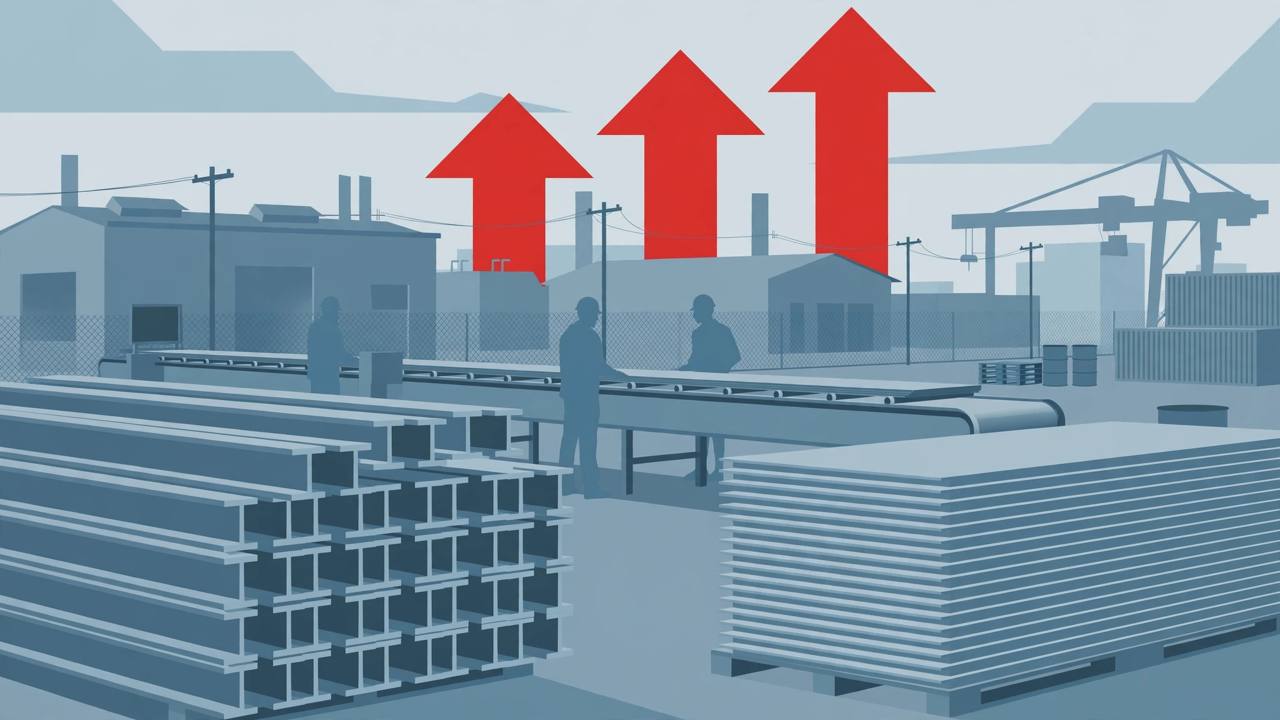
The 50-per-cent U.S. tariffs on steel and aluminum have delivered a sharp price shock to American manufacturers but no substantial revival in production or jobs, according to an Economic Note released on October 22 by the Montreal Economic Institute (MEI). The study found that U.S. steel prices have jumped 33.9 per cent and aluminum prices 58.0 per cent since February 2025.
Source: Montreal Economic Institute (IEDM)
President Donald Trump imposed 25-per-cent tariffs on steel and aluminum in March 2025 under Section 232 of the Trade Expansion Act of 1962, and the rate was raised to 50 per cent a few months later, the institute notes. Since February 2025, the U.S. producer price index for steel mill products has risen 33.9 per cent, while the index for aluminum mill shapes has risen 58.0 per cent.
"All that the tariffs have accomplished since being put in place is to raise prices for U.S. manufacturing companies that need steel and aluminum," said Joseph Steinberg, a professor of economics at the University of Toronto and an MEI senior fellow, in the institute's release.
Prices up sharply, output and jobs nearly flat
The production and employment gains were small next to the price rises, the study says. U.S. steel production increased 7.6 per cent and steel-sector employment 0.7 per cent. Aluminum production fell 0.1 per cent, while employment in aluminum and other nonferrous metals rose by just 0.6 per cent.
For comparison, over the period from December 2024 to June 2026, Canadian prices rose only 1 per cent for steel and 26 per cent for aluminum, the institute says. It cautions that these are not formal estimates, but says the gaps of more than 30 percentage points on both metals give an idea of the size of the tariff effect on U.S. prices.
Coverage of the study in the National Post summarized its conclusion the same way: the tariffs have mainly benefited the U.S. government and existing producers, while raising costs across industries such as autos and construction. That is the study's conclusion, presented here as its authors state it.
Source: National Post (via CAMSC tariff roundup)
Steel and aluminum go into cars, trucks, trailers, buildings and machinery. When U.S. mill prices rise by a third to more than half, those costs filter into vehicle prices, construction budgets and freight equipment — expenses that reach diaspora families and Punjabi trucking and construction businesses across the United States.
What is solid
- The tariff rate on steel and aluminum was raised from 25 per cent to 50 per cent after March 2025 (MEI).
- U.S. producer price indexes rose 33.9 per cent for steel mill products and 58.0 per cent for aluminum mill shapes since February 2025 (MEI, from official price data).
- The MEI Economic Note was released on October 22, 2026.
What is only claimed
- How much of the price rise is caused by the tariffs themselves — MEI says its Canada comparison is not a formal estimate, though it points to a gap of more than 30 percentage points.
- Whether the tariffs will deliver a longer-term industrial revival — the study concludes they have not done so yet; that is the institute's analysis, not a government finding.