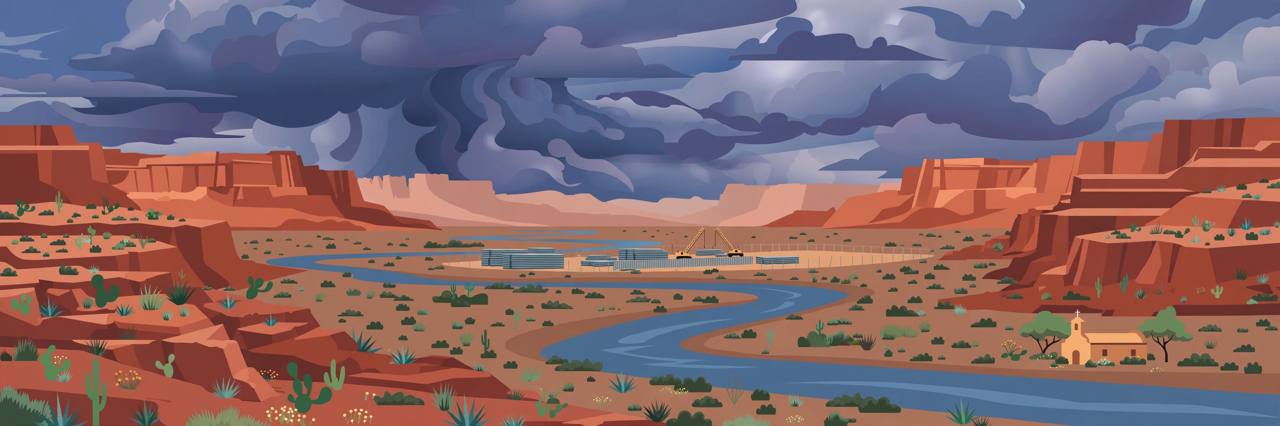
The landowners, conservationists and church preservationists fighting the border barrier in Texas's Big Bend country have now given the Supreme Court their answer: leave the halt on construction exactly where it is. In a 40-page filing on Thursday, October 29, the challengers urged the justices to refuse the Trump administration's emergency request to lift a federal judge's order that has stopped barrier work across the Big Bend region, including inside Big Bend National Park. Their lawyer, Eric Glitzenstein, warned that granting the request would let the administration "immediately resume blasting, bulldozing, road construction, and other border barrier-related construction across one of the most remote and ecologically and culturally significant landscapes in the United States."
Source: SCOTUSblog, Oct. 30, 2026
On October 21 we reported the administration's emergency application asking the Supreme Court to pause the injunction and summarily reverse it. Thursday's filing is the challengers' formal answer, filed by the 4 p.m. Eastern deadline Justice Samuel Alito set for October 29 — the case is now fully before the justices. Read the earlier story
What the challengers told the justices
The heart of the opposition is the major questions doctrine — the principle that Congress must speak clearly before an agency can make decisions of vast economic or political significance. The decision to waive "myriad federal, state, local, and tribal laws across vast geography for the purpose of building border infrastructure, even through national and state parks where border crossings are minuscule, is a truly 'extraordinary' assertion of power," the challengers wrote. "Whatever authority Congress delegated, it did not clearly authorize the sweeping exercise of power asserted here," they told the court, calling the waivers a constitutional violation of that doctrine.
Source: SCOTUSblog, Oct. 30, 2026
The challengers also attacked the government's claim of emergency harm — one of the factors courts weigh before granting temporary relief. The Department of Homeland Security will suffer no permanent harm from a temporary block, they argued, pointing out that before Judge Cardone issued her order, DHS itself had, "in response to intense local opposition," voluntarily paused construction for weeks across vast portions of the project area. A department that stopped work on its own, the filing implies, cannot credibly call the same stoppage an emergency.
Source: SCOTUSblog, Oct. 30, 2026
The judge's order underneath it all
On October 2, U.S. District Judge Kathleen Cardone in El Paso barred DHS from continuing construction in the Big Bend region "until and unless" the government complies with environmental and other applicable laws. Her written opinion followed on October 14. Cardone held that the challengers were likely to win: the 1996 Illegal Immigration Reform and Immigrant Responsibility Act lets the Homeland Security secretary waive "all legal requirements" to speed barrier construction, but read together with the neighbouring provision, she said, that power applies only to construction "to deter illegal crossings in areas of high illegal entry" — and Big Bend, which covers more than a quarter of the border yet produces only a tiny fraction of apprehensions, is not such an area. "If the Big Bend Sector is an area of high illegal entry, so is every other sector," she wrote, warning against readings that render Congress's limiting language meaningless.
Source: SCOTUSblog, Oct. 30, 2026
The government's case, in its own words
Solicitor General D. John Sauer, in the October 21 application, argued first that Cardone had no power to hear the claim at all: the complaint alleged a statutory failing — that the secretary "lacked 'clear congressional authorization'" — and, Sauer said, Congress denied district courts the authority to entertain statutory challenges to waiver decisions, leaving only constitutional ones. In any event, he continued, "even assuming that the Secretary's waiver authority implicates a question of 'vast economic and political significance,' Congress did clearly authorize the Secretary both to build border barriers and to waive legal requirements in order to facilitate their expeditious construction." The three waivers at issue were issued earlier this year by then-Secretary Kristi Noem and her successor, Markwayne Mullin.
Source: SCOTUSblog, Oct. 30, 2026
The government says the injunction has halted about 340 miles of planned barriers and roads, that five construction contracts have been awarded and that about three-quarters of a mile of barrier is already in place, with field offices, supply yards, a water-delivery system and a concrete batch plant standing idle. Plans described in the dispute include about 17 miles of noncontiguous vehicle barriers inside Big Bend National Park. Customs and Border Protection Commissioner Rodney Scott said in an August 13 statement that no 30-foot wall is planned inside Big Bend National Park or Big Bend Ranch State Park. The challengers are the Friends of the Ruidosa Church, formed to preserve a historic church on the Rio Grande, the Center for Biological Diversity, a local landowner and a Big Bend river guide; they sued in April.
The case is captioned Mullin v. Friends of the Ruidosa Church, No. 26A560, and it reaches the justices on the emergency docket — the same fast track on which so much of the administration's immigration programme has been fought this year. The government has not only asked for a stay; it has asked the court to treat the application as a petition for review and to reverse Judge Cardone summarily, without full briefing or argument. That is an unusually aggressive ask, and Thursday's opposition is the challengers' one full chance to talk the justices out of it before they act.
Source: Reporting by CBS News and SCOTUSblog, October 2026
Why a West Texas wall fight matters to this site's readers
Big Bend is remote desert, but the legal question is national: how far a Homeland Security secretary's waiver pen reaches — over environmental law, over a national park, over private ranch land — is the same question that decides how quickly enforcement infrastructure can be built anywhere on the border. For Punjabi and other immigrant families in the United States, and for the truckers who run the Interstate 10 corridor through El Paso and West Texas past this sector every day, the ruling will set the practical speed limit on border construction for years. Both sides agree on one thing: the sector is vast, crossings are comparatively few, and the landscape — canyon, river and desert — cannot be un-built once machines cross it.
What happens next
No date has been set for a ruling, and none is required: with the opposition now filed, the justices can grant or deny the emergency application at any time, with or without explanation. Until they act, Judge Cardone's injunction remains in force and construction stays stopped. If the court grants the stay, barrier work can resume while the case proceeds; if it goes further and summarily reverses, the waiver fight in Big Bend is effectively over. If it denies the application, the case returns to the ordinary appellate track in the Fifth Circuit — and the most remote stretch of the U.S.–Mexico border stays, for now, exactly as the river left it.