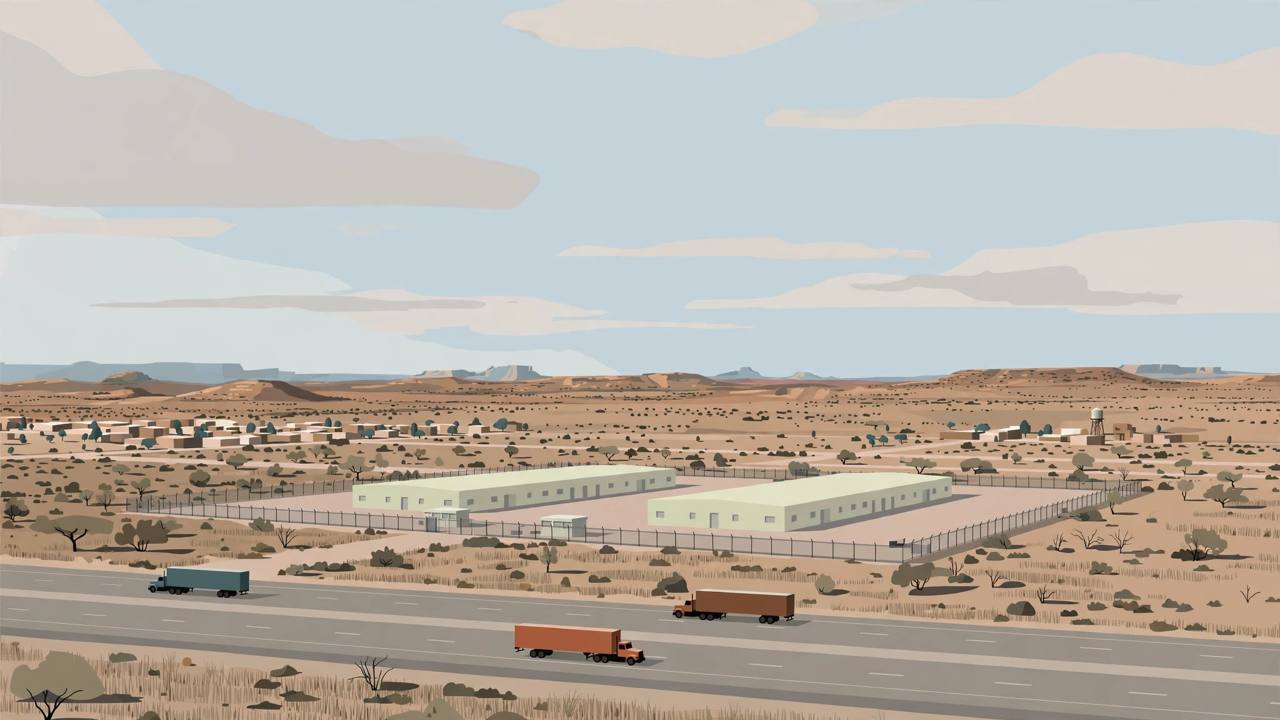
A new federal immigration processing centre with 2,329 beds is to be activated in Big Spring, a small city in West Texas, under a 10-year intergovernmental service agreement between the City of Big Spring and U.S. Immigration and Customs Enforcement (ICE), The GEO Group announced on Monday, November 2. The Big Spring Complex is made up of two facilities — the 1,404-bed Flightline Facility and the 925-bed Cedar Hill Facility — and ICE will have exclusive use of the whole site.
Source: The GEO Group via Business Wire
Under the agreement, GEO will provide support services at the complex, including security, maintenance and food services, as well as access to recreational amenities, medical care and transportation services, the company said. The announcement did not give a date on which the centre will begin receiving detainees.
Source: The GEO Group via Business Wire; Dow Jones via Morningstar
George C. Zoley, GEO's chairman, chief executive officer and founder, said in the company's statement: “We expect that our Big Spring Complex in Texas will play an important role in helping meet the need for increased federal immigration processing center bedspace. We are proud of our 40-year public-private partnership with ICE, and we stand ready to continue to assist the federal government in meeting its immigration enforcement priorities.”
Source: The GEO Group via Business Wire
Where Big Spring is — and why the location matters
Big Spring is the county seat of Howard County in West Texas, in the Permian Basin region, at the crossroads of Interstate 20 and U.S. Highway 87. Interstate 20 runs through the northern side of the city — east about 108 miles to Abilene and west about 40 miles to Midland — making the site a direct stop on one of Texas's main east–west trucking corridors. The city's population was 26,144 at the 2020 census, which means the new centre's 2,329 beds amount to roughly one detention bed for every 11 residents of the city that hosts it.
GEO, headquartered in Boca Raton, Florida and listed on the New York Stock Exchange, describes itself as a diversified government services provider specialising in secure facilities, processing centres and community re-entry centres in the United States, Australia, South Africa and the United Kingdom. Across all its operations, the company says it owns or supports 97 facilities totalling approximately 76,000 beds, with a workforce of up to about 20,000 employees.
Source: The GEO Group via Business Wire
One piece of a wider detention build-out
The Big Spring activation is the second large, long-term ICE capacity deal GEO has announced within days. On October 29, the company announced a new 10-year management contract for the 1,635-bed Northwest ICE Processing Center in Tacoma, Washington, expected to generate about $140 million in annual revenue. Together, the two deals lock in nearly 4,000 detention beds under decade-long arrangements, as the administration's enforcement drive increases demand for processing and removal capacity.
Processing centres are where ICE holds people while their immigration cases, detention reviews or removal arrangements are processed. They are not criminal prisons, but they are secure facilities: residents cannot leave, and access for family members and lawyers depends on the facility's visiting and legal-access rules. Remote locations can mean long drives for families and attorneys based in big-city legal hubs.
For Texas's Punjabi and wider South Asian diaspora — concentrated in Houston, Dallas–Fort Worth and other metro areas several hours' drive from Big Spring — the practical significance is distance. When a detained person's case is processed at a remote West Texas facility rather than near a metro legal hub, family visits, lawyer meetings and document work all become harder and slower. Punjabi truckers, meanwhile, know the I-20 corridor through Big Spring well: it is a routine freight route between West Texas oil country and the Dallas–Fort Worth distribution hub.
Two cautions belong on the record. First, the approximately $200 million figure is GEO's own expectation for its first full year of operations, not money already paid; the company's announcement carries the standard caution that forward-looking statements involve risks and uncertainties. Second, the announcement sets out the agreement and the services GEO will provide, but it does not state when the first detainees will arrive, how many staff will be hired locally, or whether every one of the 2,329 beds will be filled at once.
What happens next
The agreement is signed, so the next steps are operational: activation of the two facilities under ICE's exclusive use, staffing, and the start of transfers once ICE begins assigning detainees to Big Spring. No activation date was given in Monday's announcement. Awaaz Punjab will watch for ICE or City of Big Spring statements setting out a timetable, local hiring numbers and the centre's first intake, and will update this report when those details are confirmed.