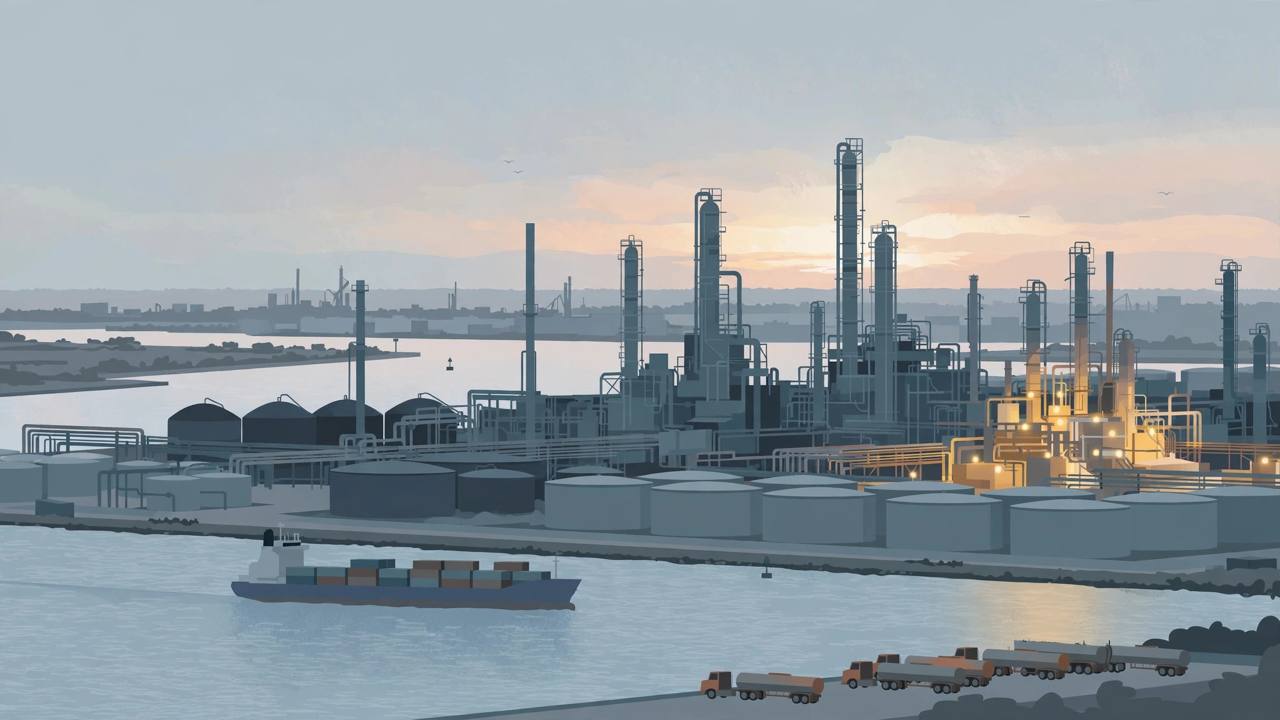
A Houston refinery that has sat silent since March 2025 is set to change hands and, if the buyer delivers on its plan, roar back to life by the end of 2027. Valero Energy Corporation announced on Friday, October 30 that its wholly owned subsidiary, Valero Refining-Texas, L.P., has entered into a definitive agreement to acquire all of the outstanding equity interests of LYB Houston Hub Holdings LLC from a subsidiary of LyondellBasell Industries N.V. for a purchase price of $320.5 million, subject to closing adjustments. LYB Houston indirectly owns an approximately 700-acre facility on the Houston Ship Channel in Texas that operated for decades as a petroleum refinery, immediately adjacent to Valero's existing Houston refinery.
Source: Valero Energy announcement via Business Wire, Oct. 30, 2026
What exactly is Valero buying
This is not a purchase of tanks alone. According to Oil & Gas Journal's account of the deal, the transaction includes about 700 acres adjacent to the Valero Houston Refinery, 13.5 million barrels of storage capacity, and logistics infrastructure including marine docks, rail-loading facilities and truck racks. Valero itself operates 14 petroleum refineries in the United States, Canada and the United Kingdom, with a combined throughput capacity of approximately 3.0 million barrels per day — so the Houston site would slot into one of the largest independent refining systems in the world, directly beside a plant Valero already runs. Bloomberg Law reported that Valero's existing neighbouring refinery is capable of processing more than 200,000 barrels of oil a day.
Source: Oil & Gas Journal, Oct. 30, 2026
Why Valero wants a refinery somebody else walked away from
Valero told investors, in an October 30 presentation reported by Oil & Gas Journal, that the acquisition will help address intermediate feedstock shortages across its U.S. Gulf Coast refining system, reducing reliance on third-party purchases while creating opportunities to integrate refining and logistics operations. Incremental fluid catalytic cracking (FCC) and hydrocracker feed production at the restarted site would reduce external feedstock sourcing, while excess hydrotreating capacity could be used to upgrade intermediates from other Valero Gulf Coast refineries. In plain terms: the restarted units would make partly processed material that Valero's other Gulf Coast plants currently have to buy from outsiders, and its spare upgrading capacity could finish material those sister plants produce.
Source: Oil & Gas Journal, Oct. 30, 2026
Valero currently expects to initially restart 165,000 barrels per day of light sweet crude processing capacity at the site by year-end 2027, and says the acquisition also provides the opportunity to later invest in high-complexity, heavy sour crude processing. No budget or timetable for that later heavy-sour investment has been disclosed.
The seller's side: an exit LyondellBasell began in 2022
For LyondellBasell, the sale closes a long goodbye. The company announced plans in April 2022 to cease operation of its subsidiary Houston Refining LP's 268,000-barrel-per-day refinery as part of its exit from the crude oil refining business. Following delays, the refinery was shuttered in March 2025. Over the years, LyondellBasell evaluated other options for the site, including a potential plan to transition the refinery into a hydrogen production site; ultimately, the company said, it determined that selling the asset offered the most compelling opportunity to advance its priorities. Under the sale terms announced by LyondellBasell, Valero is assuming responsibility for ongoing site operations, environmental liabilities, pension costs and related employee obligations.
Source: LyondellBasell announcement via GlobeNewswire, Oct. 30, 2026
A century-old plant, bought in a hot refining market
Bloomberg Law described the facility as a 100-year-old fuel-making plant and framed the deal against a renaissance in refining profits spurred by global conflicts — the market backdrop that makes a shuttered Gulf Coast refinery, bought for $320.5 million, look cheap next to the cost of building equivalent capacity from scratch. That framing matters for readers who haul fuel or buy it for a living: refining capacity on the Gulf Coast is the machinery that turns crude oil into the diesel and gasoline that move North America's trucks, and every major restart or closure on the Ship Channel eventually shows up in supply, in terminal queues and in prices at the pump.
Source: Bloomberg Law, Oct. 30, 2026
What this means for Houston, the Ship Channel and truckers
The site sits on the Houston Ship Channel, the working waterway that anchors one of the largest petrochemical and refining complexes on earth, in a metropolitan area with a large Punjabi and wider South Asian community — including many families in trucking, fuel retail and logistics. The transaction's own logistics tell part of the story: marine docks for ships, rail-loading facilities, and truck racks, the loading points where tanker trucks fill up. A restart targeted for year-end 2027 does not change tomorrow's diesel price, and Valero has disclosed no restart capital budget, contractor awards or jobs numbers — but a 165,000-barrel-a-day restart beside an existing Valero plant is, over time, additional fuel-making capacity in the region that supplies a large share of the fuel burned on Texas and Gulf Coast highways.
Source: Oil & Gas Journal, Oct. 30, 2026
The conditions still standing between announcement and closing
The deal is signed, not closed. Closing is subject to customary closing conditions, including the expiration or termination of the waiting period under the Hart-Scott-Rodino Antitrust Improvements Act of 1976 — the federal antitrust review that large acquisitions must clear — and is expected to occur by the end of 2026. LyondellBasell's own announcement puts the expected close in the fourth quarter of 2026, subject to regulatory approvals and other customary closing conditions. Only after closing does Valero take over site operations, environmental liabilities and the pension and employee obligations it has agreed to assume.
Source: Valero Energy announcement via Business Wire, Oct. 30, 2026
What happens next
The sequence to watch is now fixed: first, antitrust clearance and closing by the end of 2026; then the restart programme, with 165,000 barrels a day of light sweet crude processing targeted by year-end 2027; and, beyond that, a decision Valero has pointedly not yet made — whether to invest in high-complexity, heavy sour crude processing at the site. Valero's chairman, chief executive officer and president Lane Riggs said the site could support that future investment, but the company provided no financial details or timetable for it. For Houston's refining workforce and the trucking and fuel businesses around the Ship Channel, the next hard news will be closing day — and any restart spending, permits or hiring Valero announces after it owns the plant.
Source: Oil & Gas Journal, Oct. 30, 2026