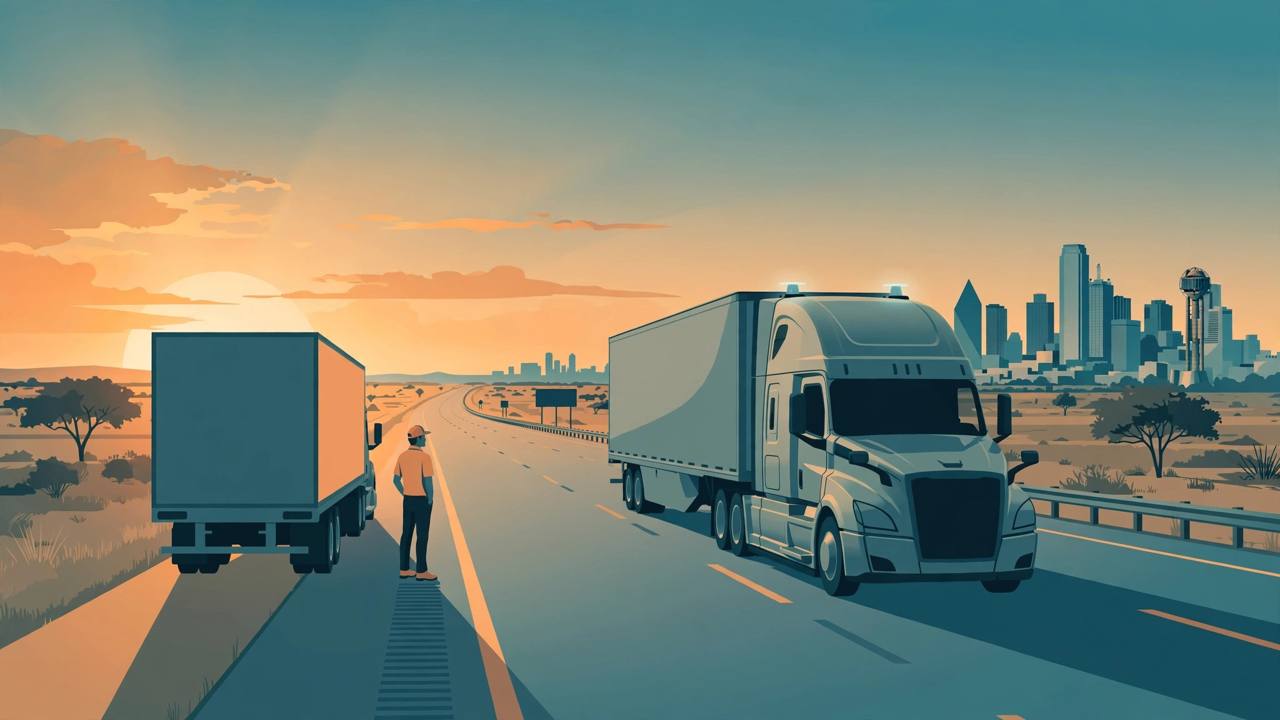
A semi-truck with nobody in the cab is now one step — the company's own measure says one per cent — away from starting commercial freight runs on one of Texas's busiest trucking corridors. Kodiak AI, the Mountain View, California-based autonomous trucking company listed on Nasdaq as KDK, announced on Thursday, October 30, that its Autonomy Readiness Measure (ARM) for long-haul driverless operations has reached 99%, putting it, in its words, ahead of pace to launch driverless long-haul commercial service by the end of 2026. Once the remaining work is done, the first driver-out runs will haul IKEA freight on Interstate 45 between Dallas and Houston.
Source: Kodiak AI announcement, Oct. 30, 2026 (GlobeNewswire)
What the 99% figure actually means — and what it does not
The ARM is Kodiak's own yardstick, not a government grade or an independent certification — a point readers should hold on to. The company defines it as the percentage of claims and evidence in its long-haul safety case that are materially complete. A safety case is a structured argument, backed by evidence, that its driving system — the Kodiak Driver — can operate safely in a defined environment, here long-haul highway driving with no one in the cab. The climb through 2026 has been steady and public: 84% in February, 86% in April, 91% in July, 93% in August, 96% in September and now 99% in October. The releases describe no separate regulatory approval step for the long-haul launch, and the announcement carries the standard forward-looking-statements warning that timing can change.
Source: Kodiak AI announcement, Oct. 30; independent explainer coverage of the ARM definition
The route: I-45, Dallas to Houston, with IKEA first
Kodiak named IKEA Supply as its driverless launch shipper on September 29, and picked the Dallas–Houston lane on September 25. The driverless leg covers 219 miles, mostly on Interstate 45, between Kodiak's Houston facility and its Dallas-area hub at Lancaster, Texas, as part of a 292-mile IKEA run from the Baytown distribution centre to the IKEA store in Frisco, FreightWaves reported. The partnership is not new: over four years Kodiak says it has delivered more than 1,300 IKEA loads and logged more than 750,000 autonomous miles with a safety observer in the cab, with what it calls a nearly perfect on-time delivery record. Since August, trucks in the launch programme have been running the Lancaster–Houston lane daily, and the company says deliveries now consistently finish without the observer needing to intervene — a company claim that has not been independently verified.
Source: FreightWaves reporting, via WebProNews, Oct. 23 update
What the company's leaders said
"Our momentum is compounding as we conduct our final preparations ahead of launching driverless long-haul service," said founder and chief executive Don Burnette. "October represents continued great progress for closing safety case claims. We've identified and scheduled the remaining engineering verification and validation milestones needed. This is the home stretch." Burnette has said the company will start with a single driverless truck on the lane and then scale through 2027 and beyond. Frank Fratrik, Kodiak's director of safety, said October's progress came from using the company's quantitative Probabilistic Risk Assessment methodology to account for the behavioural risk of the autonomy system, and from its BreakPoint simulation tool, which hunts in simulation for rare edge-case scenarios that would take years to encounter in real driving. "As we finalize our deployment plan, our safety case is nearly complete," Fratrik said. "Each claim closes on evidence, and that evidence is nearly there."
Source: Kodiak AI announcement, Oct. 30 — Burnette and Fratrik statements
Background: driverless trucks are already working in Texas — off the highway
Kodiak's highway safety case builds on an industrial safety case it already completed for the Permian Basin oil country of West Texas, where, as of the end of the second quarter of 2026, 35 driverless trucks with no humans in the cab were deployed for its customer Atlas Energy Solutions — a fleet the company describes as the largest of its kind in the world. Kodiak says it has driven more than 3.5 million autonomous miles in total since 2019, with safety drivers aboard on highways. In 2024 it became the first company to deploy driverless technology in customer-owned driverless semi-trucks. It is not alone on I-45: rival Aurora began driverless runs on the same Dallas–Houston highway in 2025, and in early October the Federal Motor Carrier Safety Administration granted Kodiak an exemption on warning-beacon rules, one of the small regulatory pieces a driver-out operation needs.
Source: Kodiak AI announcement; WebProNews (FMCSA exemption, Oct. 7); Interesting Engineering (Aurora, 2025)
99% is Kodiak grading its own homework: it counts how much of the company's own safety-case paperwork is complete, not how safe the truck has been proven to be, and Kodiak publishes no crash or incident rate for its highway runs. The honest reading is narrower and still significant — the last scheduled checks before a real launch are now on the calendar, and the launch partner, route and freight are all named.
Why this matters to the drivers who run this corridor
Interstate 45 between Dallas and Houston is not a test track; it is a working freight artery, and thousands of Punjabi and South Asian truckers — owner-operators and company drivers alike — run Texas lanes like it every week. A driverless truck does not arrive everywhere at once: Kodiak's own plan starts with one truck on one lane for one shipper, then scales through 2027. But the direction of travel is now dated and specific. The loads named first are exactly the kind of steady, repeatable distribution-centre-to-store freight that fills many driving weeks, which is why unions, carriers and drivers' groups have watched the Dallas–Houston corridor — where Aurora is already running — as the place where the economics of driver-out trucking will be proved or fail. What it does not change yet: the overwhelming majority of Texas freight still moves with a driver, demand for experienced drivers on complex, multi-stop and cross-border work remains, and no date has been announced for any wider rollout beyond this lane.
What happens next
Kodiak says the remaining one per cent is a set of identified and scheduled engineering verification and validation milestones: finishing the long-haul risk assessment, verifying the launch vehicle configuration and showing the truck can keep itself safe at highway speed, including controlled stops if it detects a serious problem, with remote human guidance available but nobody in the cab. When the safety case closes, the company says it will launch driverless highway service for IKEA on the 219-mile I-45 route before the end of 2026, then scale through 2027. Awaaz Punjab will report the first driver-out run when it happens — and what drivers on the corridor see when it does.