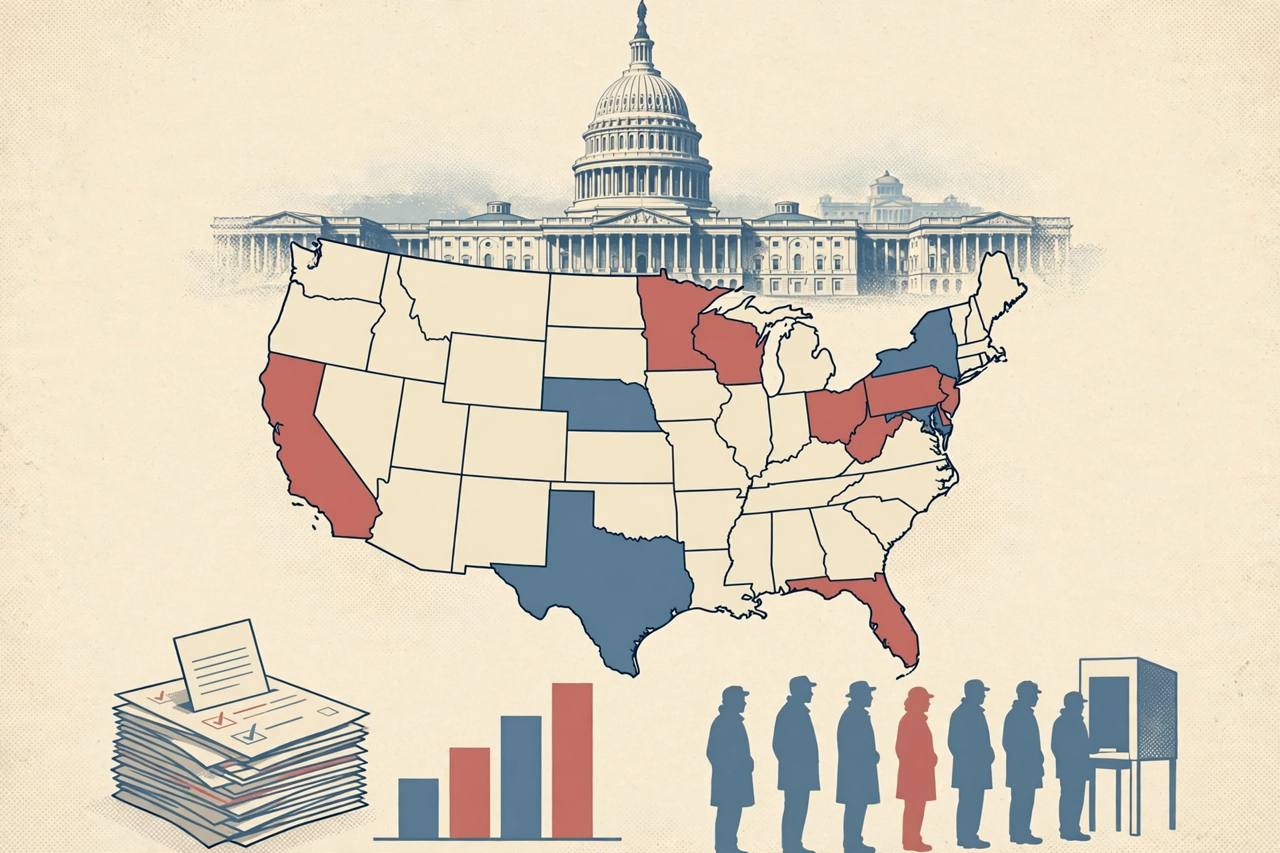
Democratic candidates lead in all seven Senate battlegrounds in the final round of New York Times/Siena University polling, released on Sunday, November 1 — two days before the midterm elections on Tuesday, November 3 that will decide control of the United States Senate. The leads run from 11 points in Michigan down to a single point in Iowa, and the Siena Research Institute's own director warned on release that most of the races sit inside the polls' margins of error, so a majority for either party remains possible.
Source: Siena Research Institute, NYTimes/Siena final polls, Nov 1, 2026
The seven states surveyed — Alaska, Iowa, Kansas, Maine, Michigan, Ohio and Texas — are the races expected to settle the Senate. Five of the seven seats are currently held by Republicans, which is why the map matters so much: Democrats need a net gain of four seats on Tuesday to take control of the chamber, and the final Times/Siena numbers put their candidates ahead, narrowly or clearly, in every one of the seven.
Source: ANI, reporting New York Times/Siena findings, Nov 2, 2026
The two leads that clear the margin of error
Only two of the seven leads are larger than the polls' full margin-of-error spread. In Michigan, Democrat Abdul El-Sayed leads former U.S. Representative Mike Rogers, the Republican nominee, 53 per cent to 42 per cent — an 11-point lead on a sample of 1,011 likely voters, with a margin of error of plus or minus 3.8 points. Michigan's seat is currently held by Democrats, so a hold there is necessary but not sufficient for a Senate takeover.
Source: Siena Research Institute, NYTimes/Siena final polls, Nov 1, 2026
In Texas, Democratic state Representative James Talarico leads Republican Ken Paxton 50 per cent to 43 per cent, on the largest sample of the seven states — 1,215 likely voters, margin of error plus or minus 3.4 points. A Democratic win in Texas would be historic: the state has not elected a Democrat to the Senate since 1988. Kansas, where Democrat Adam Hamilton leads Republican Senator Roger Marshall 49 to 44, with Libertarian David Graham at 4 per cent, has not elected a Democratic senator since 1932.
Source: ANI, reporting New York Times/Siena findings, Nov 2, 2026
Five races inside the margin of error
The other five races are statistically tied once the margins of error are counted. In Maine, Democrat Troy Jackson leads Republican Senator Susan Collins 51 to 45 (margin of error 4.7 points). In Ohio's special election for the seat Vice President JD Vance vacated, former Senator Sherrod Brown, a Democrat, leads Republican Senator Jon Husted 49 to 44 (margin of error 4.4). In Alaska, former Representative Mary Peltola leads Republican Senator Dan Sullivan 48 to 46 (margin of error 5.0), and in Iowa's open-seat race, Democrat Josh Turek leads Republican Representative Ashley Hinson 48 to 47 — a one-point gap the institute describes as virtually tied.
Source: Siena Research Institute, NYTimes/Siena final polls, Nov 1, 2026
The Times/Siena surveys were conducted between October 23 and November 1, 2026, among likely voters, with samples of 610 voters in Alaska, 705 in Iowa, 736 in Kansas, 714 in Maine, 1,011 in Michigan, 717 in Ohio and 1,215 in Texas. The margin of sampling error runs from plus or minus 3.4 points in Texas to 5.0 points in Alaska, and 1.6 points across all seven states combined. A lead inside that margin is a snapshot of a tied race, not a forecast — turnout on Tuesday will decide these seats, not the polling.
"A blue wave is a distinct possibility" — the pollster's own caution
Don Levy, executive director of the Siena Research Institute, framed the release carefully. "Our final U.S. Senate polls show Democrats with leads of 5 to 11 points in Kansas (5), Ohio (5), Maine (6), Texas (7), and Michigan (11)," Levy said. "In Alaska Peltola (D) leads Sullivan (R) by 2 points and Iowa is virtually tied. Now, it's time for all votes to be cast and the counts to speak louder than the polls. While a blue wave, and Democratic control of the Senate is, according to our polls, a distinct possibility, with so many races within the poll's total margin of error, a Senate majority for either party remains possible."
Source: Siena Research Institute, NYTimes/Siena final polls, Nov 1, 2026
Compared with the Times/Siena polling of the same seven states in September, the Democratic candidates improved in six of the seven states in this final round; Alaska was the only state where the Democratic candidate lost ground. The surveys also found President Donald Trump's approval rating at 38 per cent across the seven battleground states, the New York Times reported, with Democrats holding a nine-point advantage on the cost-of-living issue in those states — the backdrop against which Republican incumbents in Kansas, Maine, Ohio, Alaska and Texas are defending their seats.
Source: ANI, reporting New York Times/Siena findings, Nov 2, 2026
The governors' races in the same polls
The same polling round covered the seven states' races for governor, and there too Democrats lead in all seven — by eight points or more in four of them. In Alaska, Democrat Jonathan Kreiss-Tomkins leads Republican Bernadette Wilson 54 to 46 in the ranked-choice count; in Iowa, Democrat Rob Sand leads Republican Zach Lahn 51 to 43; in Michigan, Democrat Jocelyn Benson leads Republican John James 52 to 39; and in Maine, Democrat Hannah Pingree leads Republican Bobby Charles 49 to 37, with independent Richard Bennett at 8 per cent. "The races for Governor in the battleground states currently show the Democrats up 8 or more points in Alaska, Iowa, Maine and Michigan," Levy said. "In the much-watched race in Ohio, Acton leads Ramaswamy by six points and both Kansas and Texas are too close to call." In Ohio, Democrat Amy Acton leads Republican Vivek Ramaswamy 49 to 43; in Kansas, Democrat Cindy Holscher leads Republican Ty Masterson 48 to 47; and in Texas, Democrat Gina Hinojosa leads Republican Governor Greg Abbott 48 to 47.
Source: Siena Research Institute, NYTimes/Siena final polls, Nov 1, 2026
Why Senate control matters beyond Washington
Control of the Senate decides far more than party bragging rights. The chamber confirms federal judges and cabinet officials, and it must pass — or can block — the immigration, tariff, tax and highway-funding legislation that has driven this Congress. For Punjabi and other immigrant families across the Midwest and Texas, and for Punjabi truckers whose work runs through Ohio, Michigan, Iowa and Texas corridors, which party holds the Senate after Tuesday shapes the next two years of enforcement policy, trade costs and infrastructure spending. That is why seven state races, most of them hundreds of miles from the coasts, are being watched so closely this weekend.
Source: ANI, reporting New York Times/Siena findings, Nov 2, 2026
What happens next
Everything now turns on turnout. Election Day is Tuesday, November 3, when all 435 House seats, 35 Senate seats and 36 governorships are on the ballot; more than 50 million Americans had already voted early by November 1, a record level for a midterm. These Times/Siena numbers are the last major polling of the Senate battlegrounds before voting ends. When the counts begin on Tuesday night, the first tests of the polls will be the close races in Ohio, Iowa and Alaska — if the Democrats' leads inside the margin of error hold in even some of them, the path Levy described to a Democratic Senate becomes real; if they break the other way, Republicans keep the chamber. Awaaz Punjab will carry the results as they are called.
Source: Siena Research Institute, NYTimes/Siena final polls, Nov 1, 2026