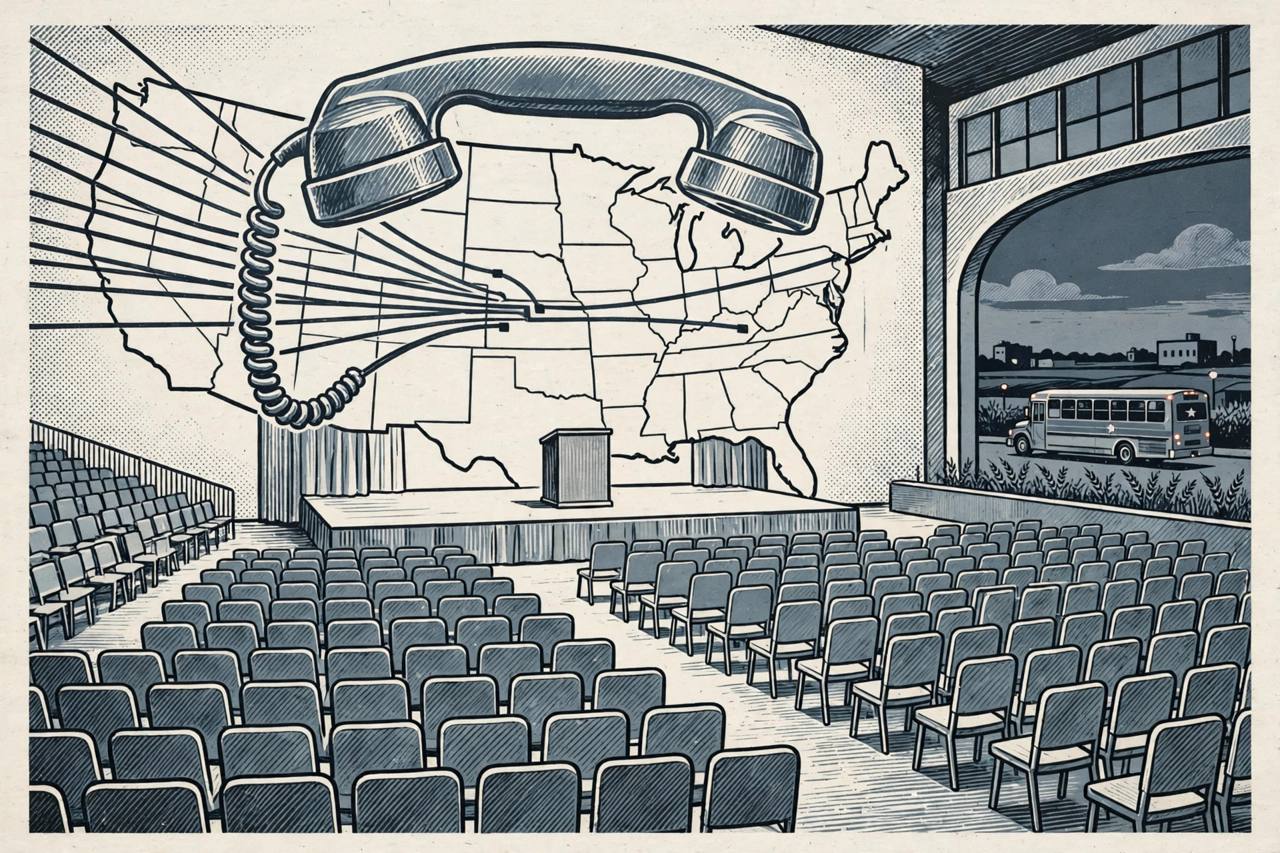
President Donald Trump on Thursday, October 29, cancelled his planned weekend campaign rallies in Kansas and Iowa and will close the midterm campaign largely by telephone instead, the Republican National Committee said. The Saturday rally in Salina, Kansas, and the Sunday rally in Dubuque, Iowa, will no longer take place in person, four days before the Tuesday, November 3, midterm elections that will decide control of Congress. In their place, Trump will hold what the RNC called a '72-hour sprint' of tele-rallies — rallies by phone — in nearly 20 states, a format his allies say lets him reach more voters in the final weekend than two arena stops would.
Source: The National News Desk, Oct. 30, 2026
Republican National Committee officials said in a Thursday statement that, 'with Republicans in a strong position in Kansas and Iowa,' the in-person events would no longer take place as scheduled, Newsweek reported. The White House said Trump will hold more than 20 tele-rallies before Tuesday's vote, and MAGA Inc., the Trump-aligned funding group, will host the virtual events in at least 19 states, Kansas and Iowa included. A full public schedule of the telephone events has not been released. The Salina appearance will instead take place virtually.
Source: The States Journal / Newsweek reporting, Oct. 30, 2026
What Trump himself said — and the health question he rejected
Returning to the White House on Thursday, Trump predicted Republicans would have 'a strong Tuesday night' and said he did not need to travel to Kansas because Republican Senator Roger Marshall was 'doing very well.' When a Reuters reporter asked whether he was skipping Kansas because of his health or because he was tired of travelling, Trump called the reporter 'sick' and 'disgusting' and said: 'You've been following me for two weeks. I feel perfect.' No verified evidence has established a health reason for the cancellations, and this report does not treat speculation about the president's health as fact.
The schedule itself shows the strain of the month behind him. Trump held 25 rallies in October, falling short of his stated goal of more than 30, and on Monday in Mississippi he acknowledged the pace to the crowd: 'God didn't make your vocal cords to do a rally every day.' At a tele-rally he is expected to speak for about 10 minutes, compared with more than 90 minutes at some in-person events — the arithmetic behind the switch: one telephone call can be repeated state after state in a single evening, while an arena rally consumes a day of travel for a single state's crowd.
Why Kansas was on the schedule at all
Kansas was not a ceremonial stop. A CNN/SSRS poll conducted October 20–26 put Democratic challenger Adam Hamilton four points ahead of Senator Roger Marshall among Kansas likely voters, 49 percent to 45 percent — a tight race in a state Republicans expect to hold, and the reason Kansas was worth a second presidential visit in a month. Trump campaigned for Marshall in Park City, near Wichita, on October 19, and Vice President JD Vance has appeared for Marshall several times, including in the Kansas City area in September and in Topeka on Monday. Republicans are defending narrow majorities in both chambers of Congress, and the competitive Senate map runs well beyond Kansas: South Carolina, Texas, Ohio, Iowa and Alaska are all being contested hard, with both parties also watching Mississippi.
Democrats moved quickly to frame the cancellations as retreat. Abdul El-Sayed, the Democratic Senate candidate in Michigan, said Trump had 'given up' on trying to turn out Republican voters. Republican officials, for their part, presented the change as reach, not retreat: a 72-hour telephone sprint across nearly 20 states in place of two plane trips, ending a month in which the president still logged 25 rallies.
A tele-rally is a campaign event held by telephone and livestream: supporters are called or tune in, and the candidate speaks remotely for a short, focused address — here, about 10 minutes at a time. It trades the energy and local television pictures of an arena crowd for speed and repetition: the same candidate can 'appear' in several states in one night without leaving Washington.
The one in-person rally that survived
Trump is not leaving the trail entirely. His last in-person rally before Election Day goes ahead on Friday in Daytona Beach, Florida, where he is expected to campaign for Republican gubernatorial candidate Byron Donalds and Senate candidate Ashley Moody. Florida is also home turf — a short trip from his Mar-a-Lago resort in Palm Beach — which makes it the cheapest in-person date on the calendar to keep. After Friday, the closing argument to voters in Kansas, Iowa and the rest of the battleground map will arrive by phone.
What this means for voters in Kansas, Iowa and the diaspora
For supporters in Salina and Dubuque who had planned a weekend trip to see the president in person, the weekend is simply cancelled — there is no replacement arena event, only the virtual version of the Salina stop and the wider tele-rally programme. For the much larger audience the campaign is chasing — including Punjabi and other immigrant voters in states like Texas, Pennsylvania, Michigan, New York and South Carolina, all named in reporting on the tele-rally states — the final Republican pitch of the 2026 midterms will not be a rally they attend but a call they receive. Early and mail voting is already under way in most states, so the telephone sprint is aimed as much at getting identified supporters to return ballots and turn up on Tuesday as at persuading the undecided.
What happens next
The Daytona Beach rally takes place Friday, the tele-rallies run through the final 72 hours, and polls open across the country on Tuesday, November 3. The questions the weekend will answer are practical ones: whether the RNC publishes a full tele-rally schedule, how many of the promised 20-plus calls actually happen, and whether a president who built his politics on arena crowds can close a midterm campaign by telephone in the two states he chose to skip — above all Kansas, where the only public polling in this report shows his party's senator trailing.