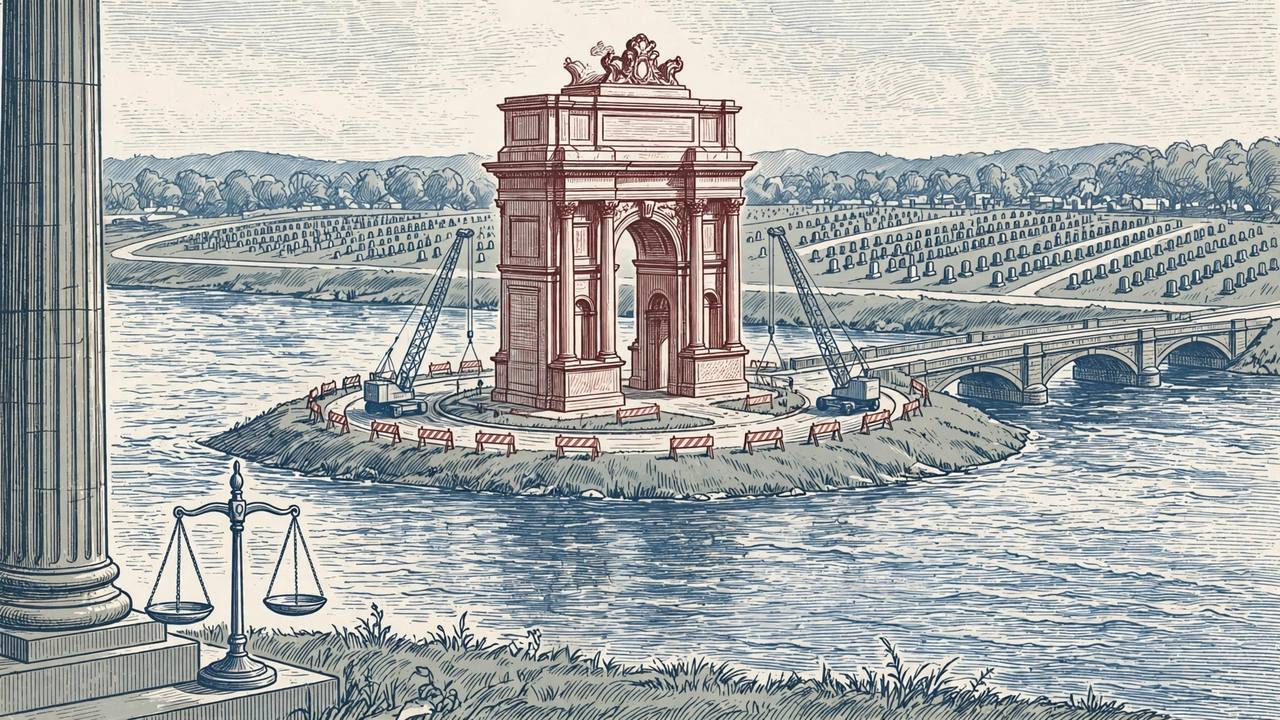
The District of Columbia and the Commonwealth of Virginia sued in federal court on Saturday, October 31, to stop President Donald Trump's planned 250-foot triumphal arch at Memorial Circle in Washington — days before the administration says construction could begin. The new filing makes three lawsuits now seeking to halt work on the monument, which would rise on a patch of grass off the bridge that spans the Potomac River and connects the city with Arlington National Cemetery.
Source: Associated Press (via Military.com)
The 46-page, eight-count lawsuit was filed by D.C. Attorney General Brian Schwalb and Virginia Attorney General Jay Jones against the National Park Service and the Interior Department. It calls the project “flagrantly unlawful” and asks the court for a temporary restraining order, arguing that “as soon as Defendants break ground on this project, they will inflict irreparable harm on both the District and Virginia.”
Source: City Cast DC
The laws the two governments say were broken
The complaint argues the arch is illegal on several fronts: Congress never gave the specific authorization the Commemorative Works Act requires; at 250 feet the structure is nearly double the 130-foot limit set by the District's Height of Buildings Act; and the Park Service rushed or skipped the historic-preservation and environmental reviews required by the National Historic Preservation Act and the National Environmental Policy Act, with further counts under the Administrative Procedure Act. The suit names Interior Secretary Doug Burgum and National Park Service official Jessica Bowron among the defendants.
Source: Political.org (case details)
What would be built at Memorial Circle
On Friday the government submitted a 106-page plan for the arch to the court. It envisions a structure more than 12 storeys high carrying a huge bronze statue of Lady Liberty with wings, holding a torch with an eternal flame. Inside would be an observation deck with views east and west, an “occupied roof,” two mezzanines, rooms for program space, offices, a staff lounge, circular staircases, multiple elevators and a “fire command centre.” The project also proposes significant traffic changes, including rerouting traffic on nearby roads, and administration officials have said the arch would also serve a national-security function.
Source: Associated Press (via Military.com)
A second judge is already weighing a halt — and questioned the security claim
U.S. District Judge Tanya Chutkan is already considering whether to halt the project in the original lawsuit, brought by three Vietnam War veterans and an architectural historian. She held a hearing on Friday, did not immediately act, and said she would move expeditiously. At an emergency hearing on October 30 she questioned the administration's push to break ground as early as November 5 and its claim — backed by sworn statements from Defense Secretary Pete Hegseth and Homeland Security Secretary Markwayne Mullin — that the concrete-and-granite arch is needed for national security and anti-drone defence.
Source: Associated Press (via Military.com)
Why D.C. and Virginia say the harm starts on day one
“The Arch site sits at the center of a major traffic artery between the District and Virginia, in the monumental core of the capital, on an island that straddles the Potomac River,” Schwalb and Jones wrote. “During the three-year period of construction, the Arch project will inevitably snarl traffic between the jurisdictions, produce pollution and stormwater runoff in the Potomac, interfere with emergency services, and pose numerous other challenges.” The lawsuit also raises how traffic disruption would affect emergency responses in a region where joint operations are the norm — including the January 2025 midair collision between a military helicopter and an airliner that killed 67 people.
Source: Associated Press (via Military.com)
Jones said in a statement: “President Trump's illegal vanity project is an affront to this hallowed ground and the extraordinary sacrifices it represents,” pointing to Virginia's role as home to Arlington National Cemetery. Schwalb said: “We're filing this lawsuit now to protect DC's unique interests and critical role in preserving the safeguards that keep our nation's capital beautiful and safe.”
Source: City Cast DC
The White House answer
A White House spokesperson, in an emailed statement reported Saturday, called the project “one of the most iconic landmarks not only in Washington, D.C., but throughout the world,” saying it “will serve as a gateway to Arlington National Cemetery for veterans, the families of the fallen, and all Americans alike, serving as a visual reminder of the noble sacrifices borne by so many American heroes throughout our 250 year history.” The Associated Press reported the White House did not immediately respond to its request for comment on the new lawsuit itself. The administration has defended its authority to build without new congressional approval, pointing to a plan Congress authorized in 1924 at the same location.
Source: City Cast DC
Background: a year of approvals, then a rush to court
Trump first announced the arch in 2025 as part of his effort to remake the capital. Earlier this year the National Capital Planning Commission, led by Trump appointees, approved the initial plans. Arlington County, Virginia, sued in early October — the first government body to take legal action — and the veterans' case followed, with plaintiffs in that case asking Judge Chutkan on Thursday to bar any construction steps before Congress authorizes the project. The D.C.–Virginia suit alleges the administration is now trying to “outrun judicial review”: “It is entirely foreseeable that, once construction begins, Defendants will argue, as they have done in other cases, that an order halting construction would irreparably harm the federal government.”
Source: City Cast DC
The National Capital Planning Commission is set to vote on the final arch plans on Thursday, November 5. The administration has told the court construction could begin the same day, once the commission approves and the Interior Department issues its final decision. That is why three separate courts fights are moving at emergency speed this weekend.
What this means for drivers and for the diaspora
Memorial Circle is not a remote monument site — it is a working traffic artery between Washington and Virginia, used daily by commuters, tour traffic heading to Arlington National Cemetery, and commercial drivers crossing the Potomac. Three years of construction and the road rerouting in the government's own plan would land on that artery whether or not the arch is ever finished, which is why two governments — not only preservation groups — are now in court. For Punjabi and other immigrant families in the Washington–Virginia–Maryland area, many of whom visit Arlington and the Lincoln Memorial area for ceremonies and family events, the practical question is the same one the judges face: whether work starts on November 5 or waits for Congress and the courts.
What is solid
- D.C. and Virginia filed a 46-page, eight-count federal lawsuit on Saturday, October 31, seeking a temporary restraining order against the arch project
- The arch is planned at 250 feet at Memorial Circle; the administration's own filing says construction could begin November 5 after a final planning-commission vote that day
- Three lawsuits now challenge the project, and Judge Tanya Chutkan held a hearing Friday in the veterans' case and said she would move expeditiously
What is only claimed
- Whether the project is unlawful, as D.C. and Virginia allege — no congressional authorization, a Height Act breach and skipped reviews — or lawful, as the administration argues from a 1924 authorization at the site
- Whether the arch has a genuine national-security function, as sworn statements from the Defense and Homeland Security secretaries claim, an argument Judge Chutkan questioned
- Whether construction would cause the traffic, river and emergency-services harm the two governments predict
What happens next
All eyes are on Thursday, November 5: the planning commission's final vote, a possible Interior Department go-ahead the same day, and the courts. Judge Chutkan could rule at any time in the veterans' case, and the new D.C.–Virginia suit asks for emergency relief before ground is broken. If construction begins first, the plaintiffs warn, the legal fight changes from stopping a project to stopping one already rising over the Potomac.