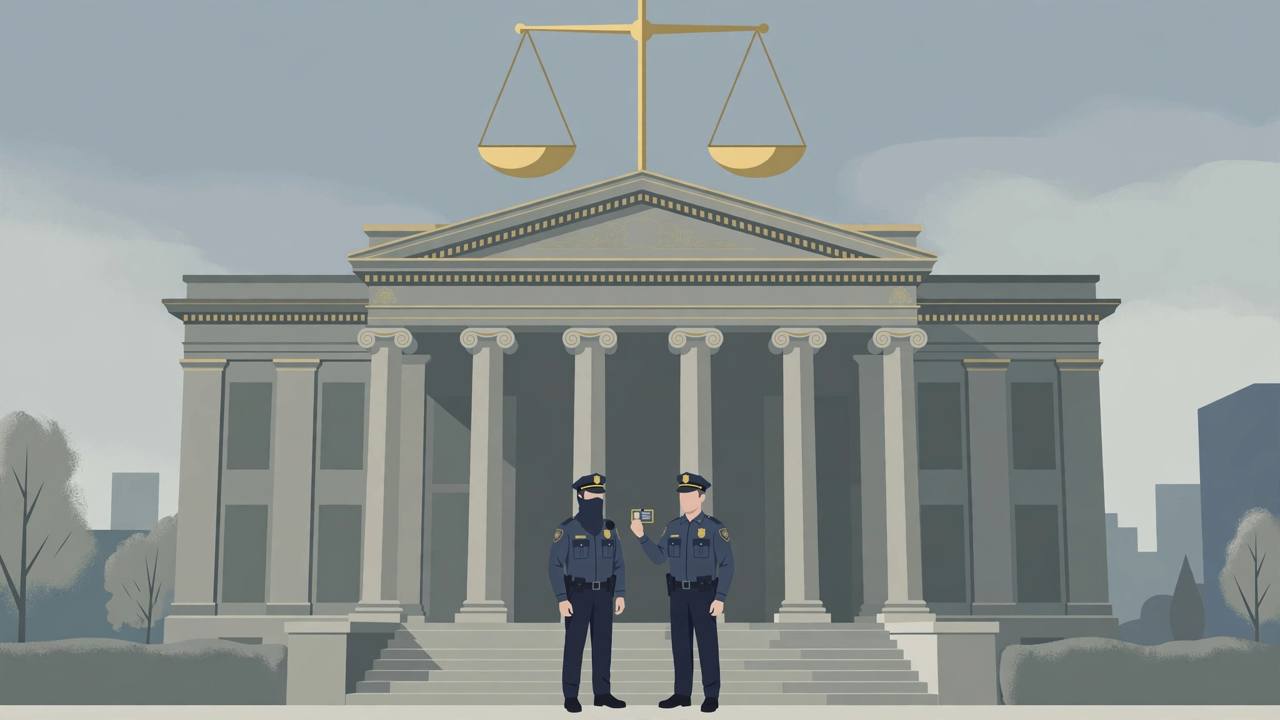
RICHMOND, Virginia — Can a state order federal immigration agents to show their faces? That question sat at the centre of a packed morning of argument on Tuesday, October 27, when a three-judge panel of the U.S. Court of Appeals for the Fourth Circuit — Judges Robert King, Toby Heytens and DeAndrea Gist Benjamin — heard Virginia's consolidated appeals at the Lewis F. Powell Jr. U.S. Courthouse in Richmond. Virginia is asking the court to undo lower-court orders that have largely blocked two of its newest laws aimed at U.S. Immigration and Customs Enforcement (ICE): a ban on officers covering their faces on duty, and a law that sets state conditions on the deals local police sign to do ICE's work.
The early signals were mixed, and they split by law. Bloomberg Law reported that Virginia's lawyer fielded tough questions from the panel about the state's authority to require federal law-enforcement officers to show their faces and identify themselves when enforcing immigration laws, and that the judges questioned whether the mask law regulates the federal government in violation of the Supremacy Clause — a point the National Law Journal's coverage also stressed. The same Bloomberg report said the panel appeared more receptive to lifting the preliminary injunction that blocks Virginia's second law, the one dictating the terms on which local agencies may cooperate with ICE. Separately, the Washington Examiner reported that Justice Department lawyer Megan Owen, defending the injunctions, also faced intense scrutiny from the panel — a reminder that hard questions at argument are not a verdict, for either side.
Source: Bloomberg Law
Two Virginia laws, one courtroom
The mask ban is Va. Code § 19.2-83.6:2, signed by Governor Abigail Spanberger on May 20. It makes it a misdemeanor for any law-enforcement officer — state or federal — to cover the face while on duty, subject to some exceptions, and it adds identification rules for officers. It was written with masked federal immigration arrests in mind: the governor's office argued, when a judge first blocked the law, that masked officers erode accountability and public trust, WHSV reported.
The second law, Va. Code § 15.2-1726.1, does not ban local cooperation with ICE outright. Instead it sets guidelines for when and how Virginia localities may devote state and local resources to federal immigration enforcement, including conditions on so-called 287(g) agreements — the written deals under which ICE deputizes local officers to perform immigration functions. The Trump administration sued Virginia over both laws. On August 30, 2026, a federal judge in the Eastern District of Virginia issued a partial preliminary injunction in the 287(g) case, staying implementation of the conditions law as it applies to existing 287(g) agreements, according to the Legal Aid Justice Center, which has filed a brief supporting Virginia. The two appeals are docketed as United States v. Commonwealth of Virginia, Nos. 26-1874 and 26-2258.
The mask ban never took effect. Senior U.S. District Judge Robert E. Payne enjoined it on the eve of its July 1 effective date. As Virginia Lawyers Weekly summarized his reasoning, the law likely violates the doctrine of intergovernmental immunity — the principle that states may not directly regulate the federal government — because it imposes rules on federal immigration officers that federal law itself does not impose; Payne also pointed to evidence of doxxing, threats and assaults against ICE officers as showing the irreparable harm an unmasked-agent rule could cause. Attorney General Jay Jones said at the time, “I strongly disagree with the judge's decision.” In September, the Fourth Circuit refused to let Virginia enforce the ban while the appeal proceeds.
Why the panel's questions matter beyond Virginia
Virginia is not litigating in a vacuum. Earlier this month, the Ninth Circuit barred California from making federal agents display names or badge numbers, reasoning that an evenhanded rule covering a state's own police can still directly regulate federal agents — the same logic Judge Payne applied. Other states and cities are writing similar mask, identification and cooperation rules right now, and a Fourth Circuit ruling will bind federal courts across Maryland, Virginia, West Virginia and the Carolinas. The Justice Department is pressing the same theory in another case, over Denver's ban on masked federal agents. Whichever way Richmond rules, the losing side is widely expected to look toward the Supreme Court.
The cooperation law matters just as much on the ground, because 287(g) is now the everyday machinery of immigration enforcement. The MacArthur Justice Center, which filed a brief supporting Virginia on October 2, notes the program has grown from 35 agreements nationwide in January 2017 to more than 2,000 by August 2026. Congress designed the program as voluntary: local officers carry out immigration functions only at the expense of the state or locality and to the extent consistent with state and local law. Virginia's position is that those words let it set the terms. The federal government's position is that a state may not attach conditions that impair agreements already signed — and the district court agreed with Washington, at least preliminarily, on the Contracts Clause theory. For immigrant families in Virginia — and for drivers, including the state's many immigrant truckers, whose most likely encounter with immigration enforcement is a local traffic stop — the answer decides who sets the rules when a local officer acts as an ICE deputy.
Source: MacArthur Justice Center
Virginia: officers who hide their faces erode accountability and public trust, and a voluntary federal program cannot commandeer local police free of state conditions. The Justice Department: a state mask law directly regulates federal officers — who face documented threats — and state conditions cannot void or impair federal agreements already in force. Both characterizations are the parties' arguments, not findings by the court.
What happens next
The panel gave no deadline for its opinions, and appeals courts set none — rulings in both Virginia appeals will arrive when they arrive, weeks or months from now. The same courtroom stays on immigration all week: on Friday, October 30, the Fourth Circuit hears the administration's appeal in its lawsuit against the entire federal bench of Maryland, over a standing order — signed by Chief Judge George L. Russell III on December 1, 2025 — that briefly pauses the removal of a detained immigrant who files a habeas petition, until 4 p.m. on the second business day. Judge Thomas T. Cullen dismissed that suit on August 26, 2025, holding that one branch of government has no cause of action to sue judges this way and advising the government to appeal individual habeas cases instead. Six of the matters on the court's October 27–30 calendar involve immigration or its enforcement. Between the Virginia appeals and the Maryland case, this one week in Richmond will do more to define how far states — and courts — can go in slowing federal immigration enforcement than any single raid could.