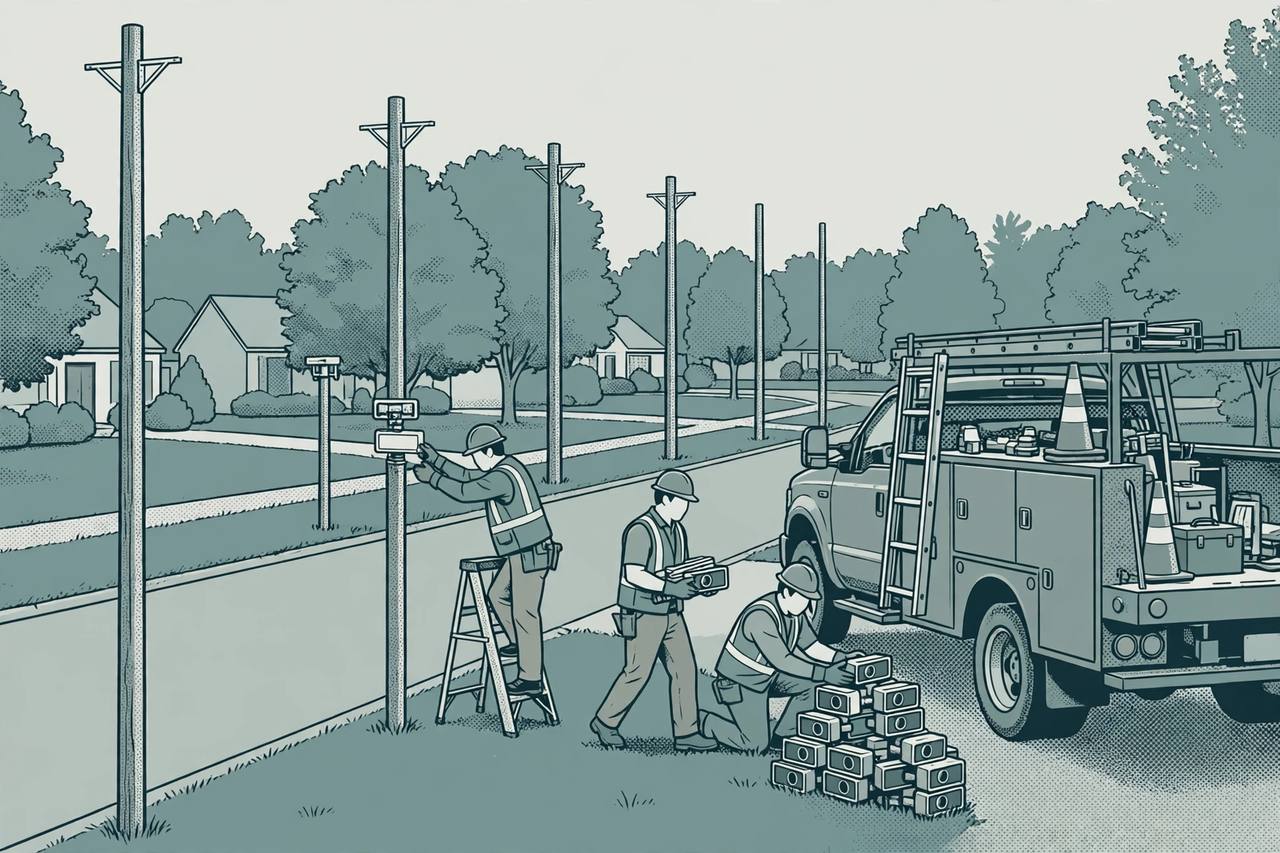
Henrico County, the county that wraps around Richmond, Virginia, has taken down its own surveillance cameras. County work crews on Saturday, October 31, removed more than 120 Flock Safety automatic license plate reader (ALPR) cameras themselves after officials said the company had failed to fulfil its "contractual obligation" to remove them, TechRadar reported on Monday, November 2. An image obtained by Richmond television outlet 12 On Your Side shows a pile of cameras and solar panels collected by the crews. The mounting poles the cameras sat on still remain standing, because, crews said, Flock has to remove those itself.
Source: TechRadar via The Tech Street Now
This is the physical end of a decision Awaaz Punjab readers have already seen unfold: in early October the county ended its contract with Flock over privacy concerns, and the agreement required the cameras to be gone within two weeks, WENG Radio reported on November 2. They were not gone — so the county removed them by hand. Officials say there is no evidence Henrico police ever misused the system, and Board of Supervisors chairman the Rev. Roscoe D. Cooper III described the move as proactive rather than reactive, pointing to national and state-level conversations about the technology.
Source: WENG Radio
How the county got here
Henrico had used Flock since 2022 and renewed its contract in July, in a deal set to run into November 2027, before reversing course within months. On October 6 the Henrico County Police Division announced it would terminate the contract, with a letter giving the company seven days' notice and Flock then having two weeks to remove the 122-camera network — at the time described as the sixth largest Flock network in Virginia. County Manager John Vithoulkas framed the October decision as a balance: "It was a balance between public safety and the fact that people feel like their rights are being infringed upon as they drive through these cameras," he told local media. The county said there would be no cost to the county for the removal, and that all data stored as evidence would be deleted within 30 days.
Source: Daily Signal reporting via WLT Report (October termination)
Flock's cameras photograph every passing vehicle, read the plate and log it in a searchable database; if a plate is on a hot list — a stolen car, or a vehicle tied to a shooting — dispatch can get a real-time alert. Supporters of the systems, including police chiefs in the Richmond area, credit those alerts with arrests. The privacy argument runs the other way: the cameras record everyone who drives past, not only suspects, and residents in community after community have asked who holds that data, how long it is kept, and who else can access it — the questions WENG noted are now being asked far beyond Virginia.
Source: WENG Radio
Henrico is not alone — and neither is the waiting
Virginia has become one of the centres of the national pullback from Flock. On September 15, Arlington County voted to discontinue its use of Flock and ordered its 41 cameras removed from public property within 14 days, citing resident pushback and the need to maintain public trust. Goochland County's cameras went dark in August, and more than 20 Virginia cities and counties have suspended use of the cameras or ended their relationship with Flock altogether. A state law that took effect in 2025 required officials to delete all camera-captured data after 21 days. In neighbouring Richmond, the city followed Henrico's lead in October and said it would not renew its own Flock arrangement.
Source: Daily Signal reporting via WLT Report; Conservative Playlist (Daily Signal)
The unfinished business is the hardware itself. The cameras remain Flock's property, and both Henrico County and Plymouth, Massachusetts — where the police chief, after his own cancellation, directed staff to disconnect the cameras' power cords, according to The Drive as reported by TechRadar — are still waiting for a response from the company about when the equipment will be collected. In Henrico's case the poles also remain in place along county roads, a visible remainder of a network that no longer operates.
Source: TechRadar via Wilson's Media / The Tech Street Now
License plate readers do not distinguish between a suspect's car and everyone else's: every vehicle that passed a Henrico camera — commuters, delivery vans and the long-haul trucks that move through the Richmond area's interstate corridors every day — was photographed and logged. Henrico's removal closes one of Virginia's largest networks, but cameras operated by other jurisdictions still line highways across the state, and Virginia's 21-day data-deletion law is the rule that governs what those systems may keep.
What happens next
What remains is collection and cleanup. Flock still has to collect its cameras — now sitting in a county pile, solar panels and all, in the photograph obtained by 12 On Your Side — and to remove the poles its Henrico crews left standing, and neither the TechRadar report nor the county's October statements give a date for that. The data question has a clearer clock: under the county's October decision, stored data was to be deleted within 30 days of termination, and Virginia law separately caps retention of camera-captured data at 21 days. For the national debate, Henrico now stands as the worked example of a question other counties are starting to ask, as WENG put it: what recourse does a community have when a vendor simply does not fulfil its contractual obligations?