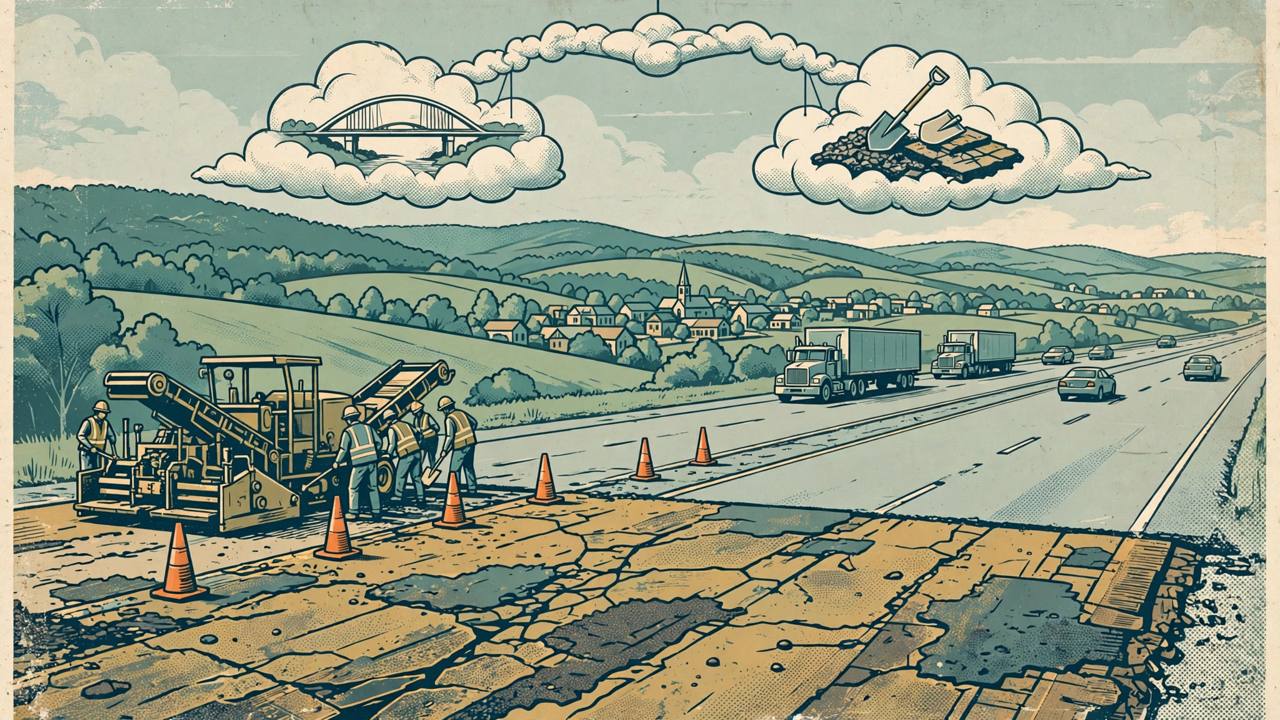
RICHMOND, Virginia — Virginia is staring at a $1.7 billion highway-maintenance gap, and the Commonwealth Transportation Board (CTB) is weighing a plan that would close it the hard way: by shifting money away from new construction and local transportation projects and into fixing the roads the state already has. The plan, introduced at the board's October 13 meeting, would add $239 million a year for pavement repairs starting in fiscal year 2028, redirect existing funds, and use $300 million in GARVEE bonds to soften the cuts to construction.
Source: Virginia Mercury via WarrenCountyVa.com
Virginia law leaves the board little choice about the order of priorities: the state is required to maintain its existing transportation assets — pavement and bridges — before it expands them. What changed is the math. The state's road and bridge inventory has grown over the past 20 years (about 2,000 additional miles of pavement and 400 bridges, officials told the board in September), repair costs have climbed sharply, and budget decisions last year put construction ahead of maintenance, creating the deficit the board is now trying to close.
Source: Planetizen summary of Virginia Mercury reporting, Sept 2026
The numbers behind the gap
Construction and maintenance costs have doubled in the past 10 years, according to the National Highway Construction Cost Index (NHCCI) data presented to the board. Asphalt alone accounted for 33% of that decade-long increase, with higher gravel and aggregate costs driven by fuel and hauling expenses, rising labour costs and quarry blasting expenses. In plain terms: the same mile of resurfacing costs roughly twice what it did a decade ago, while the network that needs resurfacing keeps growing.
What would lose money: Smart Scale and six named projects
The biggest loser would be Smart Scale, Virginia's competitive grant programme for transportation projects, which would shrink by about 25% under the plan. Since it was created in 2016, Smart Scale has awarded roughly $7 billion to projects across the Commonwealth — roads, transit, and bike and pedestrian work. Harrisonburg councilmember Laura Dent told the board her city relies on it for far more than highways: “We rely on Smart Scale for local transportation safety, not just highways. We need sidewalks and public transit and other things that make urban living more safer and more sustainable,” she said.
A second idea discussed by the board would move about $705 million out of the state's priority projects and into other funding sources — or send six of those projects back to compete in Round 7 of Smart Scale, which is already in its screening and scoring process. In November 2025 the previous board allocated about $715 million from GARVEE bonds and the Priority Transportation Fund to that project list; about $10 million has been spent, leaving roughly $705 million in play. The Secretary of Transportation's office recommends using more restricted funding sources for about $555 million worth of projects, which it says would preserve flexible money for other needs.
The six projects recommended for resubmission to Smart Scale Round 7 are specific, and local: the Route 288 Southbound Hard Shoulder Running Lane in Goochland County ($67 million); the Route 17 (Lee Highway) Corridor Safety project in Warrenton ($20.4 million); the Route 294 (Prince William Parkway) Corridor project in Prince William County ($21.4 million); East Parham Road improvements from I-95 to Cleveland Street in Henrico County ($10.4 million); the Port of Virginia Interchange/Commerce Road Streetscape project in Richmond ($16.1 million); and the Meadowville Bridge/Intersection project in Chesterfield County ($24.3 million).
Board member J. Randall Minchew worried that injecting the six projects into Round 7 would be unfair — “almost like someone being injected into the NCAA basketball tournament in round three.” Secretary of Transportation Nick Donohue replied that all projects would compete on merit with no scoring preference: “They're not jumping to the Sweet 16. What we're doing is we're expanding the field of 68 to include another six. They will get no preferential treatment other than, effectively, they get to skip the application process.”
What happens if Virginia does nothing
The board was shown a sobering forecast. Under the current Commonwealth Transportation Fund budget, investment in pavement maintenance declines, Interstate pavement conditions slide, and performance could fall to 71% “sufficient” — with approximately 1,200 lane miles lost by 2031. For drivers, that means rougher Interstates and more pothole-and-patch driving on the corridors that carry Virginia's commuters and freight: I-95, I-81, I-64 and I-66 among them.
This is not a new argument in Richmond. At a September 15 work session, Deputy Secretary of Transportation Laura Schewel floated an even larger shift — roughly $290 million a year for maintenance over six years — which at the time was estimated to cut Smart Scale temporarily by around 51% without mitigations. Secretary Donohue was blunt about that earlier version, and the warning still hangs over the October plan: “There is no mitigation strategy that makes this not painful. This is going to be painful no matter what we do moving forward.”
A new accountability policy, and the December 9 vote
Alongside the money, the board discussed a policy that would require written explanations for significant changes in pavement and bridge maintenance spending — including any cut of more than 5% — and a data-based reassessment of road and bridge conditions every four years, forecasting pavement needs over 20 years and bridge needs over 50 years. The board will take a final vote on the plan on December 9.
Why truckers and diaspora families should care
Virginia's highways are working roads for this site's readers. I-81 is one of the East Coast's great trucking corridors, I-95 ties Richmond to Washington and the Northeast, and the Port of Virginia at Hampton Roads feeds container traffic deep into the state — routes Punjabi owner-operators and fleet drivers run daily. Northern Virginia and the Richmond suburbs also hold a large Punjabi and Indian diaspora whose commutes run on exactly the roads in this fight — Prince William Parkway, Route 17 and Parham Road are all on the six-project list. Whether the December 9 vote protects those projects or sends them back into a smaller Smart Scale competition will decide how much of Virginia's road money goes to fixing what exists, and how much is left to build what is next.